In 1956, Soviet leader Nikita Khrushchev stunned the communist world by denouncing Joseph Stalin’s crimes in a closed-door speech at the Communist Party Congress.
The address, later leaked, raised expectations that the Soviet system might be capable of reform from within. Instead, it exposed pressures the leadership struggled to contain, contributing to unrest at home and rebellion abroad—notably in Hungary—and ultimately reinforcing the limits of permissible change.
That pattern—tactical relaxation under pressure, followed by retrenchment—offers a useful lens for understanding Iran’s current moment.
Since June’s 12-day war with Israel and the United States, the Islamic Republic has been navigating what officials privately describe as a convergence of external threat and internal fragility.
Internationally, Tehran faces deepening isolation and a US administration that has shown a willingness to use force. Domestically, the aftershocks of the 2022 Woman, Life, Freedom uprising continue to shape public behavior and elite anxiety.
Lifeline: patriotism
Against that backdrop, the state has adopted a dual strategy.
On one track, it has sought to soften flashpoints—particularly hijab enforcement—that could reignite street unrest. Police patrols have become less visible, enforcement more uneven, and officials have emphasized “cultural” rather than coercive methods.
On another track, the leadership has leaned into a form of state-sponsored nationalism that draws selectively on Iran’s pre-Islamic past.
Last month, authorities unveiled a statue in Tehran depicting the Roman Emperor Valerian kneeling before the Sassanid king Shapur I, commemorating a third-century Persian victory over Rome. The accompanying slogan—“You will kneel before Iran again”—was echoed in imagery portraying Israel’s prime minister in a similar posture.
Such symbolism would have been unthinkable for much of the theocracy’s history, when pre-Islamic iconography was treated with suspicion or outright hostility.
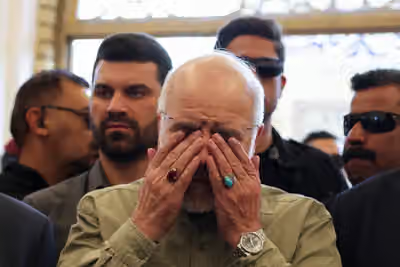
Supreme Leader Ali Khamenei reinforced this shift in July when, in his first public appearance after the war, he asked a religious eulogist to perform “Ey Iran,” a nationalist song associated with the pre-revolutionary era.
The gesture was widely read, both inside Iran and abroad, as an attempt to blur the line between religious authority and national identity—and by some, as a signal of potential recalibration.
‘Let a hundred flowers bloom’
History suggests caution. Authoritarian systems have often reached for controlled liberalization or symbolic inclusion during moments of acute stress, only to reverse course once the immediate danger recedes.
Mao Zedong’s 1957 “Hundred Flowers” campaign—launched in part to manage the fallout from Khrushchev’s de-Stalinization—famously invited criticism before giving way to a sweeping crackdown when dissent exceeded official expectations.
Iran’s trajectory over recent months has followed a similar arc.
Even as officials spoke of unity and restraint, legislation advanced to tighten restrictions on speech, expand capital punishment for acts of dissent, and broaden the security services’ remit online.
Arrests and executions have continued at a steady pace, and pressure on journalists, activists and minority communities has intensified.
Earlier this month, Khamenei dismissed criticism of hijab laws as part of a Western ideological campaign, warning domestic media against amplifying such views. The judiciary chief swiftly followed suit, announcing a more coordinated effort involving police and prosecutors—a signal less of retreat than of reorganization.
The episode underscores a recurring dynamic in the Islamic Republic’s history: moments of apparent opening that generate speculation about reform, followed by moves that reassert control once the boundaries of dissent become clearer.
As with Khrushchev’s speech nearly seven decades ago, the significance may lie less in the promise of change than in what the response reveals about the system’s underlying anxieties—and the limits it is ultimately prepared to enforce.