Ukraine says it hit Russian ships accused of carrying arms between Iran and Russia
A view shows Russian warships during major naval drills, File Photo.
Ukraine said on Friday it struck two Russian vessels in the Caspian Sea that had previously been sanctioned by the United States for transporting military cargoes between Iran and Russia.
Ukraine’s special forces said in a statement on Telegram that the operation was carried out with the help of what they described as a local resistance group and targeted the ships near the Russian republic of Kalmykia.
The vessels were identified as the Composer Rakhmaninoff and the Askar-Sarydzha. Ukraine said both ships had been used by Russia for military purposes and were under US sanctions over their role in moving weapons and military equipment between Iran and Russia.
Ukraine did not say how the ships were hit or provide details on the extent of any damage.
The statement said the resistance group had supplied information on the ships’ маршруtes and cargoes. Russia has not commented on the claim.
Iran and Russia have expanded military and logistical cooperation since Moscow’s full-scale invasion of Ukraine in 2022. Western governments have accused Tehran of supplying drones and other equipment to Russia, allegations Iran has denied.
Iranian-designed Shahed drones, now manufactured inside Russia under the name Geran, have played a growing role in the war. The Financial Times reported earlier this year that the drones are increasingly overwhelming Ukraine’s air defenses as Russia steps up swarm attacks.
Ukraine’s air force has said Russia often launches large numbers of Shahed-type drones alongside missile strikes to strain air defense systems. The United States has imposed multiple rounds of sanctions on Iran’s drone production and procurement networks over their alleged role in supporting Russia’s war effort.
Leaders from Russia, Iran, Turkey other regional states gathered on Friday in Turkmenistan for a rare international summit marking the country’s 30 years of official neutrality, as diplomatic engagement across the region intensifies amid wider global strains.
Iranian President Masoud Pezeshkian and Russian President Vladimir Putin held talks on the sidelines of the International Forum for Peace and Trust in the capital Ashgabat, an unusual gathering in one of the world’s most closed states.
Putin said Moscow and Tehran remain in close contact on major international issues, including Iran’s nuclear program.
“We are in close contact on all key international issues, including all matters related to the Iranian nuclear program. You know our position: we support Iran at the UN,” Putin said, adding that the foreign ministers of the two countries are “in constant contact.”
He said Russia and Iran are negotiating cooperation in the gas and electricity sectors and will work together on energy transmission projects.
“We are holding talks in the gas and power sectors, and cooperation in energy transfer will take shape,” he said.
He added that relations between the two countries are expanding steadily. “Our relations are developing day by day,” Putin said, pointing to plans to advance the North–South transport corridor linking Russia to South Asia via Iran.
Putin also cited plans to expand cooperation at Iran’s Bushehr nuclear power plant, which was built by Russia.
Broader strategic ties
The meeting comes as Tehran and Moscow deepen strategic cooperation under Western sanctions. Earlier this month, the two countries signed a new agreement covering artificial intelligence and cybersecurity, expanding collaboration in digital infrastructure, data transit and e-government.
Iran and Russia have also worked closely on space projects. Tehran has said three Iranian satellites will be launched aboard a Russian Soyuz rocket later this month, following earlier launches carried out with Russian support.
A relative of Rouzbeh Vadi said the Iranian nuclear scientist executed in August confessed only after severe torture and threats against his mother, describing a prosecution built on a single coerced statement.
Vahid Razavi, a member of Vadi’s family, told Iran International that the researcher was detained about 18 months ago following a dispute at work and was later accused of spying for Israel.
“Rouzbeh was tortured intensely, to the point that bones in his leg and two ribs were broken, and then his mother was arrested and jailed,” Razavi said. Interrogators, he added, photographed her in custody and showed the images to Vadi “to extract a forced confession.”
“They had told Rouzbeh that if he did not confess to espionage and agree to appear in a televised interview, they would torture his mother.”
Vadi, who held a doctorate in reactor engineering, had co‑authored a 2011 research paper with senior Iranian nuclear experts later killed during the June conflict with Israel, according to his Google Scholar profile.
The judiciary said he was convicted of transferring classified information about one of the scientists killed in those attacks to Mossad.
According to Razavi, interrogators warned Vadi that unless he admitted to espionage and appeared in a televised confession, “they would torture his mother.” He said Vadi accepted what he called a fabricated charge under those conditions.
Televised confession questioned
Vadi, a member of the Nuclear Science and Technology Research Institute affiliated with the Atomic Energy Organization, was executed on August 6. The judiciary said at the time he had been “recruited via cyberspace by Mossad.”
The confession, Razavi said, broadcast on state television was the sole basis for the conviction. He said authorities “moved quickly” after the 12-day conflict in June and carried out the execution without notifying the family.
Razavi also questioned state media remarks that Vadi received a black bag stuffed with cash. “In an era of digital transactions, why would a highly educated scientist accept cash in a bag?” he said.
Vadi, Razavi said, was portrayed as having copied sensitive files onto a hard drive and handed them over in a public park restroom. Such accounts, he argued, were “nonsensical” given the availability of secure digital platforms such as Signal or Telegram.
Rights organizations have long raised concerns about forced confessions obtained under torture in Iran’s judicial system.
Razavi described Vadi as intelligent, devoted to his family and focused on work, noting that he lived with his mother and had modest means. He said Vadi had no political involvement and was committed to supporting peaceful nuclear research.
Following the June war, Iranian courts have arrested, tried and executed several people on espionage charges involving Israel. In one recent case, political prisoner Javad Naeimi was executed on October 18 in Qom. These executions have drawn criticism from international human rights groups and UN rapporteurs.
Iranian Olympic skier Atefeh Ahmadi, who applied for asylum in Germany in 2023 after leaving Iran during a training trip to Europe, has returned to the country and publicly expressed gratitude to the Supreme Leader for facilitating her homecoming.
The sudden reversal and the stilted language of the announcement of her return in an Instagram post led to concerns by some about her wellbeing.
“I must tell you that I am present in my country, Iran. Undoubtedly, my country, my homeland, and my soil are the safest place in the world for me. As an Iranian, Iran is always my safe home,” the post said. “With the support and help of the Supreme Leader, I will return to the warm family hearth.”
A Quranic verse follows the message in Arabic: “When He decrees a matter, He only says to it, ‘Be,’ and it is.”
Ahmadi, 23, was the only Iranian woman to compete at the 2022 Beijing Winter Olympics and had been seen as one of the country’s top alpine skiing prospects.
Ahmadi remained in Europe after a training and competition trip in early 2023 and applied for asylum in Germany, later appearing in media and campaign material that highlighted her story as a refugee athlete.
The announcement sparked mixed reactions among Iranians on social media. Some users accused authorities of pressuring Ahmadi or using her case for propaganda.
Iranian intelligence agents and police have routinely compelled dissidents to recant their views and disavow past activism in social media posts, sometimes even mandating a set number of favorable posts in exchange for restored internet access.
“It’s unclear how they made that place unsafe for the poor girl and how much pressure they put on the family in Iran for her to write ‘My homeland is the safest place in the world for me.’ As long as the Islamic Republic exists, no person in the world will have security,” one user posted on X.
Others framed her decision as a personal choice driven by homesickness, economic insecurity abroad or family ties. Accounts close to the government praised the move.
“Atefeh Ahmadi, the former national athlete of Iran’s skiing team who had sought refuge in Germany, has returned to the country with the support of His Holiness the Supreme Leader,” one account said. “Praise be to God, we have a compassionate leader who, like a father, keeps an eye on all his children and supports them.”
Iranian officials have provided no details about the conditions of Ahmadi’s return, including whether she will rejoin the national team or what guarantees she has received.
Winter rain fell on Tehran on Wednesday after the driest autumn in over 50 years, providing temporary relief from a severe water shortage that the country's ruling clerics have led prayers to end but looks set to persist.
Capital residents shared moments of joy as they beheld the showers and expressed hope that the traditional rainy season could provide relief from a crisis that Iran's president has warned may doom the city.
“Even the rain could not defeat the heavy air pollution of Tehran, but for a short amount of time, the beauty of the northern mountains are visible,” a user posted on X.
"I know not everyone is feeling well; but I hope that wherever you are, this short rain has at least warmed our hearts for a moment with the beauty of nature," posted another user.
Iran is in its sixth consecutive year of drought, with reservoirs at historic lows. Tehran's Latyan Dam is at its lowest in six decades, Karaj (Amir Kabir) holds under 10% capacity, and Mashhad's dams are below 3%.
Nationwide, 19-22 major dams are under 15-20% capacity, while groundwater extraction exceeds recharge, causing land subsidence in Tehran and other areas.
The prolonged dry period has pushed reservoir levels across Iran to historic lows. The country’s Karkheh Dam hydroelectric plant was forced to halt power generation last week due to the shrinking water level in its reservoir.
Officials said the dam’s basin has endured years of drought, with water now flowing only through lower outlets to meet downstream needs.
Water specialists quoted by local media say that if current patterns continue, significant parts of Tehran could face severe supply instability within the next decade.
The crisis is mainly due to decades of mismanagement. Agriculture uses 80 to 90 percent of the country's water but with less than 40 percent efficiency.
Too many dams have been built, leaky pipes waste 15 to 30 percent of supply, wastewater recycling stands at only about 20 percent compared to 85 to 98 percent in neighboring countries, and conservation efforts remain weak.
President Masoud Pezeshkian warned in November that without substantial rain, Tehran faces what he called "Day Zero", necessitating water rationing or even partial evacuation of the capital. Nightly pressure cuts, heavy consumer penalties, and unannounced outages are already common; some cities have already begun rationing.
Recent rain offers hope but is insufficient to refill reservoirs or reverse depletion. Iran risks ongoing shortages in drinking water, farming, hydropower and potential unrest, with calls for structural reforms over water management and agriculture growing.
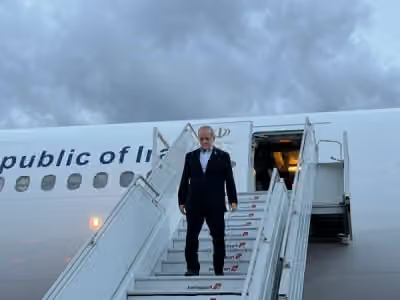
Iran has asked the United Nations to intervene after the United States expanded restrictions on the movement and activities of its diplomats, the foreign ministry said on Thursday.
Washington, Tehran said, had intensified restrictions on members of Iran’s mission, including banking hurdles and limits on routine purchases, after earlier curbs imposed during September’s UN General Assembly.
"The United States took action this week to impose maximum pressure on the Iranian regime by restricting their UNGA delegation’s movement and access to wholesale club stores and luxury goods," the state department said in a statement in September.
"We will not allow the Iranian regime to allow its clerical elites to have a shopping spree in New York while the Iranian people endure poverty, crumbling infrastructure, and dire shortages of water and electricity."
In the statement, the ministry said these measures were intended “to disrupt the normal and legal duties of Iranian diplomats.”
“The imposition of extensive restrictions on the residence and movement of Iranian diplomats, tightening restrictions on bank accounts, and imposing restrictions on daily purchases are among the pressures and harassment,” the ministry said.
Washington barred three mission staff
The ministry also criticized the US State Department for blocking continued work by three employees of Iran’s mission. It did not specify when the expanded limits began, though Iranian diplomats were previously permitted to travel only between the UN, their mission, the ambassador’s residence and John F. Kennedy International Airport.
The appeal comes after five rounds of indirect nuclear negotiations between Iran and the United States ended earlier this year. Those talks preceded a 12-day air war in June in which Israel and US forces struck Iranian nuclear sites, an escalation that deepened the diplomatic rupture.
The UN has not publicly addressed the request, but Tehran’s appeal signals mounting friction in an already strained diplomatic environment.