Iran accuses Israel of a history of ‘false flag’ operations
People pay respects at Bondi Pavilion to victims of a shooting during a Jewish holiday celebration at Bondi Beach, in Sydney, Australia, December 15.
Iran’s foreign ministry spokesperson accused Israel of drawing on a history of covert “false flag” operations to shape international narratives, implicitly suggesting that a recent attack in Sydney may have been linked to Israeli actions without making the allegation explicit.
Baghaei cited the Lavon Affair, which took place in Egypt in 1954, as an example. “The Zionist regime, exploiting Egyptian Jews, carried out a series of bombings and sabotage operations against non-civilian targets linked to the United States and Britain in Alexandria and Cairo, including libraries and post offices. This is a very clear case of a false-flag operation,” he said.
Without directly mentioning last week’s shooting in Australia, he added that “these actions are entirely precedented. The most effective way to counter such behavior is to expose it and inform public opinion about the conduct and crimes of the Zionist regime, which spares no inhumane means to advance its objectives.”
Earlier this month, a mass shooting at a Hanukkah gathering at Bondi Beach in Sydney killed 15 people, including a child. Australian police and intelligence agencies said the attack was linked to Islamic State, and authorities and world leaders said it was motivated by antisemitism.
Following the attack, some Israeli officials and media outlets raised the possibility of Iran’s involvement in the attack, saying the matter was under review. Israel Hayom reported, citing an Israeli official, that in recent months Iran’s activities to target Israeli and Jewish interests worldwide had increased.
Iranian officials and state-linked media, meanwhile, rejected accusations of structural antisemitism or plots to attack Jewish targets, instead seeking to cast Israel as responsible for the Sydney incident.
Ebrahim Azizi, head of parliament’s national security and foreign policy committee, said last week that what he called Israeli officials’ “hasty” remarks about the attack could point to their own role, while lawmaker Esmail Kowsari said: “Enemies have always tried, by hiring agents, to pin responsibility for their actions on the Islamic Republic and the IRGC.”
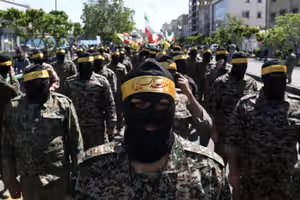
Iran’s Revolutionary Guards said on Monday that Israel was defeated in the recent 12-day conflict because it failed to trigger unrest inside Iran, despite what its spokesman described as expectations that military strikes would lead to domestic turmoil.
Ali Mohammad Naini, spokesman for the Islamic Revolutionary Guard Corps (IRGC), said Israel and its allies had pursued a dual strategy during the conflict: direct military confrontation alongside efforts to destabilize Iran from within.
“The enemy’s defeat in the 12-day war was precisely here,” Naini said. “They tried to drag the war inside the country, but that project failed.”
Naini was speaking at a meeting to organize commemorations for December 30, a state-marked anniversary tied to mass rallies that followed the disputed 2009 presidential election and the suppression of the Green Movement protests – one of the largest episodes of unrest in Iran’s recent history.
The Green Movement is often cited alongside the 2019 Bloody November protests and the 2022 Woman, Life, Freedom demonstrations as the most significant challenges to the Islamic Republic since its founding.
Naini said Iran’s adversaries had assumed that air strikes would be followed by protests, riots or internal collapse, repeating what he described as a long-standing “illusion of chaos” rooted in past episodes of unrest.
“They sat in their war rooms with a wrong calculation, waiting for disorder, riots and the breakdown of the country from within,” he said.
Instead, Naini said the attacks were followed by large public reactions that included anti-Israel rallies and funerals for those killed, which he portrayed as demonstrations of national unity.
He said Israel underestimated what he described as a “fortress-like” popular cohesion and that attempts at what Iranian officials often call soft war or cognitive war aimed at weakening society from within were completely unsuccessful.
“The enemy shifted from military war to cognitive war, using pessimism, division and exaggerating social dissatisfaction to weaken the unity that was formed,” Naini said.
The remarks come as regional tensions remain high and as Israel weighs next steps.
NBC News reported over the weekend that Israeli officials are preparing to brief US President Donald Trump on options for possible new military strikes on Iran, citing concerns that Tehran is rebuilding facilities linked to ballistic missile production and repairing air defenses damaged in earlier attacks.
Israeli Prime Minister Benjamin Netanyahu is expected to raise the issue during an upcoming meeting with Trump, including options for US support or participation in any future action, according to the report.
Trump has repeatedly said US strikes in June destroyed Iran’s nuclear capabilities and has warned Tehran against trying to rebuild them. Iran denies seeking nuclear weapons and says its military and nuclear programs are defensive.
Naini said Iran continues to monitor what he described as hostile plans closely, adding that the lesson Iranian officials draw from both past unrest and the recent war is that internal cohesion remains decisive in confronting external threats.
Israel is thinking about regime change in Iran as an option to avoid repeated rounds of conflict, former Israeli consul in Los Angeles said on Sunday.
“Israel is thinking about the regime change in Iran, because otherwise we’ll have to go to a round after round after round,” Yaki Dayan said on Israel’s i24NEWS The Rundown program.
Dayan said Israeli Prime Minister Benjamin Netanyahu will have to do significant convincing when he meets Trump later this month at Mar-a-Lago, particularly on backing further Israeli action against Iran.
"Netanyahu will have a lot of convincing here to do with Trump, not necessarily joining forces in another attack, but going to another attack and getting the defense capabilities from the Americans," he said.
Dayan said Trump is “much more in the peacemaking mode than attacking mode” on Iran and views the nuclear program as a more immediate threat than Iran’s ballistic missile program, which he said Tehran is currently prioritizing.
Dayan's remarks come as Israel Defense Forces’ (IDF) Chief of Staff Lt. Gen. Eyal Zamir said the force will strike its enemies “wherever required, on near and distant fronts alike,” in comments that appeared to allude to the possibility of further action against Iran.
Zamir said Iran had built what he described as a “ring of strangulation” around Israel, a reference to Tehran-backed groups operating across multiple fronts, and warned that the military was prepared to act both close to home and farther afield.
Israeli officials are preparing to brief Donald Trump on options for possible new military strikes on Iran, citing concerns that Tehran is expanding its ballistic missile program, NBC News reported on Saturday.
“They are preparing to make the case during an upcoming meeting with Trump that it poses a new threat,” NBC News said, citing a person with direct knowledge of the plans and four former US officials briefed on the matter.
Israeli officials believe Iran is rebuilding facilities linked to ballistic missile production and repairing air defenses damaged in earlier strikes, which they view as more urgent than nuclear enrichment efforts, NBC reported.
“The nuclear weapons program is very concerning. There’s an attempt to reconstitute. It’s not that immediate,” one person familiar with the plans told NBC, referring to Iran’s nuclear activities.
Prime Minister Benjamin Netanyahu is expected to raise the issue when he meets Trump later this month, including options for US support or participation in any future action, the report said.
Trump's warning
Trump has repeatedly said US strikes in June destroyed Iran’s nuclear capabilities and warned Tehran against trying to rebuild.
“If they do want to come back without a deal, then we’re going to obliterate that one, too,” Trump said earlier this month. “We can knock out their missiles very quickly.”
A White House spokesperson said the International Atomic Energy Agency and Iran had corroborated the US assessment that the strikes “totally obliterated” Iran’s nuclear capabilities.
June strikes and inspections dispute
Israel launched strikes on Iran on June 13, targeting nuclear facilities, senior military figures and scientists, accusing Tehran of pursuing a covert nuclear weapons program. The US followed with strikes on three Iranian nuclear facilities on June 22.
Iran, which denied the accusations, responded with missile attacks including on a US base in Qatar.
The episode comes as the IAEA presses Iran for access to damaged nuclear sites at Natanz, Fordow and Isfahan, saying it must decide whether the sites are inaccessible, a demand Tehran has rejected as unreasonable.
The US State Department called on Iran to release people detained after a memorial ceremony for Iranian human rights lawyer Khosrow Alikordi, warning of risks of abuse and unfair treatment.
“After the arrest of 39 people at the memorial ceremony for Khosrow Alikordi, and even more afterward, including members of his family, authorities have refused to provide a full list of detainees, the charges against them, or where they are being held,” the department said in a post on its Persian-language X account.
“Without transparency and due process, the risk of torture and fabricated charges increases,” it said.
The State Department said detainees had been denied access to legal counsel, necessary medication and contact with their families, and were subjected to violence and threats.
“We call for their unconditional release, immediate medical care for those in need, an end to violent attacks on peaceful gatherings, and respect for the right of society to peaceful assembly and free expression,” it said.
US calls lawyer's death suspicious
The department earlier denounced what it called the suspicious death of Alikordi, a 46-year-old lawyer who represented jailed protesters and families of people killed during demonstrations.
“He devoted his life to defending Iranians who were fighting for freedom, even though he knew it meant putting his own life at risk,” the State Department said, calling his death “a stark reminder of the dangers faced by those who fight for their rights in Iran.”
Alikordi was found dead earlier this month in his office in Mashhad, according to Iranian media. A lawyers’ news outlet said he died of cardiac arrest, while other lawyers and activists questioned that account and called for an independent investigation.
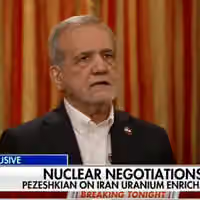
The spokesman for Iran’s Atomic Energy Organization said the country has made significant nuclear advances, and that developing an atomic bomb would be very easy if Tehran chose to pursue it.
“The simplest task is to build a nuclear bomb, because it does not need fuel control and explodes at once,” Behrouz Kamalvandi said on Saturday, calling it much simpler than developing a nuclear power plant.
“Building a nuclear power plant, which needs control of fuel and reaction levels, is difficult and technical.”
Kamalvandi said Iran has reached "the edge of power in the nuclear field, and there is no unknown issue left for us."
Before a 12-day war in June that culminated in US airstrikes on three Iranian nuclear facilities and paused any uranium enrichment in Iran, the country was enriching uranium to near weapons-grade purity levels.
While Tehran denies seeking a nuclear weapon, the United States and Western countries want Iran to end uranium enrichment, arguing that enrichment beyond 20% has no civilian purpose.
UN inspections
The UN nuclear watchdog has resumed inspection activities in Iran but remains unable to access several of the country’s most sensitive nuclear sites following June strikes, International Atomic Energy Agency (IAEA) Director General Rafael Grossi said last week.
“We are only allowed to access sites that were not hit,” he said, calling the resumption important but insufficient.
Grossi said Iran cannot unilaterally decide whether inspectors may enter the damaged facilities.
“If they say it is unsafe and inspectors cannot go there, then inspectors must be allowed to confirm that this is indeed the case,” Grossi said in an interview with Russian state media. “That determination has to be made by the agency.”
IAEA Chief Rafael Grossi
Kamalvandi, however, says the UN nuclear watchdog's requests are unreasonable.
“The agency’s insistence that access and inspections take place strictly under a safeguards agreement written for non-war conditions is unreasonable,” he said.
Kamalvandi said Iran believes the current safeguards framework cannot be applied in the same way after military attacks.
“This framework was written for ordinary circumstances,” he said. “When nuclear facilities and materials are damaged in a military attack, the conditions are different.”
He said granting access to Natanz, Fordow and Isfahan while security threats persist could endanger Iran, and added that Tehran is considering other ways to account for nuclear material without inspectors entering the sites.
The standoff follows the June war that began with Israeli strikes on June 13 on nuclear facilities, senior military figures and nuclear scientists, followed by the US attacks on June 22.
Grossi said the three sites at Natanz, Fordow and Isfahan bombed by the US are central to uranium processing, conversion and enrichment, but stressed that Iran’s nuclear program extends well beyond them.
“Iran has much more than these three facilities,” he said. “It has a very developed nuclear program, with research activities and many other sites.”
He cited Iran’s operating nuclear power plant at Bushehr and plans for additional reactors, including projects with Russia, adding: “Work continues in all these areas.”
The IAEA has long sought answers from Iran over past nuclear activities and the whereabouts of undeclared nuclear material, issues Grossi has said cannot be resolved without access to relevant sites.
Separately, a senior Iranian military commander accused Israel on Sunday of carrying out killings abroad for its own political ends.
“The Zionist regime has resorted to self-harm and, in an effort to prevent reverse migration and escape internal turmoil, is assassinating members of the Jewish community and individuals linked to it in other countries,” said Abdolrahim Mousavi, chief of the General Staff of the Armed Forces of the Islamic Republic.
“Israel is playing the victim. This is not the first time; they have repeatedly committed such crimes,” he added.
Mousavi or other Iranian officials provided no evidence for the allegation.
In August, Australia accused Iran of involvement in two antisemitic arson attacks and ordered its ambassador to leave the country within seven days.
No access to Qatar-held funds
Turning to Iran’s frozen assets held in Qatar, Baghaei said Tehran still does not have effective access to billions of dollars transferred under a US-mediated prisoner swap arrangement.
“This issue is one of hundreds of examples of the United States’ failure to honor its commitments. Under the understanding that had been reached, assets belonging to the Iranian people were supposed to be made accessible to the government of the Islamic Republic of Iran. Unfortunately, the American side did not fulfil its obligations, and this breach of commitment continues to this day.”
The funds, previously blocked in South Korean banks after US sanctions in 2018 and later transferred to Qatari banks under a 2023 agreement, remain inaccessible despite assurances they could be used under defined conditions, he said.
Iran has previously said it gained access to funds released from South Korea and transferred to Qatar, following an agreement mediated by Washington.
The $6 billion in Iranian funds was released under a US sanctions waiver as part of a prisoner exchange deal that saw Iran agree to free five Americans, while five Iranians detained in the United States were also released.
US officials said the money, transferred from South Korea to Qatar, could be used only for tightly monitored humanitarian purposes and was not directly accessible to Tehran.
Missile program pressure
Responding to a question about Israeli and US media reports suggesting Prime Minister Benjamin Netanyahu may urge US president Donald Trump to back renewed military action against Iran over its ballistic missile program, Baghaei said Iran’s missile program was purely defensive and not open to negotiation.
“Iran’s missile program has been developed solely for the defense of the country and is fundamentally not a matter for negotiation,” he said.
Iran's Foreign Ministry Spokesman Esmail Baghaei
“The media hype is also part of a hybrid war that the Zionist regime, with the help of the United States and affiliated media networks, has long designed and pursued against the Islamic Republic of Iran... The armed forces of the Islamic Republic of Iran know well how to defend the country if necessary.”
Ukraine accusations
Baghaei also rejected comments by the Council of Europe that Iran has provided military assistance to Russia in the Ukraine war, calling the comments repetitive.
“From the very beginning of the conflict, we have said disputes must be resolved through dialogue, and that we have had no involvement in this war,” he said, adding that maintaining relations with Russia did not amount to military intervention.
“European countries should genuinely focus on their own responsibilities and act on them, instead of repeatedly levelling accusations against others. European parties need to look at their own track record and examine why the Ukraine conflict emerged in the first place.”
Western governments say Tehran has provided Moscow with Shahed-series drones, which Russia has used extensively to strike Ukrainian infrastructure, particularly energy facilities and urban areas.
Iran has denied direct involvement in the war but has acknowledged supplying drones to Russia before the conflict, a remark disputed by Kyiv and its allies, who say cooperation has expanded since the invasion.
PJAK and regional security
Asked about remarks by Turkey’s defense minister suggesting the Kurdish armed group PJAK had prepared to act against Iran during Tehran's June conflict with Israel, Baghaei said he could not comment officially but described the broader context as indicative of coordinated pressure.
“One point is entirely clear: Israel and the United States had designed a very comprehensive plan to strike at the foundations of Iran,” he said, adding that Iran resisted efforts to undermine its territorial integrity.