Israel weighs regime change in Iran, former Israeli diplomat says

Israel is thinking about regime change in Iran as an option to avoid repeated rounds of conflict, former Israeli consul in Los Angeles said on Sunday.

Israel is thinking about regime change in Iran as an option to avoid repeated rounds of conflict, former Israeli consul in Los Angeles said on Sunday.
“Israel is thinking about the regime change in Iran, because otherwise we’ll have to go to a round after round after round,” Yaki Dayan said on Israel’s i24NEWS The Rundown program.
Dayan said Israeli Prime Minister Benjamin Netanyahu will have to do significant convincing when he meets Trump later this month at Mar-a-Lago, particularly on backing further Israeli action against Iran.
"Netanyahu will have a lot of convincing here to do with Trump, not necessarily joining forces in another attack, but going to another attack and getting the defense capabilities from the Americans," he said.
Dayan said Trump is “much more in the peacemaking mode than attacking mode” on Iran and views the nuclear program as a more immediate threat than Iran’s ballistic missile program, which he said Tehran is currently prioritizing.
Dayan's remarks come as Israel Defense Forces’ (IDF) Chief of Staff Lt. Gen. Eyal Zamir said the force will strike its enemies “wherever required, on near and distant fronts alike,” in comments that appeared to allude to the possibility of further action against Iran.
Zamir said Iran had built what he described as a “ring of strangulation” around Israel, a reference to Tehran-backed groups operating across multiple fronts, and warned that the military was prepared to act both close to home and farther afield.


Senator Lindsey Graham on Sunday said the United States should strike Iran again if there is credible evidence that Tehran is rebuilding its nuclear enrichment program or expanding its ballistic missile capabilities following the June strikes.
Speaking to reporters in Tel Aviv, Graham said US and Israeli attacks had destroyed Iran’s nuclear facilities but had not changed the intentions of Iran’s leadership.
“We obliterated the Iranian nuclear facilities. We did not obliterate Iran’s desire to have a nuclear weapon,” he said.
“The regime hasn’t changed at all. They still want to kill all the Jews, consider America the great Satan, and purify Islam,” Graham added.
Graham said there were signs Iran could be attempting to regenerate its capabilities. “Are they regenerating their nuclear capability? Are they building more ballistic missiles that could hurt Europe and Israel? I don’t know, but there’s evidence that, yes, they are,” he said.
He said Washington should act before Iran is able to restore those capabilities.
“If there’s credible evidence that Iran is going back into the enrichment business at other sites, that they’re trying to build more ballistic missiles to terrorize Israel and maybe Europe, that we hit them before they can do that,” Graham said.
In an interview with NBC News on the same day, Graham took a more cautious tone when asked whether additional US strikes against Iran were necessary, saying he would defer to discussions between Israeli officials and President Donald Trump. “I’m going to let the Israelis talk to President Trump about it,” he said.
Graham’s remarks come a day after NBC News reported, citing Israeli officials, that Israel was preparing to brief President Donald Trump on options for possible new military strikes on Iran, amid concerns that Tehran is expanding its ballistic missile program.
The report said Israeli officials believe Iran is rebuilding facilities linked to ballistic missile production and repairing air defenses damaged in June strikes, which they view as more urgent than nuclear enrichment efforts.
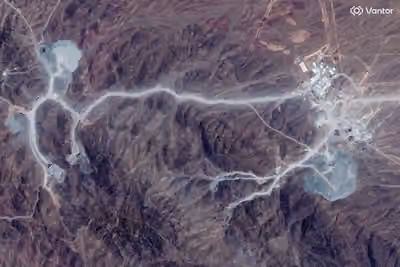
Earlier this year, US airstrikes targeted three key Iranian nuclear sites at Fordow, Natanz, and Isfahan, following an Israeli air campaign that began on June 13 against Iranian military and nuclear-related sites.
Iran denies seeking nuclear weapons and has called the attacks illegal.
The United States has demanded Iran renounce domestic uranium enrichment while Tehran maintains its nuclear program is an international right.

Iran’s Supreme Leader has reshuffled senior army commanders overseeing air power and air defense, signaling a shift toward lower-profile, operational figures after wartime losses and rising fears of renewed conflict.
In a series of decrees issued by Ali Khamenei, Iran’s Supreme Leader and commander-in-chief of the armed forces, new commanders have been appointed to sensitive posts within the regular army, particularly in the air force and air defense structures.
These developments are unfolding against a backdrop of mounting economic pressure and widespread anxiety over the prospect of another war – concerns that analysts say have contributed to the sharp recent decline in Iran’s currency.
New commanders
Earlier this week, Khamenei appointed Brigadier General Bahman Behmard as the new commander of the Army Air Force, replacing Brigadier General Hamid Vahedi.
Behmard had served since 2023 as acting deputy chief of operations of the Armed Forces General Staff and effectively assumed that role after Major General Mehdi Rabbani, the former deputy chief of operations, was killed during Israel’s attacks.
Despite his senior operational experience, Behmard has remained a relatively low-profile figure within Iran’s military establishment, with little media exposure compared to some of his predecessors.
His appointment appears to signal a preference for technical and operational credentials over public visibility at a sensitive time for Iran’s air capabilities.
At the same time, Brigadier General Alireza Elhami was appointed as commander of the Khatam al-Anbiya Joint Air Defense HQ as well as the Army’s air defense force.
Elhami previously commanded the Khatam al-Anbiya Air Defense University and is similarly regarded as a little-known figure outside military circles, with most of his career spent in training and operational planning roles rather than public-facing positions.
The Khatam Al-Anbiya Joint Air Defense HQ is responsible for coordinating Iran’s air defense across military branches. It should not be confused with the Central Khatam al-Anbiya HQ, a key pillar of the Armed Forces General Staff tasked with coordinating all military forces during major crises, including wartime.
The two commanders replaced in these posts have been reassigned to roles widely viewed as advisory or ceremonial.
Vahedi was appointed air affairs adviser to the Army commander-in-chief.
Meanwhile, Brigadier General Sabahifard, commander of Army Air Defense since 2019, and Khatam Al-Anbia Joint Air Defense HQ commander since February 2025, was named assistant to the army commander-in-chief for air defense affairs.
The leadership reshuffles extend beyond air power. In November, Army Ground Forces commander Brigadier General Kioumars Heydari was removed and replaced by Brigadier General Ali Jahanshahi, formerly deputy head of evaluation at the Central Khatam al-Anbiya HQ.
Heydari was appointed as acting commander of Khatam Al-Anbia Central HQ a few days later, a significantly more senior post.
That Central HQ has itself seen dramatic changes. IRGC Major General Ali Abdollahi was appointed commander in September after Major General Gholam-Ali Rashid and his successor Major General Ali Shadmani were both killed during Israel's attacks.
Abdollahi’s appointment was not publicly announced until early that month.
Lack of media commentary
Despite the scale of these shifts, Iranian media have offered little to no comment or analysis, largely limiting coverage to headlines that describe the moves as “important changes.”
One notable exception was the news site Khabar Online, which argued that Elhami’s appointment reflected “the army’s policy of relying on in-house commanders with long-term specialized experience,” highlighting his background in both training and operational planning. The outlet also emphasized his “low-profile” career path.
That emphasis may allude to the controversy surrounding an unverified claim during the 12-day war that Iranian air defenses had shot down an Israeli F-35 fighter jet.
The claim, widely circulated by state media including IRIB, was never substantiated. IRIB head Peyman Jebelli acknowledged earlier in December that broadcasting the false report had harmed the organization’s credibility, adding that military officials had provided the information.
Sabahifard, who was air defense commander at the time, had frequently appeared in the media before the war, publicly asserting Iran’s ability to counter advanced aircraft such as the F-35. In one of his final public remarks in late October, he described Israeli damage to Iranian equipment as “natural” and claimed rapid restoration of both hardware and manpower.

Iran said damage to its missile launchers during a 12-day conflict with Israel was limited, with a senior military official saying less than 3% were destroyed and that Iran’s missile capability remains operational.
Ahmad Vahidi, deputy chief of Iran’s armed forces general staff, said Israel had sought to amplify its performance through media and psychological operations that did not reflect realities on the ground, according to comments aired by Lebanon-based Al Mayadeen television and reported by Iranian media.
“Israel tried to present an image that does not match the reality,” Vahidi said, adding that Israel failed to achieve its objectives during the fighting.
He said Israel managed to destroy “less than 3%” of Iranian missile launch platforms during the conflict and that Iran’s missile force remained active and capable of conducting operations.
Iranian officials have repeatedly sought to play down damage from the fighting and to signal the resilience of the country’s military capabilities, while Israel has said it inflicted significant blows to Iran’s military infrastructure. Neither side’s claims could be independently verified.

Iran’s current intelligence structure is not equipped to deal with the scale and nature of threats posed by Israel and needs fundamental reorganization, a former senior commander of the Islamic Revolutionary Guard Corps (IRGC) said.
Hossein Alaei, a former commander of the IRGC navy, said Iran’s intelligence agencies failed to anticipate Israeli operations, including plans to target Iranian commanders and scientists, and argued that the system lacks the focus needed to counter Israel’s security and intelligence apparatus.
“If our intelligence services had been properly focused on Israel’s activities, they should have known about plans to assassinate Iranian commanders and scientists, including through the use of aircraft,” Alaei said, according to remarks carried by Iranian media.
Referring to the 12-day conflict between Iran and Israel, Alaei said the fighting exposed structural weaknesses in Iran’s intelligence setup and showed that it had not been organized in proportion to Israel’s intelligence and security efforts against Iran.
“The experience of the 12-day war showed that we have not structured our intelligence organization in line with the level of Israeli intelligence and security activity directed at Iran,” he said.
Alaei’s comments add to rare public acknowledgments by figures linked to Iran’s security establishment that Israel retains significant intelligence and military advantages.
Clearer division of roles in Iran’s intelligence system
Alaei called for a reorganization that would sharply divide responsibilities between Iran’s two main intelligence bodies – the Intelligence Ministry and the IRGC’s intelligence organization – saying their current overlap has reduced effectiveness.
“At present, both the Intelligence Ministry and the IRGC’s intelligence arm are simultaneously engaged in domestic security issues and in monitoring Israel, and this structure has clearly not produced the required results,” he said.
He proposed that one of the two agencies focus exclusively on Israel, while the other take primary responsibility for internal security.
Alaei also criticized what he described as a lack of basic preventive measures, saying that in some cases individuals known to be Israeli targets were living together in the same residential building, enabling Israel to kill multiple targets in a single strike.
His remarks come amid a broader debate inside Iran over the country’s military and security performance during the 12-day conflict.
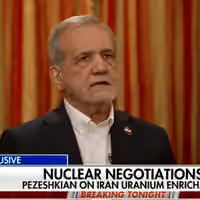
President Masoud Pezeshkian said earlier this week that Israel had enjoyed missile superiority during the fighting, comments that drew criticism from some lawmakers who accused him of undermining Iran’s defensive capabilities.
NBC News reported this week that Israel is preparing to present US President Donald Trump with options for renewed military action against Iran’s nuclear program, while the Al-Monitor website cited European diplomats as saying Israel could strike Iran again in 2026 even without US approval.

Western intelligence agencies have detected unusual activity involving Iran’s Islamic Revolutionary Guard Corps (IRGC) Aerospace Force, prompting heightened monitoring, sources familiar with the assessments told Iran International.
The activity involves movements and coordination beyond normal patterns, including Iranian drone, missile and air-defence units, the sources said.
The developments could be linked to military exercises, Western officials with knowledge of the matter told Iran International but added that the scale and synchronization had drawn closer scrutiny.
Intelligence services are tracking command-and-control signals, deployments and logistical movements associated with the IRGC Air Force, the sources said.
The assessments come amid continued tensions between Iran and Western countries over Tehran’s nuclear and missile programs, and speculation about the possibility of renewed Israeli or even US attacks on Iran.
NBC News reported earlier today that Israeli officials are preparing to brief US President Donald Trump on options for possible new military strikes on Iran, citing concerns that Tehran is expanding its ballistic missile program.
Israeli officials believe Iran is rebuilding facilities linked to ballistic missile production and repairing air defenses damaged in a 12-day war in June, which they view as more urgent concerns than nuclear enrichment and fears of Tehran acquiring a nuclear weapon, NBC reported.
Iran denies seeking a nuclear weapon but the United States and Western countries want Iran to end uranium enrichment, curb its missile power and rein its aid for armed groups in the region like Hamas and Hezbollah. Tehran has rejected the conditions.
Earlier this month, Iran’s Supreme Leader Ali Khamenei dismissed speculations about a possible fresh round of war on Iran, calling it part of “enemy propaganda”.
“Today, beyond these military confrontations — which have existed, as you have seen, and whose likelihood is constantly being talked up, with some even deliberately fanning the flames to create anxiety, though they will not succeed, God willing — we are facing a propaganda and media confrontation,” Khamenei said.