One gram of gold now equals a month’s wage for Iranian workers

An Iranian labor representative said soaring prices have eroded wages to the point where one gram of gold now equals a full month’s minimum pay for a worker.

An Iranian labor representative said soaring prices have eroded wages to the point where one gram of gold now equals a full month’s minimum pay for a worker.
“Today, one gram of gold is equal to a full month’s minimum wage for a worker,” said Habib Sadeghzadeh Tabrizi, an inspector with the country’s High Council of Islamic Labor Councils.
He added the collapse in real wages has reached a point where the traditional phrase “shrinking dinner table” no longer applies, adding that many workers effectively have no table left.
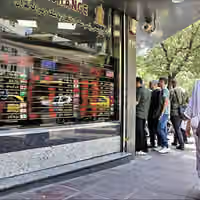
With gold trading at around 135.5 million rials per gram – roughly $104 at current exchange rates, and the dollar near 1.3 million rials, he said the gap between official wages and real living costs has become untenable.
He said runaway inflation has stripped Article 41 of Iran’s labor law – meant to link wages to inflation and living costs – of any practical meaning, adding that salaries now lose value even before they are paid.
Sadeghzadeh said wages for the current year were set when the dollar stood near 850,000 rials, but have since been overtaken by a sharp currency slide, leaving workers unable to plan even basic daily expenses.
“If this trend continues, it will not only destroy workers’ livelihoods but also undermine production and the wider economy,” he said, adding that fair tax exemptions and wage adjustments in line with real inflation are now a national necessity, not a sectoral demand.

Iran’s parliament speaker warned on Sunday that lawmakers could move to impeach President Masoud Pezeshkian’s cabinet if the government fails to rein in soaring prices, stepping up pressure on an administration grappling with a deepening economic crisis.
Mohammad Bagher Ghalibaf said runaway increases in the cost of basic goods had become one of the public’s main concerns, with rising foreign exchange and gold prices acting as key drivers – or what he called pretexts – for broader inflation.
Speaking in an open parliamentary session, Ghalibaf said the legislature had held a series of oversight meetings with senior government officials, including the ministers of economy, agriculture and industry, as well as the heads of the planning and budget organization and the central bank.
He said the talks had focused on preventing further erosion of household purchasing power, implementing a state-backed food voucher scheme and managing volatility in the currency market.
“If these measures do not deliver results, then in order to minimize time and tension, the priority will be for the government to repair its cabinet,” Ghalibaf said. “If the necessary reforms are not carried out by the government, representatives will be forced to begin the impeachment process.”
The warning adds to a widening chorus of concern inside Iran’s political establishment as inflation, a weakening rial and sharp rises in food and housing costs strain living standards, particularly for lower-income households.
Ghalibaf said parliament would continue to pursue the issue with urgency, stressing that lawmakers viewed the surge in prices for everyday necessities as a national priority.


The pressure on the Pezeshkian administration has also extended beyond economic policy.
During the same parliamentary session, dozens of lawmakers issued formal written warnings to the president and cabinet ministers on a wide range of issues, from perceived inequality in the state bureaucracy to delays in infrastructure projects, internet access, student housing and unpaid wages.
Such parliamentary admonitions are a routine feature of Iranian politics, but their volume shows the breadth of dissatisfaction as economic hardship deepens.
Impeachment is not a theoretical threat. In March 2025, just six months after Pezeshkian took office, parliament voted to impeach and remove Economy Minister Abdolnasser Hemmati, citing the rising dollar rate and higher prices for basic goods.
During that session, Pezeshkian hinted at the limits of his authority, pointing indirectly to Supreme Leader Ali Khamenei’s stance on relations with the United States and saying the government had to align itself with those positions.


Iran’s economic woes are rooted in years of sanctions, policy missteps and political constraints that have narrowed the government’s room for maneuver.
Inflation has remained high, the national currency has repeatedly hit record lows and the cost of essential goods has surged, eroding public confidence and adding to social tension.
The latest parliamentary threat comes as broader debates intensify over accountability and power in Iran’s political system. Moderates and reformist figures have increasingly argued that elected institutions lack the authority to address structural problems, while ultimate control over key areas of policy rests with unelected bodies under the Supreme Leader.
At the same time, even some of Pezeshkian’s former supporters have begun to question whether he can deliver meaningful change, with commentators and social media users warning that continued economic deterioration could trigger renewed unrest.

Tehran’s recent gestures of apparent flexibility—from looser enforcement of the hijab to an embrace of nationalist symbolism—recall moments in Communist history when a brief opening exposed risks the system ultimately moved to contain.
In 1956, Soviet leader Nikita Khrushchev stunned the communist world by denouncing Joseph Stalin’s crimes in a closed-door speech at the Communist Party Congress.
The address, later leaked, raised expectations that the Soviet system might be capable of reform from within. Instead, it exposed pressures the leadership struggled to contain, contributing to unrest at home and rebellion abroad—notably in Hungary—and ultimately reinforcing the limits of permissible change.
That pattern—tactical relaxation under pressure, followed by retrenchment—offers a useful lens for understanding Iran’s current moment.
Since June’s 12-day war with Israel and the United States, the Islamic Republic has been navigating what officials privately describe as a convergence of external threat and internal fragility.
Internationally, Tehran faces deepening isolation and a US administration that has shown a willingness to use force. Domestically, the aftershocks of the 2022 Woman, Life, Freedom uprising continue to shape public behavior and elite anxiety.
Lifeline: patriotism
Against that backdrop, the state has adopted a dual strategy.
On one track, it has sought to soften flashpoints—particularly hijab enforcement—that could reignite street unrest. Police patrols have become less visible, enforcement more uneven, and officials have emphasized “cultural” rather than coercive methods.
On another track, the leadership has leaned into a form of state-sponsored nationalism that draws selectively on Iran’s pre-Islamic past.
Last month, authorities unveiled a statue in Tehran depicting the Roman Emperor Valerian kneeling before the Sassanid king Shapur I, commemorating a third-century Persian victory over Rome. The accompanying slogan—“You will kneel before Iran again”—was echoed in imagery portraying Israel’s prime minister in a similar posture.
Such symbolism would have been unthinkable for much of the theocracy’s history, when pre-Islamic iconography was treated with suspicion or outright hostility.
Supreme Leader Ali Khamenei reinforced this shift in July when, in his first public appearance after the war, he asked a religious eulogist to perform “Ey Iran,” a nationalist song associated with the pre-revolutionary era.
The gesture was widely read, both inside Iran and abroad, as an attempt to blur the line between religious authority and national identity—and by some, as a signal of potential recalibration.
‘Let a hundred flowers bloom’
History suggests caution. Authoritarian systems have often reached for controlled liberalization or symbolic inclusion during moments of acute stress, only to reverse course once the immediate danger recedes.
Mao Zedong’s 1957 “Hundred Flowers” campaign—launched in part to manage the fallout from Khrushchev’s de-Stalinization—famously invited criticism before giving way to a sweeping crackdown when dissent exceeded official expectations.
Iran’s trajectory over recent months has followed a similar arc.
Even as officials spoke of unity and restraint, legislation advanced to tighten restrictions on speech, expand capital punishment for acts of dissent, and broaden the security services’ remit online.
Arrests and executions have continued at a steady pace, and pressure on journalists, activists and minority communities has intensified.
Earlier this month, Khamenei dismissed criticism of hijab laws as part of a Western ideological campaign, warning domestic media against amplifying such views. The judiciary chief swiftly followed suit, announcing a more coordinated effort involving police and prosecutors—a signal less of retreat than of reorganization.
The episode underscores a recurring dynamic in the Islamic Republic’s history: moments of apparent opening that generate speculation about reform, followed by moves that reassert control once the boundaries of dissent become clearer.
As with Khrushchev’s speech nearly seven decades ago, the significance may lie less in the promise of change than in what the response reveals about the system’s underlying anxieties—and the limits it is ultimately prepared to enforce.

A leading economic newspaper in Tehran warned that poverty and inequality in Iran are deepening under intensified international sanctions, saying nearly one-third of the country’s wealth is now concentrated in the hands of just one percent of the population.
In a recent report, Donya-ye-Eghtesad said worsening sanctions have tightened what it described as Iran’s “economic bottlenecks,” accelerating capital concentration while pushing a growing share of households below the poverty line.
The paper pointed to the US Treasury Department’s decision on December 18 to sanction 29 oil tankers and the companies managing them, a move Washington said targeted Iran’s so-called shadow fleet used to bypass sanctions and export oil and petrochemical products.
The United States Department of the Treasury said the vessels and firms had transported hundreds of millions of dollars’ worth of Iranian products using deceptive practices.
The measures, the daily warned, would sharply reduce Iran’s foreign currency revenues, compounding pressure on an economy already struggling with inflation, currency depreciation and declining purchasing power.
Rising prices signal widening poverty
The surge in free-market prices for foreign currency and gold, the newspaper said, reflects the spread of poverty, with inflation driven by these increases expected to place additional strain on Iranian households in the coming months.
In recent weeks, both markets have posted repeated record highs, fueling broader inflationary expectations.
Over the past year alone, average food prices in Iran have risen by more than 66 percent, according to figures cited in the report. The paper said inflationary pressures have intensified following renewed UN sanctions and repeated statements by Iranian officials insisting on continuing the country’s nuclear program.
Ali Heidari, an Iran-based economic researcher quoted by Donya-ye-Eghtesad, said inequality in Iran is far worse than the global average.
“About 29 percent of the country’s wealth is held by just one percent of the population,” he said.

Poverty, Heidari added, has expanded rapidly. Around 26 percent of Iranians lived below the poverty line in 2022, he said, rising to 36 percent in 2023 – more than 31 million people. “If data for 2025 become available, the number will almost certainly be higher,” he said.
Who loses, who gains
Retirees, workers and salaried employees, Heidari said, have borne the brunt of economic pressure, as workshops and small businesses cut jobs or reduce working hours under sanctions. By contrast, he said, hoarders and speculative actors have benefited.
He blamed Iran’s tax system for encouraging non-productive and underground economic activity, arguing that weak transparency and incentives for speculation have helped fuel wealth concentration.
Analysts have long warned that Iran’s efforts to evade sanctions have contributed to systemic corruption – a policy Tehran continues to frame as “resistance” against international pressure.

Recent rains delivered Iran from a dangerous dry spell straight into to destructive floods because the land has been denuded by years of poor management, environmental expert Roozbeh Eskandari told Eye for Iran.
As heavy rainfall hits parts of the country, flooding has replaced drought as the most visible sign of Iran’s environmental crisis.
But instead of easing water shortages, the rain is accelerating destruction, washing through cities, villages and farmlands without replenishing groundwater or restoring depleted aquifers.
Decades of destructive urban expansion, dam building, interbasin water transfers and unchecked groundwater extraction have compacted the land, Eskandari said, chalking it up to "bad governance"
Trained in hydraulic structures and environmental research, Eskandari studies how dams, urban expansion, soil degradation and groundwater extraction affect flood behavior and water scarcity, placing him at the intersection of engineering, environment and policy.
Land that once drank in the rainfall no longer can: "The soil has lost the ability to absorb the water," Eskandari said.
A familiar pattern has emerged across Iran: rain arrives after prolonged drought, but instead of recharging groundwater, it turns into runoff. Water remains on the surface, rushing downhill, collecting mud and debris and producing floods.
Climate change has altered rainfall patterns, Eskandari adds, increasing intensity and shortening precipitation periods, which he calls "not a root cause, but can be considered as an intensifier."
Flooding offers little relief because Iran lacks the systems needed to manage water when it arrives. Watershed management, land-use planning and early warning mechanisms that could turn floods into a resource are largely absent.
"These floods could be used to feed the aquifers," Eskandari said. Instead, without preparation, they are simply not used."
Environmental injustice
Damage consistently concentrates in areas with weak infrastructure and limited political influence. These include villages, informal settlements and poorer urban districts.
Wealthier neighborhoods are better protected by drainage networks, reinforced construction and faster access to emergency services, turning flooding into an issue of environmental injustice.
The flooding now unfolding is also taking place against a deeper structural crisis.
When Dr. Kaveh Madani spoke to Eye for Iran earlier this year, he warned that Iran is no longer facing a typical drought but what he calls water bankruptcy, a condition in which consumption exceeds supply and reserves built over generations have already been exhausted.
“We have never seen such a thing,” Madani said. “The people of Tehran, the city that is the richest, most populous and strongest politically, is running out of water, is facing day zero.”
Madani’s warning reinforces Eskandari’s assessment that short bursts of rain or even seasonal floods will not reverse the crisis without systemic reform.
For Eskandari, the shift from drought to flooding is not an anomaly but a warning.
“We are one step closer to territorial collapse,” he said. “These policies have taken Iran into, as I call it, a point of no return,” Eskandari said, “for the land and for the people, both at the same time.”
You can watch the full episode of Eye for Iran on YouTube or listen on any podcast platform of your choosing.

Air pollution returned to Iran’s capital and several other cities, pushing air quality back into unhealthy levels for vulnerable groups and prompting renewed health warnings, according to official data released on Friday.
The city’s average air quality index (AQI) reached 116 on Friday, placing it in the “unhealthy for sensitive groups” category, Tehran’s Air Quality Control Company said. The figure marked a sharp deterioration from the previous 24-hour average of 83, which had indicated acceptable conditions.
Since the start of the current Iranian year in March, Tehran has recorded only six days of clean air. Official figures show the capital has experienced 130 days of acceptable air quality, 113 days classified as unhealthy for sensitive groups, 20 unhealthy days for the general population, two very unhealthy days and two days deemed hazardous.
The renewed pollution prompted health warnings urging people with heart and lung disease, children, pregnant women and the elderly to stay indoors and avoid unnecessary travel, IRNA, the state-run news agency, reported on Friday.
Chronic crisis in major cities
Air quality is measured on a scale in which AQI levels between zero and 50 indicate clean air, 51 to 100 acceptable conditions, 101 to 150 unhealthy for sensitive groups, 151 to 200 unhealthy for all, 201 to 300 very unhealthy and 301 to 500 hazardous.
Air pollution has become one of Iran’s most serious public health and environmental challenges in recent years. Major cities including Tehran, Isfahan, Mashhad and Ahvaz regularly experience prolonged periods of unhealthy air, particularly during colder months when temperature inversions trap pollutants close to the ground.
Public frustration has grown as pollution episodes intensify, with many citizens saying that simply breathing clean air has become a daily struggle. Environmental specialists have long warned that weak enforcement, aging vehicle fleets and reliance on highly polluting fuels have worsened the problem.
Critics say government policies, including the burning of heavy fuel oil at power plants during energy shortages, have played a direct role in exacerbating pollution, exposing millions of residents to serious health risks.

Khuzestan cities also affected
Air pollution also affected several cities in the southern province of Khuzestan on Friday. Data from the National Air Quality Monitoring Center showed AQI levels reaching 153 in Khorramshahr and 152 in Molasani, both classified as unhealthy for all population groups.
Other cities, including Abadan, Shushtar, Karun and Haftkel, recorded AQI levels between 108 and 136, placing them in the unhealthy-for-sensitive-groups range. Local media advised residents with underlying health conditions, as well as children and the elderly, to avoid strenuous outdoor activity.
The pollution wave comes as seasonal influenza cases rise across Iran, compounding respiratory health risks. In August, Abbas Shahsavani, deputy head of the Air Quality and Climate Change Research Center at Shahid Beheshti University of Medical Sciences, said more than 35,000 deaths nationwide in the previous year were attributed to air pollution, underscoring the scale of a crisis that remains largely unresolved.