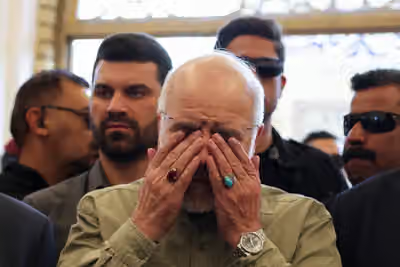
An Iranian cleric visiting the Islamic Revolutionary Guard Corps (IRGC) Aerospace Force Museum in Tehran.
US President Donald Trump’s new National Security Strategy (NSS) signals a more hands-off approach toward Iran and marks a departure from the outlook of his first term, according to veteran Iran-watcher and analyst Behnam Ben Taleblu.
The 2025 National Security Strategy reflects a narrowing of what Washington now defines as its core national interests, Taleblu said, with Iran mentioned just three times despite being labeled a central threat in Trump’s 2017 strategy.
“There’s a focus on the homeland, the Western Hemisphere, strategic competition with China and getting Europe to do more,” said Taleblu, an analyst for the Foundation for Defense of Democracies think tank in Washington DC, adding that Iran is absent from the list of top-tier threats outlined in the document.
The strategy released this month emphasizes reducing US involvement in the Middle East in favor of focusing on great power competition with China, threats in the Western Hemisphere and urging Europe to shoulder more security responsibility.
Iran appears to have slipped down Washington’s priority list following last year’s 12-day war between Israel and Iran, which the United States briefly joined.
“It seems like, at least for the Trump administration, they’re content to take that victory lap,” Taleblu said on Eye for Iran, saying the White House is attempting to declare success and move on following US strikes on Iran’s nuclear facilities.
The NSS suggests Washington is ready to “turn the page” on a region that has dominated US foreign policy for decades, he added, and it credits Trump’s energy policies, regional diplomacy and limited use of force for creating political space to step back from the Middle East.
US strikes on Iran included the use of 30,000-pound bunker-buster bombs carried by B-2 stealth bombers.
While President Trump has said Iran’s major nuclear sites were “obliterated,” US intelligence assessments indicate the program was set back but not completely destroyed, according to officials cited in US media reports.
Iran is believed to possess more than 400 kilograms of highly enriched uranium whose whereabouts remain unknown, and Iranian officials have said they rebuilt its missile capacity and would respond forcefully to any future attack.
“Iran may be weakened, but it is down and not out,” Taleblu added.
The strategy document implies that major regional crises — including the Gaza war, the Israel-Hezbollah conflict in Lebanon, Houthi attacks from Yemen and instability in post-Assad Syria — are either resolved or on track toward resolution.
The document does not appear to assess that Iran could strongly reverse recent setbacks to its nuclear program and its so-called Axis of Resistance coalition.
While Taleblu credited the Trump administration for reviving elements of its maximum pressure campaign of sanctions, he criticized what he called gaps. Iranian oil exports have reached record highs, and the administration has not issued a single new human rights designation related to Iran in 2025.
“While the regime is threatening the life of this very president and the first family, it is beyond me to be thinking about peace and prosperity without a clear strategy to contain Iran further,” Taleblu said, “There is a lot of room for improvement when I look at both this document and the administration’s track record this year.”