Iran ex-hijab enforcer gets lashes in sex scandal, escapes execution on legal twist
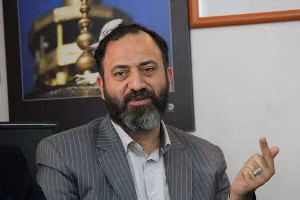
Reza Seghati, the former head of the Ministry of Culture and Islamic Guidance in Gilan province
An Iranian court has sentenced Reza Seghati, the former head of the Ministry of Culture and Islamic Guidance in Gilan province, to 100 lashes and exile in connection with a widely publicized same-sex scandal that cost him his post.
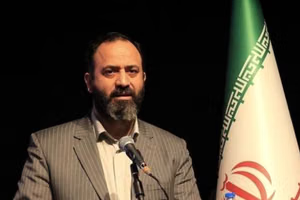
According to Iranian outlets including Ensaf News, the court found Seghati (also Seqati) guilty of “lavat tafkhizi,” a same-sex act defined under Iran’s Islamic penal code as non-penetrative sexual contact between men.
Both Seghati and the other man seen in a leaked video were handed 100 lashes and prison exile terms of one and two years respectively, reports said.
Iran’s penal code prescribes severe punishments for same-sex relations, including flogging and, in cases of penetrative intercourse or repeat offenses, the death penalty. Rights groups have long criticized these provisions, but Iranian authorities say they are enforcing Islamic law.
The scandal began in July 2023 when a video surfaced online allegedly showing Seghati engaged in sexual activity with another man. The leak led to his dismissal from office and triggered a political storm due to his past role as a vocal enforcer of Iran’s mandatory hijab rules.
Ensaf News, citing an image of the judgment, also reported that the son of a former senior Gilan official was sentenced to 10 years in prison and exile for orchestrating what authorities described as a criminal network that used secretly recorded videos to discredit rivals. Other defendants are said to remain under investigation.
Major General Abdolrahim Mousavi, chief of staff of Iran’s armed forces, said on Wednesday that Tehran’s defensive preparations had deterred enemies from launching a fresh assault, after visiting a tactical headquarters of the Islamic Revolutionary Guard Corps’ ground force.
“Our defensive and combat readiness has reached a level that deters enemies from committing miscalculations, including thoughts of renewed invasion of the country,” Mousavi said.
“We thank God that, thanks to the vigilance and wisdom of the armed forces and the use of historical experience, our defensive and combat preparedness has reached a stage that prevents enemies from making calculation errors.”
He described boosting defensive and offensive capabilities across the military as an “undismissable strategic priority” and called for greater use of the IRGC’s paramilitary Basij volunteer force to expand Iran’s deterrent power and operational reach.
“These strategies will guarantee lasting security and Iran’s deterrent defensive power against any aggression,” he added.
Israel launched a 12-day campaign that killed Iranian nuclear scientists and hundreds of military personnel and civilians and was followed by US bombings of key nuclear sites, while Iranian counterattacks killed 31 Israeli civilians and an off-duty soldier.
US and Israeli officials said the strikes were intended to block Iran from developing nuclear weapons. European powers have pressed for renewed diplomacy and the restoration of UN sanctions, while Tehran denies pursuing a bomb and describes the measures as diplomatic coercion.
Iran’s foreign ministry spokesman on Wednesday said Washington had no right to criticize Tehran’s missile program, accusing the United States of blocking prospects for nuclear negotiations by insisting on restrictions that Iran calls non-negotiable.
"The United States is in no position to make decisions about Iran’s national defence capabilities. The Islamic Republic of Iran is determined to preserve its independence at any cost, stand on its own feet, and firmly resist the excessive demands, aggression, and acts of hostility by foreign powers -- including the United States and the Zionist regime (Israel)."
His remarks echoed those of Ali Larijani, secretary of Iran’s Supreme National Security Council, who earlier this month said that US demands for missile curbs “set a path that negates any talks.”
A sixth round of indirect US-Iran talks was suspended in June after Israel and the United States struck Iranian nuclear facilities, prompting waves of Iranian missile retaliation against Israel.
Iran insists its nuclear program is for civilian use and denies developing missiles capable of carrying nuclear warheads. It argues that defense capabilities, including long-range missiles, cannot be part of any nuclear negotiations.
The United States has repeatedly said Iran’s ballistic missile program poses a threat to regional and global security and has sought to tie limits on missiles to any future nuclear diplomacy.
A June Congressional Research Service report said Western governments fear Iran’s enrichment activity could be paired with long-range delivery systems, and US lawmakers have mandated sanctions across multiple defense and foreign policy bills targeting missile development.
The State Department has imposed waves of sanctions on Iranian and Chinese entities accused of supplying materials for missile propellants and other components.
Under the Iran Freedom and Counter-Proliferation Act, the US has identified 10 strategic materials -- including alloys, magnesium and specialized aluminum -- as controlled inputs for nuclear and missile programs.
The US has paired these restrictions with measures against Iran’s missile and drone proliferation. In December 2024, it sanctioned an IRGC Aerospace Force commander and two Iran-based companies supporting the production of Shahed-136 drones and ballistic missiles, accusing Tehran of enabling Russia’s war in Ukraine and destabilizing the Middle East.
US Secretary of State Marco Rubio, speaking in Jerusalem earlier this week alongside Israeli Prime Minister Benjamin Netanyahu, said Iran’s missile ambitions already threaten Persian Gulf states and Europe.
“A nuclear Iran governed by a radical Shia cleric that possesses not just nuclear weapons potentially, but the missiles that could deliver those weapons far away is an unacceptable risk,” Rubio said, vowing continued “maximum economic pressure” until Tehran changes course.
In recent weeks, senior Iranian officials have issued increasingly direct warnings. A member of parliament’s National Security Committee, Amir Hayat-Moghaddam, said Iranian missiles can already reach all European countries and could target US cities if launched from naval vessels positioned offshore.
“We can move our ships to within 2,000 km of the US and from there target Washington, New York, and other cities,” he said.
Iran’s defense ministry has also announced that new generations of missiles with “far greater capabilities” than those used during June’s 12-day war with Israel are now ready for deployment.
“If the Zionist enemy embarks on the adventure again, we will undoubtedly use them,” Defense Minister Aziz Nassirzadeh said last month.
Also on Wednesday, Major General Abdolrahim Mousavi, chief of staff of Iran’s armed forces, said that Tehran’s defensive preparations had deterred enemies from launching a fresh assault.
Baghaei said Iran would fight until the last moment to prevent the restoration of UN sanctions under the so-called snapback mechanism, triggered last month by Britain, France and Germany.
He denounced the move as unjust and illegal, warning that if sanctions were reimposed, Tehran would end its recent understanding with the International Atomic Energy Agency (IAEA) signed in Cairo earlier in the month.
“Iran has never turned its back on diplomacy. But if hostile action is taken against us, any understanding with the IAEA will be considered terminated,” he said. “It is Iran’s right that if the other side fails to meet its commitments and seeks blackmail, no one can claim that Iran must remain bound by this understanding."
Baghaei added that Foreign Minister Abbas Araghchi will speak with his British, French and German counterparts on Wednesday.
A French diplomatic source told Reuters that the call aims to discuss the impending reimposition of sanctions and to reaffirm conditions they had set to Tehran that would enable that decision to be delayed.
The spokesman criticized what he called “unprecedented” US restrictions on visas for Iranian officials attending the United Nations General Assembly in New York, saying such measures violated America’s obligations as host country of UN headquarters.
“Some visas have been issued, but the process has been slow and irregular. Such behavior questions the credibility of the United States,” Baghaei said.
On Syria, Baghaei said Iran was not rushing to restore full diplomatic relations but maintained its friendship with the Syrian people. He condemned Israeli air strikes inside Syria and stressed Tehran’s support for the country’s territorial integrity.
“The severance of relations between two Muslim countries is not eternal. Whenever it is determined that renewed ties with Iran are in the interest of the Syrian people, reciprocal readiness will exist,” he said.
Baghaei accused Israel of threatening regional and global security through military actions in multiple countries and said Iran was working with regional neighbors to build “collective security without reliance on outside powers.”
Baghaei added that Tehran values regional efforts to ease dialogue with Washington but stressed that no state has been designated as a formal mediator.
He added that Iran would continue to engage in indirect talks based on its own national interests while rejecting speculation that outside powers were steering the process.
He added that European states should respond positively to Iran’s cooperative stance with the IAEA and resist US and Israeli pressure. “Any escalation would benefit no one,” he warned.
Israel’s recent strike on Hamas leaders in Qatar could undermine fragile efforts toward ending a nearly two-year-old war in Gaza, South Dakota Republican Senator Mike Rounds (R-SD) told Iran International.
“Number one, Hamas is a terrorist organization. We recognize Israel is going to go after every single one of those terrorists," said senator Mike Rounds.
"But at the same time, Qatar is a different country, and this took place in a different country that was our ally, and it is a country which was allowing for a peace process to try to proceed."
The senator stressed that while he backs what he called Israel’s right to target Hamas, he was concerned by the assassination attempts on the soil of a US ally at the heart of ongoing mediation.
“I think the President of the United States is correct in addressing his concern with Israel’s decision to literally attack individuals, even if they were terrorists, in a foreign country. And I think this is going to cause problems for any peace process to move forward in a timely fashion now.”
The White House has said it was notified of the strike only after missiles were already in the air, giving President Trump no chance to intervene. However, Axios, citing unnamed Israeli officials, reported that Washington had earlier notice and had informed the president.
On September 9, 2025, Israel carried out an airstrike in Doha, Qatar, targeting a meeting of Hamas political officials. At least five Hamas members and a Qatari security officer were killed.
The attack was the first known Israeli strike on Qatari soil — a state that has long hosted Hamas’ political leadership while also mediating ceasefire and hostage talks.
Israel defended the strike as a necessary step to eliminate Hamas leaders it accused of orchestrating attacks against Israeli civilians. For Qatar, however, the attack represented a violation of sovereignty and a blow to its credibility as a mediator.
The fallout was immediate and sharp. Qatar denounced the strike as “cowardly and treacherous,” vowing to raise the issue at the United Nations. The United Arab Emirates, despite its normalized ties with Israel, summoned Israel’s deputy ambassador and described the attack as “blatant and cowardly.”
Turkey accused Israel of adopting “state terrorism as policy.” The UN Security Council, with US support, condemned the operation as a violation of international law and a threat to peace talks.
Iran seized on Israel’s strike in Doha to portray itself as the defender of Arab sovereignty and Palestinian resistance, with President Masoud Pezeshkian and other officials condemning the attack as illegal and anti-peace. Officials in Tehran argue that this could push regional states closer to Iran.
Leaders of the Arab League and the Organization of Islamic Cooperation convened an emergency summit in Doha on Monday, where a draft communiqué warned Israeli operations on foreign soil risk unraveling normalization efforts across the Arab world.
Rounds’ remarks underscore Washington’s delicate balancing act — supporting what it calls Israel’s right to defend itself while also defending the sovereignty of a Persian Gulf ally critical to US diplomacy.
Iran executed political prisoner Babak Shahbazi on Wednesday, state-affiliated media reported, saying he had been convicted of spying for Israel.
Shahbazi, a father of two, had been moved to solitary confinement on Tuesday after a court in Tehran rejected his third request for a retrial, sources close to the family told Iran International.
He was detained in January 2024 and later convicted of “spying for Israel” and “corruption on earth,” charges he denies.
Rights groups have described the proceedings as grossly unfair and based on forced confessions obtained under torture.
"The court rejected our request for a retrial for the third time this morning and moved him to solitary confinement by around noon," the source said.
"We are worried they may have taken him to solitary confinement in preparation for execution," the source said.
Shahbazi was being held in Ghezel Hesar prison, one of the largest in Iran, located about 20 kilometers northwest of the capital, Tehran.
His initial sentence was handed down in May 2025 by Judge Abolghasem Salavati, who was sanctioned by the United States in 2019 for presiding over unfair trials, extracting forced confessions, and imposing harsh sentences on political prisoners and journalists.
Messages to Zelensky
The source said Shahbazi had sent messages to Ukraine’s President Volodymyr Zelensky in 2022, offering help against the Russian invasion.
The messages were later falsified by Iranian authorities to make them appear as if they had been addressed to Israeli Prime Minister Benjamin Netanyahu and the Israeli military, according to the source.
“They have no evidence against him, and they haven’t even given the family a final visit, which usually happens before an execution,” the source said.
During his detention, authorities placed Shahbazi in a cell with a prisoner who was a member of the Islamic State, the Sunni Muslim militant group.
“It was as if they deliberately wanted him to be killed in prison. When the family visited him days later, both his eyes were bruised,” the source said.
Shahbazi was pressured to write dictated confessions under the promise that his death sentence would be commuted to three years if he signed them in front of his lawyer, according to the source.
“He refused to sign because he hadn’t done those things. They even slipped in pages that weren’t his writing and told him to sign, but he didn’t. Despite that, the court sentenced him to death on the basis of unsigned dictated notes,” the source said.
The source said authorities also relied on a coerced statement by Esmail Fekri, who was executed in June after being convicted of spying for Israel. Rights groups described his trial as unfair as well.
“They told him if he confessed against Babak (Shahbazi), his cryptocurrency would be returned to him. He even later wrote a letter saying he had been forced to make that confession,” the source said.
Countless young Iranians whose lives were snuffed out in the Woman, Life, Freedom protests became enduring symbols of defiance — human faces for a movement that challenged the very foundations of the Islamic Republic.
Beyond Mahsa Amini — the most internationally recognized martyr for the cause — the names of Nika Shakarami, Hadis Najafi, Sarina Esmailzadeh, Mohsen Shekari, Mohammad Hosseini and others have been engraved in the collective memory of Iranians who remember them affectionately by their first names.
Each represented a different facet of society: women demanding autonomy, teenagers daring to risk their futures, children like 10-year-old Kian Pirfalak killed by a stray bullet and young men executed for their solidarity with women's plight.
The spark: Mahsa "Jina" Amini
The protests began with the death of Mahsa "Jina" Amini, a 22-year-old Kurdish woman who was arrested by Iran’s morality police on September 13, 2022, over the state’s mandatory hijab law.
She was critically injured in custody and died days later in the hospital.
Her name became a rallying cry, her image circulated widely on social media and protest banners across Iran and beyond. Amini's innocence and tragic death resonated deeply with ordinary Iranians, making her the most enduring icon of a movement that sought not just reform but a different future.
Nika Shakarami: the young rebel
Sixteen-year-old Nika Shakarami vanished after joining a Tehran protest in the early days of the uprising. A video captured her shortly before her disappearance, standing on a trash bin, burning her headscarf and chanting “Down with the dictator" with other protesters.
Ten days later, her body was returned to her family under suspicious circumstances. Authorities claimed she fell from a building. Her relatives disputed this, saying her nose was broken and she was beaten. A BBC World report in May 2024 alleged she was sexually assaulted and murdered.
Nika was known for her creativity and love of the arts — poetry, drawing, and music. She dreamed of becoming a professional singer. Outspoken and spirited, her short life of artistic aspiration and teenage defiance became a symbol of how ordinary young Iranians risked everything for freedom.
Hadis Najafi
Hadis Najafi: 22-year-old TikToker
Hadis Najafi, 22, was shot multiple times in the face, neck, chest, abdomen and hand during a protest rally in Karaj in central Iran. Her family was pressured to announce she had died of natural causes.
Najafi frequently posted on TikTok and Instagram, sharing glimpses of her daily life. In a video recorded before she was killed, she said: “I like to think that when I look back on this a few years later, I’ll be pleased I joined the protest.”
Her mother told Iran International that Hadis joined the protests both to mourn Mahsa Amini and to oppose the theocracy's mandatory Islamic dress code for women. Before leaving home, Hadis said she hoped that years later when change comes to Iran she could look back and be glad she had taken part.
Sarina Esmailzadeh: freedom-loving teenager
Sarina Esmailzadeh and her brother in one of her cooking posts
Sixteen-year-old Sarina Esmailzadeh from Karaj was a bright, curious teenager with broad interests. She loved cooking, K-pop music and making playful videos for her YouTube and TikTok channels.
She spoke candidly about justice and freedom. In one post she asked: “What can people expect from their own country? Welfare, welfare, welfare. Nothing else. Why am I not like that teenager in New York who doesn’t have to worry about the compulsory hijab or economic hardship?”
Her online presence, blending humor, music and political awareness, made her a powerful symbol of the courage and aspirations of Iran’s Gen Z.
Mehrshad Shahidi: a voice silenced too soon
Young chef Mehrshad Shahidi at work
Security forces beat 19-year-old chef Mehrshad Shahidi to death with batons at a Revolutionary Guards detention center in Arak, a day before his twentieth birthday in October 2022. Authorities pressured his family to say he died of a heart attack.
Thousands attended his funeral, chanting anti-government slogans. Mehrshad was already head chef at a local restaurant, studying hospitality at university, and a decorated athlete in gymnastics, volleyball, and swimming.
Authorities never tried those accused of his killing, instead threatening his family with destroying his grave — a site still visited by mourners — if they held public commemorations.
Shekari and Hosseini: death sentences for defiance
Mohammd-Mehdi Karami's father holding photos of his son (left) and Mohammad Hosseini (right)
Mohsen Shekari, 23, and Mohammad Hosseini, 39, were among the first protesters executed after closed-door trials in late 2022 and early 2023. Their deaths, intended as deterrence, became instead rallying cries.
Shekari, a café worker and self-taught guitarist, was arrested during a Tehran protest. Hosseini, a martial arts champion working on a chicken farm, was arrested after attending the memorial for Hadis Najafi in Karaj, where security forces shot dead three protesters.
Shekari was arrested at a protest rally in the west of the capital. Hosseini was arrested a day after the crackdown on a remembrance ceremony for Hadis Najafi in Karaj during which three protesters were shot dead by security forces.
Both were accused of injuring Basij militia members. They denied the charges, and rights groups reported their televised confessions were extracted under torture.
Their executions underscored the movement’s human cost — ordinary men defying extraordinary repression and paying with their lives.