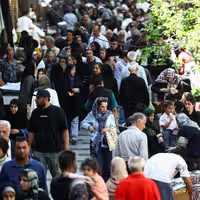
A young woman takes a picture with her mobile phone on the sidelines of a short film festival in Tehran, Iran, November 2025
Tehran's crackdowns on media persist despite the state’s mounting political and economic troubles, with bans of various forms imposed on those who drifts beyond acceptable bounds.
The restrictive measures extend beyond censorship and judicial action to include barriers to income, careers, and public influence. Social media accounts may be deactivated, and work removed from distribution.
The latest example is Reza Rashidpour, a well-known former Iranian television presenter and talk-show host whose programs were taken off the air without explanation, allegedly due to his contributions to former President Hassan Rouhani’s 2017 campaign.
In a post on X addressed to President Masoud Pezeshkian, he claimed he has now been barred from using any platform to publish his work.
“They told me that I am banned from (any artistic) activity,” he wrote. “Five years have passed. The remaining will pass too. In a corner of my home, my homeland, I will sit and watch.”
Rashidpour is by no means an outsider. Securing a major show on the state broadcaster requires extensive vetting, loyalty checks, and alignment with institutional red lines. But falling out of favor can be just as swift.
‘Failed policy’
Yet few rush to defend figures like him—or many others who once thrived within the establishment but later became expendable. The public often sees them as insiders who benefited from the system until the system abruptly turned against them.
This pattern has long applied to artists, athletes, and even politicians; former President Mohammad Khatami’s years of deplatforming and enforced invisibility is a good example.
“Why does a policy that has been applied for decades in culture, media, and politics—and has repeatedly failed—continue to be used as a tool of control?” a commentary on moderate daily Rouydad 24 asked this week.
“Few actions draw more attention to a voice than the attempt to silence it,” the piece added.
Such bans are often unofficial but powerful. Over the years, many artists and athletes who supported popular protests or criticized the state have faced similar restrictions.
Actor, vocalist, footballer
Renowned actress Fatemeh Motamed-Aria was banned from working in the film industry after criticizing government policies and appearing without a headscarf at the 2010 Cannes Film Festival, leading to previously completed films being blocked from release.
Classical music maestro Mohammad-Reza Shajarian was similarly sidelined after expressing sympathy with demonstrators in 2009—releasing the song Put Down Your Rifle, an apparent address to Iran’s security forces.
Legendary footballer Ali Daei faced restrictions after expressing support for popular protests in 2022. Authorities confiscated the passports of Daei and his family, and his jewelry shop and restaurant in Tehran were sealed.
Such restrictions could last for weeks or years, and are often lifted as opaquely as they were imposed, with no official charge of explanation.
In August, media reports said authorities blocked the SIM card of journalist Saeedeh Shafiei, forcing her to deactivate her social-media accounts and sign a pledge to publish pro-government content in exchange for restoring service.
Battered by the June war and mounting economic and environmental crises, Tehran appears to be pulling back from some of its bluntest tools—only to replace them with quieter, more insidious methods of repression.
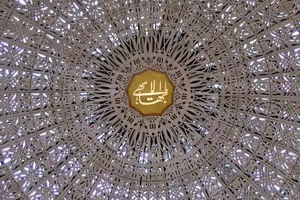
The European Parliament adopted a resolution on Thursday condemning the systematic persecution of Iran’s Baha’i community and urging EU governments to impose sanctions on officials involved in rights abuses.
The resolution was approved with 549 votes in favor, 7 against and 31 abstentions.
Members of the European Parliament said the Baha’is face escalating repression, including harassment, arbitrary detention and property confiscation, and called for the immediate release of all those jailed for their religious beliefs.
"Member states must raise the issue of severe human rights violations in Iran and impose sanctions on Iranian officials contributing to the persecution of the Baha’is," MEPs said in a statement.
The adopted resolution also said Baha’i women face gender-based persecution and account for around two thirds of those detained.
MEPs called on Iran to compensate victims, return seized assets and allow the Baha’i community access to education, employment and services.
Lawmakers criticized the rise in executions in Iran and urged Tehran to halt the use of capital punishment as a tool of political and religious repression.
The European Parliament’s resolution comes amid a renewed crackdown on Baha’is inside Iran and rising anti-Baha’i rhetoric on state media.
Last month, a hardline commentator on Iranian state television, Ali Shirazi, alleged that the Baha’i minority holds “an unbreakable bond with Zionism,” claiming that “Baha’i and Israel are one and the same.” His remarks followed reports by the Baha’i International Community (BIC) that at least 22 members of the faith had their homes and businesses raided in coordinated operations across six provinces.
Iran does not recognize the Baha’i faith as an official religion, unlike Christianity, Judaism or Zoroastrianism.
Baha'is constitute the largest religious minority in Iran and have faced systematic harassment and persecution since the Islamic Revolution of 1979.
Iranian authorities have long accused the Baha’i community of links to Israel, partly because the faith’s spiritual center is located in Haifa, where its founder’s shrine stands. Rights groups say such claims have been used to justify arrests, confiscations, and lengthy prison sentences.
Nearly three quarters of documented violations against religious minorities in Iran over the past three years have involved Baha'is, according to the US-based Human Rights Activists News Agency (HRANA).
A worker raises a Canadian flag in front of the Supreme Court building in Ottawa March 21, 2014
Canada told Iran International on Thursday it does not automatically reject Iranian men’s permanent residency applications solely for compulsory IRGC service, after a conscript said he was ruled inadmissible for his involuntary service.
In a written response via email, Immigration, Refugees and Citizenship Canada (IRCC) said that “conscription, in itself does not necessarily result in a person being deemed inadmissible to Canada, adding every application is examined case-by-case after thorough security screening.
"Officers consider whether service was voluntary, any involvement in violence or terrorism, rank and role within the IRGC, support for the organization’s goals, and current ties to its members," the statement said. "Senior regime officials who served after June 23, 2003, remain fully inadmissible."
The clarification follows Monday’s Federal Court dismissal of Mohammadreza Vadiati’s appeal. The 40-year-old Iranian asylum seeker had his permanent residency refused despite completing only mandatory IRGC service from 2006 to 2008 and insisting it was non-combatant.
Ottawa formally listed the IRGC as a terrorist entity under the Criminal Code last year.
Under Canada’s anti-terrorism laws, membership in or support for a listed terrorist entity can result in inadmissibility, asset freezes, and criminal penalties.
The listing of the IRGC – which Canada blames for human rights abuses and the 2020 downing of flight PS752 – has broad implications for thousands of Iranian nationals who performed compulsory service.
Canadian politicians, including MP Kevin Vuong and Public Safety Minister Dominic LeBlanc, have said the listing aims to curb Tehran’s influence in Canada and prevent IRGC-linked individuals from operating on Canadian soil.
The court also confirmed that humanitarian or family reunification arguments cannot override terrorism-related inadmissibility findings under the IRPA.
Iran's Speaker Mohammad Bagher Ghalibaf (left) talking to President Masoud Pezeshkian as they walk on the Parliament's garden in Tehran, Iran, August 17, 2024
Parliament Speaker Mohammad Bagher Ghalibaf is trying to turn Iran’s mounting economic turmoil into political capital, casting himself as a problem-solver while President Massoud Pezeshkian takes political blows for perceived inaction.
As newspapers warned of collapsing pension funds, chaotic currency markets and rising poverty, Ghalibaf this week moved to appropriate part of the government’s plan to shield low-income families from soaring prices.
It was not the first time he claimed credit for a program launched nearly a decade ago under Hassan Rouhani, but the timing underscored his intent: advance precisely as Pezeshkian is too embattled to push back.
Speaking in the Majles on Wednesday, Ghalibaf proposed replacing the 1980s coupon system with smart-card rationing and portrayed himself as the champion of cost-of-living issues.
He said the scheme would stabilize prices year-round, an ambitious promise in a market where staples such as rice and meat have quadrupled in price since 2020.
For Ghalibaf, however, the political optics appear to outweigh economic feasibility.
At Pezeshkian’s expense
Pezeshkian, who defeated Ghalibaf in last year’s presidential race, now faces intense criticism for promises he is struggling to deliver. Some of the failure is his administration’s own missteps; much of it is structural.
Iran’s economic landscape is dominated by quasi-state foundations, conglomerates linked to the Revolutionary Guards, and networks whose interests often run counter to national policy.
Sanctions remain a permanent drag, yet the president has no authority over nuclear or foreign policy to address them. Key domestic and foreign policy decision-making rests with Iran's Supreme Leader Ali Khamenei.
Tehran’s media and political insiders rarely point to these upper floors of power, leaving the elected administration to absorb the blame.
‘Catastrophe looming’
Iran’s oldest—and relatively neutral— daily Ettela’at captured the depth of the crisis with an unusually stark editorial on Wednesday.
“Pension funds are on the verge of bankruptcy and instability in the foreign exchange market has driven up prices, directly affecting the livelihood of the lower strata of society,” it wrote, chastising the government for placing “massive monetary and forex resources at the disposal of unknown individuals.”
The collapse of pension funds, the daily warned, will be “an irreversible social catastrophe for the country and the nation.”
Ettela’at also weighed in on the sensitive issue of fuel prices, which Pezeshkian has promised to address but finds all but impossible to touch. “You must be too brave to start a losing game of doing away with fuel subsidies,” the editorial warned.
Tehran’s prominent economic daily Jahan Sanat ran three analyses attacking the administration’s “uncalculated” economic decisions. It accused Pezeshkian of “giving a green light to price rises” by scrapping the preferential exchange rate for essential imports, creating uncertainty around the supply of basic staples.
In this climate of economic deterioration, institutional constraints and relentless public pressure, Ghalibaf appears to have sensed opportunity.
By inserting himself into economic policymaking and presenting himself as the official focused on the people’s livelihood, he is positioning for political advantage—likely with an eye on the next presidential race.
A 70-year-old American-Iranian mother has been detained in Iran for two months, the State Department confirmed to Iran International, with her political dissident son saying the move aimed to silence him.
Afarin (Masoumeh) Mohajer was detained on September 29 by security forces at Tehran's Khomeini International Airport, her son Reza Zarrabi told Iran International.
Human rights organizations had previously reported her arrest but said she was detained upon arrival in Tehran. His son, however, said she was arrested as she attempted to fly back to the United States.
Zarrabi, who is based in Frankfurt, said authorities detained his mother to pressure him into ending his political activism against Tehran’s Islamic theocracy. He calls himself a Republican and Liberal Democrat.
“We are aware of the detention of a US citizen in Iran and are closely tracking reports of this case,” the State Department spokesperson said in an email response when asked if Washington is aware of Mohajer’s detention.
"The Department of State has long warned Americans not to travel to Iran and that is particularly true now," the spokesperson added.
Zarrabi described his mother as warm and attached to him after he lost two siblings to suicide. She belonged to no political groups, he said.
Mohajer had travelled to Iran to attend to matters relating to an inheritance, Zarrabi added. She now faces charges he called false, including "membership in hostile groups, propaganda against the Islamic Republic on social media, insulting the Supreme Leader and insulting the religion (of Islam)."
Zarrabi said he has been a political activist for 14 years and a member of Iranian opposition think thanks, but that his mother had no role in his activities.
Mohajer is being held in the women’s section of Ward 209 of Evin Prison in Tehran, Zarrabi added, saying she called last week to plead with him to stop his dissident activities and believes Iranian intelligence agents coerced her.
Reza Zarrabi and his mother Afarin (Masoumeh) Mohajer.
Zarrabi expressed worries for her health in prison as she suffers from brain cancer and is certain that she is not receiving medical treatment.
“I have no doubt that she is a hostage and a victim of the Iranian government’s hostage-taking toward the United States,” he said.
Relations between Tehran and Washington are at a low ebb after the United States joined a surprise Israeli military campaign on the country in June, attacking three Iranian nuclear facilities.
Iran has long detained foreign and dual nationals whom it eventually releases in exchange for political or financial concessions.
"Anyone with a US connection, including dual US-Iranian nationals, is at significant risk of questioning, arrest, and detention in Iran," the State Department told Iran International in its statement.
"Iranian authorities routinely delay consular access to detained US nationals. In particular, Iranian authorities consistently deny consular access to dual US-Iranian nationals."
Iran's president Masoud Pezeshkian taking notes at the annual Capital Market conference in Tehran, November 22, 2025
Mounting pressure on President Masoud Pezeshkian’s administration from hardline opponents and an ailing economy appears to be cutting deep into his inner circle, triggering resignations, public spats and mistrust.
Recent departures and high-profile clashes demonstrate that misgivings within the 18-month-old administration have spilled into public view.
Fayyaz Zahed, a senior adviser, publicly quit last week.
In a sharply worded letter, Zahed denounced several recent appointments as “embarrassing” and reflective of “bad taste,” singling out the choice of Sagheb Esfahani—a hardliner with no experience in the energy sector—to head Iran’s energy optimization body.
Zahed’s colleague Mohammad Mohajeri later quoted him as telling Pezeshkian: “If you want a silent apologist as your adviser, please be advised that genuine opinion cannot be bought with orders and directives.”
Jafar the kingmaker
Much of the internal disarray is now being linked to the expanding influence of Vice President Mohammad Jafar Ghaempanah—an old friend, wartime companion and arguably the president’s closest confidant.
Reports from Khabar Online and outlets aligned with Majles Speaker Mohammad Bagher Ghalibaf accuse Ghaempanah of driving a series of controversial appointments and sidelining more experienced advisers.
Hardline media have seized on the moment, describing the resignations—grudgingly accepted by Pezeshkian—as evidence of a broader administrative failure, one that neither the president nor his deputies can reverse.
These departures land at a time when Iran’s economy is dragging under renewed sanctions, high inflation, frustrated expectations from the post-election period and a sense that Pezeshkian has struggled to articulate a coherent economic direction.
Hardline outlets including Javan, Kayhan and Sobh-e No have amplified that narrative, arguing that the president’s inability to rein in his inner circle has compounded the economic drift.
The line of attack is clear: factional meddling and poor personnel decisions are not just political missteps—they are undermining governance at a moment of national fragility.
VP Aref next?
Against this backdrop, pro-Ghalibaf media such as Sobh-e No and Khorassan now claim that First Vice President Mohammad Reza Aref has submitted his resignation.
The government has not confirmed the reports. Some accounts suggest the trigger is Aref’s escalating clashes with Ghaempanah and Chief of Staff Mohen Hajimirzai. Others say Aref grew frustrated with the “limited scope” of his role.
Aref himself has been criticized by both conservatives and moderates for taking on more responsibilities than his capacity allowed.
If Pezeshkian accepts Aref’s resignation, Ghaempanah would become the president’s last remaining senior vice president, consolidating his position as the most influential figure in the administration’s inner ring.
One anecdote from a recent provincial visit has circulated widely: after one too many sycophantic compliments from Ghaempanah, Pezeshkian reportedly snapped, “Come off it!”
Sasan Karimi, an aide to former foreign minister Javad Zarif, later quipped on social media: “The country would have been better off if Jafar (Ghaempanah) really did come off it. Sometimes the biggest obstacles lie within the innermost circles.”
Together, the confirmed exit of Zahed, the deepening feud around Ghaempanah, the economic malaise, and the swirl of unverified but persistent reports surrounding Aref paint a picture of an administration under severe strain and struggling to hold itself up.