New Zealand reimposes Iran sanctions over nuclear breaches
New Zealand's Foreign Minister Winston Peters attends a press conference, following his meeting with Chinese Foreign Minister Wang Yi, in Beijing, China February 26, 2025.
New Zealand said on Friday it would reimpose United Nations sanctions on Iran, citing Tehran’s failure to comply with its nuclear obligations under the 2015 Joint Comprehensive Plan of Action, with the measures to take effect on October 18.
The measures respond to Iran’s continued non-compliance with the internationally recognized nuclear accord and will take effect on October 18, Foreign Minister Winston Peters said.
The sanctions restore restrictions on trade and travel, mirroring steps already taken by Britain, France and Germany, which last month reinstated UN penalties over similar breaches.
“This reimposition of UN-mandated sanctions reflects the international community’s deep concerns about Iran’s non-compliance with its nuclear obligations and unjustifiable levels of uranium enrichment activity,” Peters said.
In a confidential report leaked to reporters in September, the International Atomic Energy Agency (IAEA) said Iran's stock of near-weapons grade uranium had increased almost eight percent before Israel attacked its nuclear facilities on June 13.
The report shows Iran had 440.9 kilograms (972 pounds) of uranium enriched up to 60%, marking a 7.9% increase since the UN nuclear watchdog’s previous report in May.
The statement by Peters outlined a range of restrictions including an asset freeze and travel bans on sanctioned persons, import and export bans on specified nuclear and military goods, and an obligation for New Zealanders to exercise vigilance in all dealings with Iran.
New Zealand “has consistently supported diplomatic efforts to prevent the proliferation of nuclear weapons from any source” and encouraged Tehran to “re-engage in negotiations and resume full cooperation with the International Atomic Energy Agency,” Peters added.
The move aligns Wellington with Western allies that have intensified measures against Iran following recent findings by the IAEA indicating serious safeguards violations and rising uranium enrichment.
New Zealand will introduce a compulsory registration scheme for citizens doing business with Iran from February 1, 2026, Peters said.
A boy wrapping himself in the Iranian flag watches proceedings at a state-sponsored rally to mark the anniversary of the death of Hezbollah leader Hassan Nasrallah, in Tehran, Iran, October 2, 2025
Supreme Leader Ali Khamenei's representative to Iran's Islamic Revolutionary Guard Corps (IRGC) said on Thursday that Washington seeks Tehran's submission and uses the nuclear program as a means to that end.
“The core issue is neither nuclear energy, nor human rights nor other apparent matters; the real aim is sovereignty and governance, the ancient conflict between tyrants and prophets,” Abdullah Haji-Sadeqi said in a speech in the holy city of Qom.
The remarks, a day after a key foreign policy aide to Khamenei ruled out US demands on reining in Iran's regional military activities and missile capacity, suggest Iran's 86-year-old ultimate decision maker maintains a hardline stance opposing any detente.
“The Leader of the Revolution said the whole dispute is that America says Iran must obey us. We, the Iranian nation, must properly understand this truth,” Haji-Sadeqi said. “If nuclear energy, human rights, or other issues are mentioned, all of these are merely tools to achieve that main goal.”
Trump administration earlier this year gave Iran a 60-day ultimatum to reach a nuclear deal, demanding it end all domestic uranium enrichment. Tehran denies seeking a weapon and sees enrichment as a right.
On June 13, the 61st day since US-Iran talks began, Israel launched a surprise military campaign which killed nuclear scientists along with hundreds of military personnel and civilians.
On June 22, the United States joined the fighting with strikes by B-2 bombers and submarine-launched missiles on three Iranian nuclear sites which US President Donald Trump has repeatedly said "obliterated" the country's nuclear program.
Iran denies seeking a nuclear weapon and has condemned the attacks as a violation of its sovereignty and international law.
Rights groups have criticized Tehran's rights record, as Iran has executed at least 1,172 people this year according to the US-based Abdorrahman Boroumand Center for Human Rights in Iran.
Amnesty International reported that between January and September 2025, Iran executed more than 1,000 people — the highest number in three decades — marking a 75% increase in the first four months alone (343 compared with 195 in 2024).
At least 404 executions have taken place since the June Israel-Iran war, according to the human rights organization Hengaw.
Fast-attack crafts from Iran's Islamic Revolutionary Guard Corps Navy swarming Panama-flagged oil tanker Niovi as it transits the Strait of Hormuz from Dubai to port of Fujairah in the United Arab Emirates, Persian Gulf, are seen in this screenshot of a video provided by the US Navy on May 3, 2023.
Iranian state-linked hackers are expanding their cyber operations beyond the Middle East to include targets in North America and Europe, according to Microsoft’s 2025 Digital Defense Report published on Thursday.
"Recently, three Iranian state-affiliated actors attacked shipping and logistics firms in Europe and the Persian Gulf to gain ongoing access to sensitive commercial data, raising the possibility that Iran may be pre-positioning to have the ability to interfere with commercial shipping operations," the report said.
In response, Iran’s mission to the United Nations denied the allegation, saying Tehran “is not the initiator of any offensive cyber operations against any country.”
The mission said Iran is a victim of cyberattacks itself and “will respond to any cyber threat in proportion to its nature and scope.”
Microsoft's report comes just days after Britain’s MI5 warned members of Parliament that spies from China, Russia and Iran are targeting UK politicians in an effort to influence policy, gather intelligence and undermine democracy.
On Tuesday, MI5 Director General Ken McCallum urged lawmakers to stay alert to blackmail attempts, phishing attacks, and approaches from individuals seeking to cultivate long-term relationships or make donations to sway decisions.
FBI director Kash Patel on Wednesday said the United States has seen a 50% increase in espionage cases linked to Iran.
US security agencies had warned in July of increased risk from Iranian cyber actors.
“Based on the current geopolitical environment, Iranian-affiliated cyber actors may target US devices and networks for near-term cyber operations,” the Cybersecurity and Infrastructure Security Agency (CISA) said in the report, issued jointly with the National Security Agency (NSA), Department of Homeland Security (DHS), and FBI.
Iran’s foreign minister said on Thursday that illegitimate sanctions imposed by the United States and the European Union have limited Tehran’s ability to expand economic cooperation with other nations.
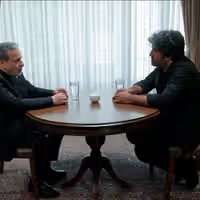
Foreign Minister Abbas Araghchi made the remarks in an interview with Uganda’s BBEG media outlet on the sidelines of the Non-Aligned Movement foreign ministers’ meeting in Kampala.
He said Iran remained committed to strengthening economic partnerships among member states.
“We welcome unity and economic partnerships among Non-Aligned Movement countries to promote effective diplomacy and sustainable development within our group. This solidarity is vital for all our partners,” Araghchi said.
Iran, he added, had significant capacity to share expertise with developing nations in areas such as oil and gas and called for greater South-South cooperation.
The Non-Aligned Movement was founded during the Cold War by states seeking to avoid alignment with either the US or Soviet blocs.
NAM includes around 120 member countries and focuses on issues such as sovereignty, economic development, social justice and mutual cooperation.
Iran became a NAM member in 1961 and has at times held its presidency.
A day earlier, Araghchi had urged member states to reject what he described as “invalid” attempts by the United States and the three European countries known as the E3 — Britain, France and Germany — to reimpose United Nations sanctions on Iran.
He called the move “groundless and illegitimate” speaking during the 19th Ministerial Meeting of the Coordinating Bureau of the Non-Aligned Movement (NAM) in Kampala on Wednesday.
“This stance not only renews our joint dedication to NAM’s core values but also sends a loud and clear message to the world that independent nations, united in solidarity and purposeful resolve, will not bow to bullying or coercive pressures,” he said.
The E3 triggered the reimposition of international sanctions on Iran last month, accusing Tehran of spurning diplomacy and nuclear inspections.
Russia and China sought to block the move at the UN Security Council on September 26 not enough member states supported their bid and the sanctions were reimposed the following day.
Iran has not yet provided reports or set inspection dates for damaged nuclear sites under its Cairo access agreement with the International Atomic Energy Agency, Wall Street Journal correspondent reported on Thursday.
“While Iran has not binned or ended discussions with the IAEA on implementing the Cairo access deal, I understand it still hasn’t issued reports or given dates for issuing reports on damaged sites and stockpile. Nor of course permitted access to damaged sites,” Laurence Norman wrote on X. He said IAEA chief Rafael Grossi “is for now being given more space” but continues to press Tehran to advance on these steps.
The comments come as Iran’s Atomic Energy Organization chief Mohammad Eslami said on Wednesday that “no IAEA inspector is currently in the country.” Eslami said only two visits had been allowed since the June airstrikes on Iranian nuclear facilities — to Bushehr and Tehran reactors — both cleared by the Supreme National Security Council.
The Cairo deal, reached in September between Foreign Minister Abbas Araghchi and Grossi, was meant to restore limited cooperation after the strikes. It outlined “practical modalities” for monitoring declared nuclear sites, but Iranian officials warned the accord could collapse if UN sanctions were reinstated. Western governments triggered the snapback of those sanctions in late September, citing Iran’s failure to meet its obligations.
Eslami said Iran is not considering leaving the Nuclear Non-Proliferation Treaty but faulted the IAEA for failing to condemn the US and Israeli attacks. “The agency should have condemned the attack on Iran’s nuclear sites, but it did not,” he said, adding that Iran’s cooperation is now governed by a new parliamentary law limiting access.
Norman said the IAEA has so far avoided demanding immediate access to a specific site to prevent a direct refusal by Tehran, “risking a crisis.” He added that Iran “could play its old game of offering something ahead of [the] November IAEA board” but warned that without progress, “we could be running into another significant moment in November.”
A Norwegian court has sentenced a former security guard at the US embassy in Oslo to three years and seven months in prison for passing sensitive information to Russian and Iranian intelligence, the court said on Thursday.
The man told investigators he acted to protest US support for Israel’s war in Gaza.
The 28-year-old Norwegian, whose name has not been released, was found guilty of providing floor plans, personal details of embassy staff and their families, and information about activities at the mission between March and November 2024. The court said he received 10,000 euros ($11,700) from Russian intelligence and 0.17 bitcoin from Iranian intelligence in return.
During the trial, the defendant admitted to spying but denied aggravated espionage, saying the material he shared was not classified. He told the court his actions were motivated by opposition to Washington’s support for Israel’s military operations in Gaza.
The verdict comes amid heightened concern in Europe about foreign espionage and influence operations. Britain’s MI5 warned this week that intelligence agencies from China, Russia and Iran are targeting lawmakers to shape policy and collect information.
European authorities have also stepped up investigations into financial and cyber networks linked to Iran. In Germany, media reports said a Berlin businesswoman allegedly helped move Iranian oil revenues through front companies tied to the defense ministry. In Australia, police charged a Sydney man with sending nearly $650,000 to sanctioned Iranian banks.
Western intelligence services say Tehran has expanded its overseas operations in recent years through cyber activity, disinformation campaigns and the recruitment of local agents. Iran denies running espionage networks abroad and says it faces similar accusations meant to isolate it diplomatically.