• العربية
  • فارسی
Brand
  • Iran Insight
  • Politics
  • Economy
  • Analysis
  • Special Report
  • Opinion
  • Podcast
  • Iran Insight
  • Politics
  • Economy
  • Analysis
  • Special Report
  • Opinion
  • Podcast
  • Theme
  • Language
    • العربية
    • فارسی
  • Iran Insight
  • Politics
  • Economy
  • Analysis
  • Special Report
  • Opinion
  • Podcast
All rights reserved for Volant Media UK Limited
volant media logo

Iran has not given IAEA access, reports on nuclear sites - WSJ

Oct 16, 2025, 11:57 GMT+1Updated: 13:42 GMT+1

Iran has not yet provided reports or set inspection dates for damaged nuclear sites under its Cairo access agreement with the International Atomic Energy Agency, Wall Street Journal correspondent reported on Thursday.

“While Iran has not binned or ended discussions with the IAEA on implementing the Cairo access deal, I understand it still hasn’t issued reports or given dates for issuing reports on damaged sites and stockpile. Nor of course permitted access to damaged sites,” Laurence Norman wrote on X. He said IAEA chief Rafael Grossi “is for now being given more space” but continues to press Tehran to advance on these steps.

The comments come as Iran’s Atomic Energy Organization chief Mohammad Eslami said on Wednesday that “no IAEA inspector is currently in the country.” Eslami said only two visits had been allowed since the June airstrikes on Iranian nuclear facilities — to Bushehr and Tehran reactors — both cleared by the Supreme National Security Council.

The Cairo deal, reached in September between Foreign Minister Abbas Araghchi and Grossi, was meant to restore limited cooperation after the strikes. It outlined “practical modalities” for monitoring declared nuclear sites, but Iranian officials warned the accord could collapse if UN sanctions were reinstated. Western governments triggered the snapback of those sanctions in late September, citing Iran’s failure to meet its obligations.

Eslami said Iran is not considering leaving the Nuclear Non-Proliferation Treaty but faulted the IAEA for failing to condemn the US and Israeli attacks. “The agency should have condemned the attack on Iran’s nuclear sites, but it did not,” he said, adding that Iran’s cooperation is now governed by a new parliamentary law limiting access.

Norman said the IAEA has so far avoided demanding immediate access to a specific site to prevent a direct refusal by Tehran, “risking a crisis.” He added that Iran “could play its old game of offering something ahead of [the] November IAEA board” but warned that without progress, “we could be running into another significant moment in November.”

Most Viewed

100 days after carnage: Iran economy reels from war, inflation, unemployment
1
INSIGHT

100 days after carnage: Iran economy reels from war, inflation, unemployment

2
OPINION

The Hormuz get out of jail card turned to a grave

3
EXCLUSIVE

Iranian assaulted in London amid concern over threats to regime critics

4
PODCAST

Too early to tell who is winning Iran war, experts say

5

IRGC fires at Indian vessel in Hormuz

Banner
Banner

Spotlight

  • From instability to influence: Pakistan’s pivotal role in US-Iran diplomacy

    From instability to influence: Pakistan’s pivotal role in US-Iran diplomacy

  • A nation in limbo: 100 days after the massacre, has the world moved on?
    INSIGHT

    A nation in limbo: 100 days after the massacre, has the world moved on?

  • 100 days after carnage: Iran economy reels from war, inflation, unemployment
    INSIGHT

    100 days after carnage: Iran economy reels from war, inflation, unemployment

  • The Hormuz get out of jail card turned to a grave
    OPINION

    The Hormuz get out of jail card turned to a grave

  • How Tehran bends its own red lines to boost state rallies
    INSIGHT

    How Tehran bends its own red lines to boost state rallies

  • Iran blackout cripples freelancer, small business incomes
    VOICES FROM IRAN

    Iran blackout cripples freelancer, small business incomes

•
•
•

More Stories

Norway jails ex-US embassy guard for spying for Iran and Russia

Oct 16, 2025, 11:25 GMT+1

A Norwegian court has sentenced a former security guard at the US embassy in Oslo to three years and seven months in prison for passing sensitive information to Russian and Iranian intelligence, the court said on Thursday.

The man told investigators he acted to protest US support for Israel’s war in Gaza.

The 28-year-old Norwegian, whose name has not been released, was found guilty of providing floor plans, personal details of embassy staff and their families, and information about activities at the mission between March and November 2024. The court said he received 10,000 euros ($11,700) from Russian intelligence and 0.17 bitcoin from Iranian intelligence in return.

During the trial, the defendant admitted to spying but denied aggravated espionage, saying the material he shared was not classified. He told the court his actions were motivated by opposition to Washington’s support for Israel’s military operations in Gaza.

The verdict comes amid heightened concern in Europe about foreign espionage and influence operations. Britain’s MI5 warned this week that intelligence agencies from China, Russia and Iran are targeting lawmakers to shape policy and collect information.

European authorities have also stepped up investigations into financial and cyber networks linked to Iran. In Germany, media reports said a Berlin businesswoman allegedly helped move Iranian oil revenues through front companies tied to the defense ministry. In Australia, police charged a Sydney man with sending nearly $650,000 to sanctioned Iranian banks.

Western intelligence services say Tehran has expanded its overseas operations in recent years through cyber activity, disinformation campaigns and the recruitment of local agents. Iran denies running espionage networks abroad and says it faces similar accusations meant to isolate it diplomatically.

Iran summons Polish diplomat over London drone display

Oct 16, 2025, 09:34 GMT+1

Iran summoned Poland’s Chargé d’Affaires in Tehran on Thursday to protest Polish Foreign Minister Radoslaw Sikorski's participation in an event in the British Parliament that displayed a downed Iranian-made drone allegedly used by Russia in its war on Ukraine.

The exhibition, organized by the US-based advocacy group United Against Nuclear Iran (UANI), featured a Shahed-136 drone recovered in Ukraine and was intended, according to the group, to highlight Tehran’s role in aiding Moscow’s military campaign. Sikorski attended the event during a visit to London for meetings with British officials.

Earlier that day, Sikorski told reporters that a recent Russian drone incursion into Polish airspace was “tactically stupid and counterproductive,” saying it had only strengthened Western resolve against Moscow. The Polish minister said the drones appeared to have been launched deliberately from Russia and coordinated with Belarus.

Mahmoud Heidari, the Foreign Ministry’s director general for Mediterranean and Eastern European affairs, summoned Polish Chargé d’Affaires Marcin Wilczek and conveyed what he called Tehran’s “strong protest” over the London event. Heidari rejected what he described as “baseless and repetitive accusations” about Iran’s drone program and expressed regret over Sikorski’s involvement.

Iran’s Foreign Ministry said the move to exhibit the drone violated diplomatic norms and repeated politically motivated allegations about Iran’s role in the Ukraine conflict.

Iran denies supplying drones for use in the war, saying it sold a limited number to Russia before the invasion began. Western governments and Ukraine say Shahed-type drones, designed in Iran and now produced in Russia under the name Geran, have become central to Moscow’s air assaults. The Financial Times reported in July that the modified drones have tripled their success rate in hitting targets.

Polish officials have not publicly commented on the summons, but Warsaw has cooperated with UANI and Ukrainian forces in transferring a similar drone to the United States earlier this year for display at a political conference attended by US President Donald Trump.

Pezeshkian blames Iran’s woes on mismanagement, not US pressure

Oct 16, 2025, 09:12 GMT+1

Iran’s economic and social difficulties stem from mismanagement by its own officials rather than from US pressure, President Masoud Pezeshkian said on Thursday.

“We are lying on wealth yet remain poor because of ourselves — the managers, officials, politicians and lawmakers — not America,” Pezeshkian said at a meeting of education managers in the central city of Isfahan. He urged local authorities to depend on people’s capacities instead of waiting for the state to act. “If you rely on the government, nothing will change in fifty years. But if you trust the people, you can achieve anything,” he said.

Pezeshkian said the growing desire among young Iranians to emigrate was troubling and reflected a loss of faith in the country’s future. “Why should our children think about leaving?” he asked. “Going abroad to study and learn is not bad, but believing that they must go and never return is a disaster,” he said. The president urged young people to gain knowledge overseas and bring it back to serve their homeland.

Warning over internal conflict

Iran’s main threat comes from domestic divisions rather than from the United States or Israel, Pezeshkian said. “I am not afraid of America or Israel. I fear our own disputes,” he said. “If we fight each other, we do not need enemies. We destroy ourselves.”

Pezeshkian voiced similar concerns on Wednesday, saying at a cabinet meeting that political infighting was a greater danger than foreign hostility, the state news agency IRNA reported. “I have no serious concern about plots by the United States or others, because their hostility is obvious,” he said. “But I am deeply worried about false divisions and efforts to blacken everything inside the country.”

Hardline lawmakers have opened impeachment moves against four of his cabinet ministers this month in what critics say is an attempt to paralyze his government. Pezeshkian, a relative moderate, has urged cooperation to restore public trust and ease growing hardship under renewed sanctions.

Trump wants to bend world to his will, Khamenei advisor says

Oct 16, 2025, 01:30 GMT+1

A senior advisor to Iran’s Supreme Leader said on Wednesday that US President Donald Trump seeks to force the world to carry out his bidding but that Iran hopes a Gaza truce will hold.

“Trump is operating in a new paradigm and wants to unilaterally impose his power on the world,” Kamal Kharrazi said in an interview with Khamenei official website, adding Israel acts under green light of the United States. 

Kharrazi is veteran theocrat Khamenei's top foreign policy advisors and heads the Strategic Council on Foreign Relations. Members of the body are handpicked by Khamenei and its reports and advisories have often presaged major policy shifts by the ruling system.

His remarks carried on the official website of Iran's top decision-maker appear to represent one of the closest approximation of the Supreme Leader's view on the recent Gaza truce and Trump's role since it was clinched over the weekend.

“While we must not shy away from negotiations and should remain at the table, we must also ensure that nothing is imposed on us, and if they try, we must stand firm,” he added.

Kamal Kharrazi, former Iran's foreign minister and current Iran's supreme leader foreign policy advisor
100%
Kamal Kharrazi, former Iran's foreign minister and current Iran's supreme leader foreign policy advisor

'Missile are no up for negotiations'

“The issue of missiles and the issue of resistance are not issues that Iran wants to negotiate on,” Kharrazi added.

Members of the body he leads are by handpicked by Khamenei and its reports and advisories have often presaged major policy shifts by the ruling system.

A senior Iranian lawmaker said last week that Supreme Leader Ali Khamenei has lifted all limits on the range of Iran’s missiles, previously capped at 2,200 kilometers (about 1,367 miles), signaling a potential major shift in Tehran’s defense posture following the punishing June war.

The stance was echoed by other Iranian officials, who emphasized that there would be no negotiations over the missile program’s range.

“Americans will take the wish of reducing Iran’s missile range to below 500 kilometers to the grave,” Armed Forces Judiciary chief Ahmadreza Pourkhaghan said during a meeting with Revolutionary Guard Aerospace Force commanders, according to state media on October 7.

Kharrazi also warned that Israel seeks to dominate beyond its borders and that Iran must always be prepared.

“We must be vigilant against Israel’s future plans for the region and even the world. Though they are a small minority, they seek to dominate the region and the world by relying on great powers; hence, we must prepare for resistance starting today,” Kharrazi said.

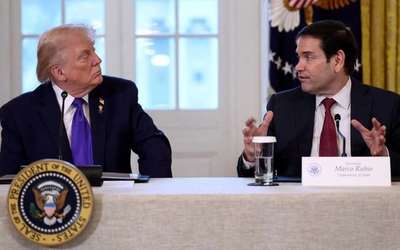
Trump says Iran focused on survival, not rebuilding nuclear program

Oct 15, 2025, 21:45 GMT+1

President Donald Trump on Wednesday said Tehran is too focused on survival to rebuild its nuclear capabilities after US attacks in June, adding that the United States would attack again if Iran attempts to do so.

"Today, Iran is trying to survive. When I heard the reports two weeks ago, Iran is looking to build a nuclear weapon. I said, don't worry about it," Trump told reporters in the White House.

"I said the last thing they want to do is a nuclear weapon. It didn't work out. And if they did a nuclear weapon, before they got even close, that site would be attacked and it would be wiped out."

Trump earlier this year gave Iran a 60-day ultimatum to reach a nuclear deal, demanding it end all domestic uranium enrichment. Tehran denies seeking a weapon and sees enrichment as a right.

On June 13, the 61st day since US-Iran talks began, Israel launched a surprise military campaign which killed nuclear scientists along with hundreds of military personnel and civilians.

On June 22, the United States joined the fighting with strikes by B-2 bombers and submarine-launched missiles on three Iranian nuclear sites which US President Donald Trump has repeatedly said "obliterated" the country's nuclear program.

'Shot down 1000s of drones'

Trump appeared to acknowledge new details of US military efforts to repel Iranian counterattacks during the conflict.

"We were shooting them down like it was target practice, but we shot down thousands of drones and missiles," he said.

Trump on Monday clinched the release of 20 Israeli hostages in exchange for hundreds of Palestinian political prisoners in a complex international deal he said will bring the devastating two-year-old war in Gaza to a close.

His decision to attack Iran facilitated the breakthrough, he said.

"If we weren't involved, there wouldn't be peace," Trump continued. "If we didn't destroy the nuclear capability of Iran, that deal would have never happened for two reasons: the Arab nations would not have felt bold enough to do it, because you have a very powerful, at that time, Iran - it's not powerful anymore.

Russian President Vladimir Putin, Trump alleged, described the air attack on Iran as a success in private remarks at the two leader's summit in Alaska over the summer.

"(The B-2) is unbelievable as a weapon. I know Putin - when I was riding with him in Alaska, we passed a lot of them, and he said, 'that really did the trick.' I said, 'Yeah, it's amazing."