Trump wants to bend world to his will, Khamenei advisor says

A senior advisor to Iran’s Supreme Leader said on Wednesday that US President Donald Trump seeks to force the world to carry out his bidding but that Iran hopes a Gaza truce will hold.

A senior advisor to Iran’s Supreme Leader said on Wednesday that US President Donald Trump seeks to force the world to carry out his bidding but that Iran hopes a Gaza truce will hold.
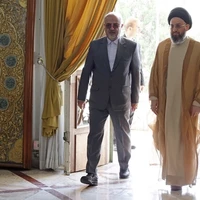
“Trump is operating in a new paradigm and wants to unilaterally impose his power on the world,” Kamal Kharrazi said in an interview with Khamenei official website, adding Israel acts under green light of the United States.
Kharrazi is veteran theocrat Khamenei's top foreign policy advisors and heads the Strategic Council on Foreign Relations. Members of the body are handpicked by Khamenei and its reports and advisories have often presaged major policy shifts by the ruling system.
His remarks carried on the official website of Iran's top decision-maker appear to represent one of the closest approximation of the Supreme Leader's view on the recent Gaza truce and Trump's role since it was clinched over the weekend.
“While we must not shy away from negotiations and should remain at the table, we must also ensure that nothing is imposed on us, and if they try, we must stand firm,” he added.

'Missile are no up for negotiations'
“The issue of missiles and the issue of resistance are not issues that Iran wants to negotiate on,” Kharrazi added.
Members of the body he leads are by handpicked by Khamenei and its reports and advisories have often presaged major policy shifts by the ruling system.
A senior Iranian lawmaker said last week that Supreme Leader Ali Khamenei has lifted all limits on the range of Iran’s missiles, previously capped at 2,200 kilometers (about 1,367 miles), signaling a potential major shift in Tehran’s defense posture following the punishing June war.
The stance was echoed by other Iranian officials, who emphasized that there would be no negotiations over the missile program’s range.
“Americans will take the wish of reducing Iran’s missile range to below 500 kilometers to the grave,” Armed Forces Judiciary chief Ahmadreza Pourkhaghan said during a meeting with Revolutionary Guard Aerospace Force commanders, according to state media on October 7.
Kharrazi also warned that Israel seeks to dominate beyond its borders and that Iran must always be prepared.
“We must be vigilant against Israel’s future plans for the region and even the world. Though they are a small minority, they seek to dominate the region and the world by relying on great powers; hence, we must prepare for resistance starting today,” Kharrazi said.


President Donald Trump on Wednesday said Tehran is too focused on survival to rebuild its nuclear capabilities after US attacks in June, adding that the United States would attack again if Iran attempts to do so.
"Today, Iran is trying to survive. When I heard the reports two weeks ago, Iran is looking to build a nuclear weapon. I said, don't worry about it," Trump told reporters in the White House.
"I said the last thing they want to do is a nuclear weapon. It didn't work out. And if they did a nuclear weapon, before they got even close, that site would be attacked and it would be wiped out."
Trump earlier this year gave Iran a 60-day ultimatum to reach a nuclear deal, demanding it end all domestic uranium enrichment. Tehran denies seeking a weapon and sees enrichment as a right.
On June 13, the 61st day since US-Iran talks began, Israel launched a surprise military campaign which killed nuclear scientists along with hundreds of military personnel and civilians.
On June 22, the United States joined the fighting with strikes by B-2 bombers and submarine-launched missiles on three Iranian nuclear sites which US President Donald Trump has repeatedly said "obliterated" the country's nuclear program.
'Shot down 1000s of drones'
Trump appeared to acknowledge new details of US military efforts to repel Iranian counterattacks during the conflict.
"We were shooting them down like it was target practice, but we shot down thousands of drones and missiles," he said.
Trump on Monday clinched the release of 20 Israeli hostages in exchange for hundreds of Palestinian political prisoners in a complex international deal he said will bring the devastating two-year-old war in Gaza to a close.
His decision to attack Iran facilitated the breakthrough, he said.
"If we weren't involved, there wouldn't be peace," Trump continued. "If we didn't destroy the nuclear capability of Iran, that deal would have never happened for two reasons: the Arab nations would not have felt bold enough to do it, because you have a very powerful, at that time, Iran - it's not powerful anymore.
Russian President Vladimir Putin, Trump alleged, described the air attack on Iran as a success in private remarks at the two leader's summit in Alaska over the summer.
"(The B-2) is unbelievable as a weapon. I know Putin - when I was riding with him in Alaska, we passed a lot of them, and he said, 'that really did the trick.' I said, 'Yeah, it's amazing."

A member of Iran’s parliament said on Wednesday that the Islamic Revolutionary Guard Corps (IRGC) opposed a 2015 nuclear deal but ultimately complied after Supreme Leader Ali Khamenei urged support for Tehran's negotiators.
Nezamoddin Mousavi, former head of the IRGC's Fars News agency, told another Guards-linked outlet Tasnim News that the military organization was never satisfied with the deal, and that Supreme Leader Ali Khamenei never trusted the United States but insisted on supporting Iran’s negotiators.
"The Leader had a clear framework regarding the negotiations," Mousavi said. "He was not hopeful about them and viewed the United States as untrustworthy. But at the same time, he believed the negotiators should be treated with respect."
"The IRGC shared this view, and I understood that we should maintain respect for (foreign minister) Zarif and ensure a unified voice was heard from us, so it wouldn’t appear that there were two centers of authority in the country.” he added.
The remarks give rare insight into the policy outlook of the sprawling military group that is central to Tehran's domestic security and military stance abroad.
They appear to expose new details on the decision-making behind the doomed 2015 international nuclear deal that has become especially irksome to Iran's leadership after a provision paved the way for UN sanctions to be reimposed last month.
Hardliners in Iran have long criticized former Foreign Minister Mohammad Javad Zarif for accepting the Joint Comprehensive Plan of Action’s (JCPOA) snapback mechanism, viewing it as a concession that ultimately enabled the reimposition of sanctions on September 28.
The snapback mechanism allows any participant including the five permanent members of the UN Security Council plus Germany to reimpose UN sanctions on Iran in the event of alleged violations, without the possibility of a veto.
Russian Foreign Minister Sergei Lavrov said on Monday he was surprised by Iran’s agreement to the snapback condition, calling it a “legal trap.”
“To be honest, we were surprised. But if our Iranian partners accepted this formulation—which, frankly, was a legal trap—we had no grounds to object,” Lavrov said.

‘With the Supreme Leader'
Mousavi, who as head of Revolutionary Guards-linked Fars News agency attended government and IRGC meetings on the Iran deal, said the Guards never promised to restrict their activities beyond the deal’s commitments.
He added that the Iranian government at the time was unhappy with the Guards’ missile tests and military exercises, causing internal disputes.
“We must respect the ruling bodies, and the IRGC is part of the establishment. The IRGC does not follow an expert’s command; it aligns with the Supreme Leader,” Mousavi said.
“If officials sign agreements beyond Iran’s commitments, the IRGC won’t accept them, but this does not imply belief in dual governance. After Americans failed to uphold their commitments, these revolutionary bodies demanded accountability.”
“Our clear and fundamental criticisms of the JCPOA are evident and have been published in media like Fars News Agency and Tasnim. Other sessions were held for finalization - not necessarily involving Mr. Zarif or government officials - and I saw no one convinced by the process or willing to justify it,” Mousavi added.
The United States withdrew from the Iran nuclear deal in 2018 under the first Trump administration. In response, Iran gradually reduced its compliance with the JCPOA and began enriching uranium at higher levels in 2019.
In June, Israel launched a surprise military offensive targeting Iran’s military and nuclear facilities, including assassinations of top officials. Iran retaliated with waves of drone and ballistic missile strikes.
The United States entered the conflict on June 22 with strikes on key nuclear sites in Natanz, Fordow and Isfahan, but brokered a ceasefire between Iran and Israel after 12 days of fighting on June 24.
Following the attacks, Iran halted cooperation with the International Atomic Energy Agency (IAEA) and the diplomatic impasse over Iran's nuclear activities continues.

A senior cleric close to Iran’s Supreme Leader on Tuesday unveiled a state-published book outlining what it calls Tehran’s plan to destroy Israel.
The book, titled “Israel Annihilation Plan: The Islamic Republic's Strategy for the Destruction of the Zionist Regime,” was presented at an event in Iran's holy city of Qom.
The presentation suggested that despite a Gaza ceasefire which could tamp down region-wide conflicts over the past two years, Tehran was far from retiring its hostility and harsh rhetoric toward its regional arch-enemy.
Alireza Panahian, a cleric close to supreme leader Ali Khamenei, praised the authors during the unveiling ceremony, calling the book a valuable step in elaborating on the views of Khamenei and his predecessor Ruhollah Khomeini.

'Khamenei a hero'
Since the 1979 Islamic Revolution led by Khomeini, Iran has made opposition to Israel a core feature of its state ideology.
Under its founding leader, Israel was denounced as a “Zionist regime” lacking legitimacy, and it was cast as a symbol of Western imperialism in the Muslim world that must be annihilated.
Over time, this rhetoric has been echoed and expanded by his successor Khamenei, who has repeatedly called Israel a “cancerous tumor” and forecast its eventual demise.
In the ceremony held at Qom's Shrine of Hazrat Fatima Masoumeh, Panahian said “in the aftermath of the 12-day war (with Israel in June), the Supreme Leader’s name is recognized worldwide as that of a hero who stood up against the global order of domination."
Israel launched a surprise military offensive in June, striking Iran’s military and nuclear facilities as well as targeting top officials. Iran retaliated with salvos of drones and ballistic missiles.

'Israel's Irreparable defeat'
Author Ali-Asghar Mohammadi-Rad told attendees the book delved into "the theoretical and strategic foundations of Iran's plan to end the life of this regime, as well as an analysis of Israel's irreparable defeats in the recent battle."
"In the final chapter of the book, the connection between the recent 12-day war and the Islamic Republic of Iran's grand strategy of collapsing the Zionist regime is explained, and it is shown that this battle is part of the process of realizing that same strategic plan," he added, according to Tasnim news agency.
The book's back-cover blurb praises the October 7, 2023, attack by Tehran-backed Hamas militants as "a wake-up call for Iran and the entire world."
"The global public—poisoned by the stench of lies and worldliness spread by their rulers—needed to hear the cry of Palestine’s oppression, and the fabricated oppression of (Jewish people in) the Holocaust should sound for them as a bell of disgrace and a cry for freedom," it said.


The Gaza summit in Egypt and Iran's refusal to take part have ignited fierce debate in Tehran over diplomacy and regional strategy as US president Donald Trump moves to reshape the Middle East.
While hardline media aligned with the establishment condemned the summit outright, reformist and moderate voices turned their criticism inward, questioning the government’s decision to boycott the meeting and the reasoning behind it.
Hardline daily Jam-e Jam, run by state broadcaster IRIB, headlined its front page “The Shameful Summit.”
The gathering, the daily wrote, was not a symbol of peace, but "a stage for diplomacy wearing a mask of empathy — while the same actors keep the fires of war burning.”
'Resistance miracle'
Javan, linked to the Revolutionary Guards (IRGC), was more bullish.
“Does anyone in the West truly believe they ‘won the war’ and can dictate postwar conditions?” the daily asked in an editorial. “The new order favors the Resistance Front and the Islamic Republic, to the detriment of Israel and Saudi Arabia.”
The ultra-conservative Kayhan, funded by the Supreme Leader’s office, had the answer to Javan’s rhetorical question.
“The Zionist regime failed to achieve any of its military goals and had to negotiate with Hamas,” Kayhan wrote under the front-page headline “The Miracle of Resistance.”
Hamshahri, run by Tehran’s municipality, backed Iran’s decision to decline Egypt’s invitation, calling it “an effort to rescue Netanyahu from the Gaza quagmire through negotiation with Hamas.”
Hardline commentator Mohammad Nadimi issued a harsh warning.
“Sharm el-Sheikh is the completion of the Arab-Israeli-American alliance for a new Middle East. Join it, and we give up the islands, missiles, enrichment and drones; refuse, and we must prepare for war to restore balance,” he posted on X.
‘Peace hanging in balance’
Tehran moderates offered a more restrained response — with the reformist daily Shargh splashing “Peace on a Razor’s Edge” on its Tuesday front page.
“Whether Iran views this ceasefire as an opportunity to consolidate influence or a temporary setback depends on Washington’s policy toward Tehran and its regional competition with Riyadh,” the paper’s editorial read.
Former presidential aide Mohammad Ali Abtahi highlighted the human loss in Gaza.
“Two years ago neither Hamas imagined accepting peace after 65,000 martyrs and Gaza’s destruction, nor Israel thought it would end up signing a peace deal with the group it calls terrorist,” he wrote on X.
Former ambassador Nosratollah Tajik questioned the efficacy of the summit.
“Trump’s speech at Sharm el-Sheikh, with no mention of the Palestinian people, shows he does not intend to address the roots of the conflict. Without a Palestinian state and refugee settlement, this is just another painkiller, not a cure.”
Isolation or Strength?
The government-run Iran daily defended the decision to skip the summit, calling it a “Trump spectacle” to compensate for not winning a Nobel Peace Prize.
Tehran’s refusal to be part of the show, the paper said, underscored its “independent role amid geopolitical rivalries and chronic mistrust.”
But the reformist Ham Mihan rebuked that logic.
“If that is the case, why did you seek meetings with them (the Americans) at the United Nations?” it asked in its Tuesday editorial. “Such reasoning may appear principled but isolates the country further and defines Iran as outside the existing world order.”
Political analyst Majid Younesian, writing in the same paper, urged realism.
“Declining Egypt’s invitation is neither a waste of diplomatic opportunity nor a trap. The truth is that Iran’s state apparatus is still not ready to alter its approach toward engagement with the West,” he wrote.

Iran is not considering leaving the Nuclear Non-Proliferation Treaty but faults the International Atomic Energy Agency for failing to condemn US and Israeli airstrikes on its nuclear facilities, Atomic Energy Organization chief Mohammad Eslami said on Wednesday.
Eslami said any decision on withdrawal “would have to be made by the relevant authorities,” adding that “the overall conclusion is that leaving the NPT is not on the agenda.” He said the IAEA “should have condemned the attack on Iran’s nuclear sites, but it did not,” and criticized the agency for not ensuring the protection of sensitive nuclear data.
“The agency has issued no declaration to guarantee the safeguarding of information related to our nuclear industry,” Eslami said. He added that Iran’s cooperation with the agency is now governed by a parliamentary law passed after the June strikes, which requires the IAEA to act within that framework.
Limited inspections, no IAEA staff in Iran
Eslami said inspectors have visited Iran only twice since the attacks, both times with clearance from the Supreme National Security Council, to the Bushehr and Tehran reactor sites. “No IAEA inspector is currently in the country,” he said.
The comments come after Iran and the IAEA reached a cooperation agreement in Cairo in September to resume inspections suspended following the June airstrikes. The deal, negotiated between Foreign Minister Abbas Araghchi and IAEA Director General Rafael Grossi, outlined “practical modalities” for monitoring Iran’s declared sites under what Tehran called “postwar conditions.” Both sides described it as a step in the right direction, but Iranian officials warned the accord could collapse if UN sanctions were reinstated.
Tensions over snapback sanctions and oversight
Western governments triggered the reimposition of UN sanctions on Iran in late September, saying Tehran had failed to meet its obligations. Araghchi later said the fate of the Cairo accord rested with Iran’s Supreme National Security Council, while hardline lawmakers renewed calls to end cooperation with the agency altogether.
Last month, Eslami told Japan’s Kyodo News that Iran faced “wartime conditions” after the US and Israeli strikes and that inspections would not fully resume without new guarantees to protect its facilities and data. IAEA chief Grossi said later that Iran remains bound by its treaty obligations even if sanctions are restored, stressing that cooperation “must be permanent.”