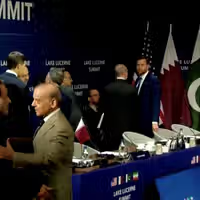
The Wall Street Journal reported that a senior Arab government official close to the Trump administration has urged Washington to avoid further military confrontation with Iran, warning that renewed conflict with Israel could destabilize the region and that de-escalation should be the priority.
“The region today cannot go through the same Iranian-Israeli war or the other wars of the last two years. The cost is too high,” the official said, adding that he is advising US counterparts that de-escalation is the only alternative.
He said Iran’s weakened state is a reason for caution and argued that fresh strikes risk triggering instability reminiscent of post-Saddam Iraq.
“Diplomacy has to be the way forward,” the official said, according to the WSJ.
An Iranian cleric representing Supreme Leader Ali Khamenei in the Revolutionary Guards escalated rhetoric against Israel, likening it to a cancer to be removed and saying such an outcome would undermine US claims of global leadership.
Abdollah Hajj Sadeghi criticized US President Donald Trump, accusing Washington of backing Israeli action and misrepresenting June’s 12-day conflict between Iran and Israel.
He said Iran would answer any future Israeli move with a unified response both diplomatically and in the battlefield, and argued opponents had misread Iranian society after years of economic pressure.

Russia said on Thursday the restoration of UN snapback sanctions on Iran was illegal and deepened the crisis over Tehran’s nuclear program, accusing Britain, France and Germany of manipulation.
Foreign ministry spokesperson Maria Zakharova told a news briefing, "Accordingly, the results... are legally null and void and cannot impose any legal obligations on other states," echoing the argument expressed by Tehran.
Moscow, which says it supports Iran’s right to peaceful nuclear energy, also condemned US and Israeli strikes on Iranian nuclear sites in June.
European capitals are keeping diplomacy with Iran on the table even after the reimposition of UN snapback sanctions, the Wall Street Journal reported.
A European official told the Journal reimposing UN snapback sanctions on Iran was not the bloc’s preferred option and that “the diplomatic door is still open.”
“We don’t believe in a military solution to the proliferation crisis,” the official said.
The report said US allies fear fresh Israeli strikes even as Washington argues renewed pressure will force talks.
The Israeli and US strikes on Iran’s nuclear facilities in June were “a major gamble” that disrupted a dangerous status quo but left unanswered questions about whether Tehran might now seek a bomb, according to an analysis published in the journal Survival: Global Politics and Strategy.
Michael Eisenstadt, a senior fellow at the Washington Institute for Near East Policy, wrote that while it is unclear how much damage was inflicted, the attacks upended Iran’s steady accumulation of highly enriched uranium and expansion of its missile program.
He said the strikes could “strengthen the hand of nuclear-weapons advocates in Iran” but also make continued hedging -- keeping a weapons option without building one -- more attractive, given Tehran’s vulnerability to sabotage and airstrikes.
“Iran may take its time, as long as it believes rebuilding is likely to prompt another Israeli or American military response,” Eisenstadt wrote, adding that its programremains penetrated by Israeli intelligence.
He warned that Tehran might still attempt a clandestine effort in hardened sites or seek external supplies, though “such a path would be fraught with risks.”
Eisenstadt said many in Tehran may still argue for restraint, given economic pressures and lost air defenses.
Although the strikes were a gamble, Eisenstadt concluded they halted steps that might have enabled Iran to quickly break out. “The key question,” he wrote, “is whether the United States and Israel can translate recent military gains into sustainable political achievements by stabilizing Syria, constraining Hezbollah and concluding a broader and better nuclear deal with Iran.”
A senior commander of Iran’s Revolutionary Guards said the country’s offensive power has increased tenfold since the 12-day war with Israel earlier this year, state media reported on Thursday.
Hossein Nejat, deputy commander of the IRGC’s Sarallah Headquarters, told Fars news agency that “if Israel makes the same mistake again, our offensive capability is now 10 times greater than at the start of the 12-day war.”
Nejat added that the improvements extended beyond weapons systems to updated operational plans and structured exercises, which he said would allow Iran to deliver stronger blows to “sensitive centers of the Zionist regime” if conflict resumes.