A senior commander of Iran’s Revolutionary Guards said the country’s offensive power has increased tenfold since the 12-day war with Israel earlier this year, state media reported on Thursday.
Hossein Nejat, deputy commander of the IRGC’s Sarallah Headquarters, told Fars news agency that “if Israel makes the same mistake again, our offensive capability is now 10 times greater than at the start of the 12-day war.”
Nejat added that the improvements extended beyond weapons systems to updated operational plans and structured exercises, which he said would allow Iran to deliver stronger blows to “sensitive centers of the Zionist regime” if conflict resumes.


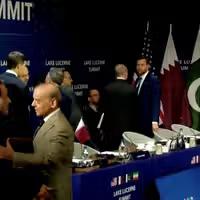
Iran is adopting a policy of “strategic patience” in response to mounting Western pressure, the government's news agency IRNA said on Thursday, after Foreign Minister Abbas Araghchi returned from talks in New York.
Araghchi told CNN this week that negotiations with Washington under the current conditions amounted to “a total deadlock,” citing what Tehran calls repeated breaches of commitments by the United States.
He said UN sanctions reimposed under the snapback mechanism had made diplomacy more complicated and difficult.
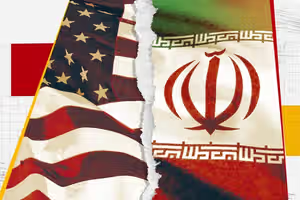
The IRNA analysis said Iran and the United States, since Donald Trump’s return to the White House in January, had moved between dialogue and confrontation.
Initial indirect talks mediated through Oman and Qatar saw US envoy Steve Witkoff float limited enrichment proposals, but Washington later demanded zero enrichment and the handover of enriched uranium stockpiles.
Iran has strongly rejected US demands, a stance underscored by Supreme Leader Ali Khamenei in a televised address just before President Masoud Pezeshkian’s speech to the UN General Assembly.
Echoing that line, Ali Larijani, secretary of Iran’s Supreme National Security Council, said on Thursday that Western powers were not seeking genuine negotiations but aimed to exploit economic and security pressure. “Western governments see economic pressure as a tool to trigger unrest and weaken Iran,” he said.
Pezeshkian also rejected those terms, saying: “Why should we give them our enriched uranium? For what reason? If there is to be dialogue, it must be about the whole issue. Otherwise this is not negotiation; this is surrender.”
Government spokesperson Fatemeh Mohajerani said on Wednesday that, according to Araghchi, Iran had expressed readiness in New York to hold a meeting with the three European countries, the International Atomic Energy Agency and US envoy Steve Witkoff, but the proposal was either rejected or the counterparts failed to attend.
Mistrust deepens after June conflict
IRNA said Tehran views US demands as unilateral impositions and believes the American approach has aligned with Israel’s military campaign against Iran earlier this year.
The agency added that Israel’s 12-day conflict with Iran in June, joined briefly by US forces, was seen in Tehran as “a shot at diplomacy” that reinforced mistrust.
Citing Iranian officials, IRNA said Washington most recently offered to delay snapback sanctions by three, then nine, and finally 12 months in return for a halt to enrichment and the transfer of uranium stocks.
Tehran rejected the plan, with Pezeshkian calling it “excessive and coercive.”


Tehran mulling over response
The analysis said Iran’s immediate response is likely to be guided by the Supreme National Security Council, with possible measures including suspending the “Cairo Agreement” with the International Atomic Energy Agency.
While exit from the Nuclear Non-Proliferation Treaty was described as unlikely, IRNA said Iran would continue to rely on “resistance economics,” closer ties with non-Western partners such as China and Russia, and selective diplomacy.
The government is scheduled to approve a response plan to the UN snapback sanctions on Sunday, Mohajerani said on Wednesday, adding the strategy assigns ministries tasks to ease public pressure.
“Tehran currently sees the solution in adopting strategic patience until the West changes course or the playing field shifts,” the agency wrote. It added that success would depend on domestic economic reforms, unity at home, and stronger backing from non-Western allies.
The West is not pursuing real negotiations with Tehran but instead seeks to exploit economic and security pressure, the secretary of Iran’s Supreme National Security Council said on Thursday.
“It seems the United States, Israel and Western states largely believe they have limited time to reshape regional geopolitics, and they recognize the resistance front as a significant force,” Ali Larijani said.
Western governments, he added, see economic pressure on Iran as a potential trigger for social unrest that could make it easier to settle accounts with the country.

Iran requires uranium enriched to 60% and above, as well as plutonium enriched to 90%, the spokesman of parliament’s National Security and Foreign Policy Committee said Thursday.
“For sub-surface fuel, we need uranium enriched to 60% and beyond,” Ebrahim Rezaei said.
“We also need plutonium enriched to 90%, but our requirement is not for military purposes or weapon-building,” Rezaei

added.
The Islamic Republic is adopting a policy of “strategic patience” in response to the reimposition of United Nations sanctions, Iran’s official IRNA news agency said on Thursday.
“Tehran sees the path forward in waiting for either a change in Western approaches or shifts in the political landscape,” IRNA wrote.
The agency cautioned that the risks are considerable, citing Israeli pressure and US efforts to bolster Tel Aviv.
Authorities in Tehran, according to the outlet, also view engagement with what it described as the US president’s maximalist demands as both endless and ineffective in advancing national interests.


An attorney representing two Iranian nationals alleged on Wednesday that US authorities deported his clients to Iran without due process, placing them at risk of persecution, ABC News reported.
Ali Herischi, who represents several Iranians seeking asylum in the United States, told ABC News that two of his clients “disappeared” from the Immigration and Customs Enforcement (ICE) detainee locator system this week and were then deported to Iran.
He said one of them is a Christian convert who had arrived at the southern border earlier this year with his pregnant wife.
“We tried multiple times to ask for his appeal,” Herischi said. “And suddenly, without any information, we realized that he disappeared from [the ICE] detainee locator and then the news broke that Iranians had been deported back to Iran.”
Herischi said his client’s wife, who recently gave birth and remains in the United States, was able to briefly speak with her husband after his deportation. According to Herischi, the man told her that he was “shackled and handcuffed all the way to Iran.”
The attorney called the deportations “unconscionable,” adding, “It was so wrong, and unfortunately these are the same people that … US foreign policy tries to protect. These are those who stand up against the regime, who pay a price for standing up against the regime, and then you give them back directly to the hand of evil.”
ABC News reported that Herischi represents 25 people who are worried about being deported to Iran.
Earlier this week, Iranian state media quoted an official as saying about 120 Iranian nationals detained in the US would be returned in the coming days.
The New York Times reported on Tuesday that a chartered US flight carrying more than 100 Iranians departed Louisiana and was scheduled to arrive in Tehran via Qatar.
Iranian officials confirmed that 120 citizens are being repatriated, some voluntarily, while others had asylum claims denied.
For decades, the US has provided refuge to Iranians fleeing political or religious persecution. Human rights advocates warn that returnees -- including converts to Christianity, dissidents and activists -- could face serious risks on arrival in Iran.