• العربية
  • فارسی
Brand
  • Iran Insight
  • Politics
  • Economy
  • Analysis
  • Special Report
  • Opinion
  • Podcast
  • Live TV
  • Iran Insight
  • Politics
  • Economy
  • Analysis
  • Special Report
  • Opinion
  • Podcast
  • Live TV
  • Theme
  • Language
    • العربية
    • فارسی
  • Iran Insight
  • Politics
  • Economy
  • Analysis
  • Special Report
  • Opinion
  • Podcast
  • Live TV
All rights reserved for Volant Media UK Limited
volant media logo

Iran's rial dips to 1.18 million per dollar following UN sanctions snapback

Oct 2, 2025, 13:46 GMT+1
The American flag and other flags are displayed on a sign at a currency exchange in Tehran, Iran, September 27, 2025.

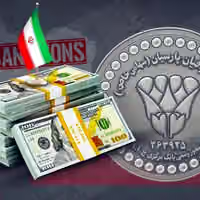
Iran’s rial weakened on Thursday to about 1,180,000 per US dollar on Tehran’s unofficial market, roughly a week after the United Nations reimposed snapback sanctions, as President Masoud Pezeshkian urged cost-cutting and efficiency to shield households.

Traders also quoted the euro around 1,386,500 rials and the pound at about 1,591,200.

The UN measures, restored over Iran’s nuclear program, have added pressure to an economy already struggling with high inflation and repeated supply strains. Iran denies seeking nuclear weapons.

Visiting Bandar Abbas on Thursday, Pezeshkian said savings and better management could soften the blow.

“We can organize livelihoods, living conditions and housing by saving 10% in costs, which is equivalent to $16–18 billion a year,” he said.

“They say with snapback, they will sanction you, while we have sanctioned ourselves,” he added, arguing that curbing waste and relying less on oil and gas would blunt external pressure.

“They scare us with snapback because we tied our life to oil and gas,” he said. “I think of a day when we have neither oil nor gas. Should we die?”

The president called for practical conservation across government. He said employees and managers could work in smaller offices and avoid unnecessary energy use, recalling that at the United Nations “the corridor was partitioned and managers worked there in 2-by-3 rooms, next to the Secretary-General’s office. In Iran, everyone has a room, and the secretary has a room. You can avoid keeping all the lights on.”

Most Viewed

Ghalibaf's hunger warning sparks hardline backlash over showing weakness
1
INSIGHT

Ghalibaf's hunger warning sparks hardline backlash over showing weakness

2
INSIGHT

Iran's central bank says it is not hyperinflation. Economists are not convinced

3

Iran leaders sound economic alarms under Trump’s Economic D-Day

4
ANALYSIS

Houthis more effective Iran ally than Hezbollah, Yemen expert says

5

Trans woman prisoner says she was raped in Iran Intelligence Ministry detention

Banner
Banner

Spotlight

  • Ghalibaf's hunger warning sparks hardline backlash over showing weakness
    INSIGHT

    Ghalibaf's hunger warning sparks hardline backlash over showing weakness

  • Iran crude loadings plunge to one-seventh of pre-war level as blockade bites
    ANALYSIS

    Iran crude loadings plunge to one-seventh of pre-war level as blockade bites

  • Turkey’s gas pivot leaves Iran with fewer cards to play
    ANALYSIS

    Turkey’s gas pivot leaves Iran with fewer cards to play

  • Can Iran's fragile economy survive Trump's 'Economic D-Day'?
    ANALYSIS

    Can Iran's fragile economy survive Trump's 'Economic D-Day'?

  • The unlikely return of European diplomacy in the Iran-US conflict
    ANALYSIS

    The unlikely return of European diplomacy in the Iran-US conflict

  • For Iranian journalists, exile can last a lifetime
    OPINION

    For Iranian journalists, exile can last a lifetime

Banner