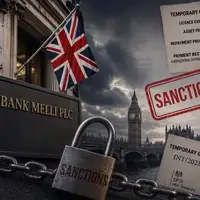
The Islamic Republic is adopting a policy of “strategic patience” in response to the reimposition of United Nations sanctions, Iran’s official IRNA news agency said on Thursday.
“Tehran sees the path forward in waiting for either a change in Western approaches or shifts in the political landscape,” IRNA wrote.
The agency cautioned that the risks are considerable, citing Israeli pressure and US efforts to bolster Tel Aviv.
Authorities in Tehran, according to the outlet, also view engagement with what it described as the US president’s maximalist demands as both endless and ineffective in advancing national interests.


An attorney representing two Iranian nationals alleged on Wednesday that US authorities deported his clients to Iran without due process, placing them at risk of persecution, ABC News reported.
Ali Herischi, who represents several Iranians seeking asylum in the United States, told ABC News that two of his clients “disappeared” from the Immigration and Customs Enforcement (ICE) detainee locator system this week and were then deported to Iran.
He said one of them is a Christian convert who had arrived at the southern border earlier this year with his pregnant wife.
“We tried multiple times to ask for his appeal,” Herischi said. “And suddenly, without any information, we realized that he disappeared from [the ICE] detainee locator and then the news broke that Iranians had been deported back to Iran.”
Herischi said his client’s wife, who recently gave birth and remains in the United States, was able to briefly speak with her husband after his deportation. According to Herischi, the man told her that he was “shackled and handcuffed all the way to Iran.”
The attorney called the deportations “unconscionable,” adding, “It was so wrong, and unfortunately these are the same people that … US foreign policy tries to protect. These are those who stand up against the regime, who pay a price for standing up against the regime, and then you give them back directly to the hand of evil.”
ABC News reported that Herischi represents 25 people who are worried about being deported to Iran.
Earlier this week, Iranian state media quoted an official as saying about 120 Iranian nationals detained in the US would be returned in the coming days.
The New York Times reported on Tuesday that a chartered US flight carrying more than 100 Iranians departed Louisiana and was scheduled to arrive in Tehran via Qatar.
Iranian officials confirmed that 120 citizens are being repatriated, some voluntarily, while others had asylum claims denied.
For decades, the US has provided refuge to Iranians fleeing political or religious persecution. Human rights advocates warn that returnees -- including converts to Christianity, dissidents and activists -- could face serious risks on arrival in Iran.
The snapback of UN sanctions is unacceptable, said an Iranian MP urging reciprocal action after what it described as Europe’s failure to uphold commitments.
“The activation of the snapback mechanism is an illegal, inhuman, unlawful and hostile action against the Islamic Republic of Iran; we must take decisive and resolute countermeasures,” Manouchehr Motaki said on Thursday.
“The JCPOA parties not only failed to meet their obligations, they carried out the greatest obstructive measures in implementing the agreement,” Motaki added.

While Iran’s hardline-led parliament resounds with defiant statements dismissing the impact of new UN sanctions, a few lawmakers are beginning to admit the likely economic toll.
Independent MP Hamid Reza Goudarzi broke ranks on Wednesday, saying the so-called snapback of measures halted under the 2015 nuclear deal has “damaged Iran’s economy.”
His remarks drew sharp criticism from colleagues but resonated with many outside parliament who are struggling with higher prices and a collapsing currency.
The rial, which hovered around one million to the US dollar before the sanctions’ return, surged past 1,160,000 by midday Wednesday, a new low. Food and basic staples are increasingly out of reach.
Another moderate MP, Salman Eshaghi, lamented the strain on his constituents in eastern Iran: “People can no longer afford meat, chicken, rice and other staples,” he said, urging the judiciary to summon local and national officials over the price hikes.
But the dominant voices in the Majles remain combative.
‘They want riots’
Vahid Ahmadi, a member of the National Security and Foreign Relations Committee, dismissed the currency crash as a “psychological” effect.
“Nothing has happened as a result of the snapback,” he insisted. “The rise in exchange rates has no economic reason.”
Ahmadi argued that sanctions were simply a continuation of war by other means: “The 12-day war against Iran was intended to trigger regime change and national disintegration. Now that our enemies have failed and begged for a ceasefire, they aim to confront the Islamic Republic through snapback sanctions.”
Another senior MP Ahmad Rastineh echoed this line: “the snapback is designed to incite riots in Iran,” he asserted. “We seek the destruction of Israel, and we will continue to pursue that goal.”
Cracks in hardline narrative?
Hossein Ali Haji Deligani, notorious for his incendiary remarks, took it a step further.
“The European troika is a slave and servant of the United States,” he said. “It is not in Iran’s interest to remain in the 2015 nuclear deal or the Non-Proliferation Treaty.”
Many interpreted this as an open call to review Iran’s nuclear doctrine, edging toward weaponization.
Such hardline voices dominate Iran’s parliament, but cracks are widening as economic pressure intensifies.
Hossein Samsami, an MP for Tehran, tied rising prices directly to the collapsing exchange rate, contradicting colleagues who blamed foreign plots or “psychology.”
The fact that even conservative outlets like the Students News Network are publishing such remarks shows how far the looming crisis has pushed officials: denial still dominates, but moments of candor are breaking through.
A member of Iran’s parliament national security commission dismissed the UN snapback mechanism, saying it adds little to existing sanctions already imposed by the United States and Europe.
“The snapback mechanism is not an important phenomenon and will be nothing more than US sanctions,” Alaeddin Boroujerdi said on Thursday.
“This mechanism is more of a psychological warfare operation, because the sanctions imposed so far by the United States and Europe have even exceeded the total from six previous Security Council resolutions,” Boroujerdi added.
The conditional approval of Iran’s accession to the Combating the Financing of Terrorism (CFT) convention puts the country on a “historic but ambiguous path,” Fars News Agency, affiliated with the Revolutionary Guards wrote on Thursday.
The outlet warned the move could carry “very heavy and irreparable” consequences for national security and sovereignty.
The main concern is the potential labeling of regional resistance groups as terrorism by Western states, Fars wrote, adding that such a clash could become not only a legal issue but also a “strategic challenge for Iran’s diplomacy and national interests.”