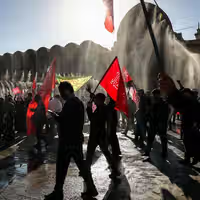
Iran’s Javan daily, affiliated with the Revolutionary Guards, said the reimposition of United Nations sanctions through the snapback mechanism had not surprised Tehran but exposed what it called the “barbarism” and “unreliability” of the West.
The newspaper wrote that Western powers “never settle for less than absolute superiority over non-Western nations” and described international agreements as tools for domination rather than commitments.
It argued that reliance on Western promises is misguided, invoking critiques from philosophers such as Martin Heidegger and Edward Said to suggest that Western culture is inherently exploitative.
“The sanctions and activation of the snapback mechanism reveal again that Western civilization is rooted in treachery and domination,” it said.
The prospect of war involving Iran was “unlikely,” the semi-official Mehr news agency reported on Monday, dismissing rumors as “enemy propaganda.”
“There is no evidence of military activity in the region,” Mehr cited an informed source as saying, adding that recent movements of aerial refueling aircraft were related to pressure on Russia and “not a cause for concern.”
The source urged citizens to follow only official news outlets and avoid spreading rumors, stressing that Iran’s armed forces “are fully prepared to defend the country’s borders.”

Curbs to prenatal screenings and abortions in Iran’s 2021 Youth Population law have contributed to the doubling of Down syndrome births, according to a report by Shargh newspaper.
The current rate is about one in 700 births, compared to one in 1,000 in developed countries, it reported, and Down syndrome rates in Iran have risen from 1.2% to 2.9%.
The law, officially titled the Youthful Population and Family Support Act, was ratified in late 2021 and implemented in 2022. It seeks to raise fertility rates to 2.5 children per woman amid declining population growth, which currently stands at about 0.7%.
The law restricts abortions, prenatal screenings and contraceptives while offering incentives for marriage and childbearing.
Midwives in health centers are barred from requesting or discussing prenatal screenings, and legal obstacles have made voluntary pregnancy terminations nearly impossible, the report said.
Abortion now requires both a medical commission and judicial approval even in cases of confirmed fetal abnormalities under the justification of “intolerable hardship.”
These restrictions have pared back screening visits, with a 20–30% decline in Tehran and a 50% decline in less-privileged provinces, contributing to more chromosomal disorder births, according to Shargh.
“There are an estimated 120,000 individuals with Down syndrome currently living in Iran,” said Pourandokht Bonyadi, head of the Iran Down Syndrome Charity Foundation.
Underground abortion market
While the law has failed to significantly raise birth rates, it has fueled an underground abortion market.
Iran’s judiciary announced last week that a person in Hormozgan province had been sentenced to death for performing 140 illegal abortions. The case is under Supreme Court review.
“Out of 12,000 annual forensic medicine referrals for pregnancy termination, 8,000 involve fetal abnormalities, but 2,000 are rejected due to procedural issues or late referrals,” said Mohammad Akrami, president of the Iranian Medical Genetics Association.
Experts warn the law’s restrictive measures could have long-term social and healthcare consequences, urging policymakers to reconsider the legislation to curb rising disability rates and the spread of illegal abortions.
Incentives but limited results
Alongside restrictions, the law provides incentives to encourage fertility, including marriage loans, child allowances, housing loans for young couples, tax breaks for parents, employment priority for families and expanded health and transportation subsidies.
Despite these measures, the law has not produced the intended rise in fertility. According to official media, the rate of population decline has slowed by about 20% over the past seven years, but fertility has only stabilized at 1.6 children per woman, far below the 2.5 target.
John Bolton, former US national security advisor, said US and Israeli strikes on Iran’s nuclear facilities in June showed Tehran was “powerless” to stop its critical assets from being destroyed.
“People as a whole saw that the regime was powerless to stop the US and Israel from destroying its critical asset,” he told an audience at Harvard Kennedy School on Monday. “That has contributed to the feeling that the regime’s days are numbered.”
Bolton, who has long advocated military action against Iran, added that there were “very real” threats against his life from Iranian officials.
He said Trump revoked his Secret Service protection just hours after inauguration, despite those threats.
“Trump was asked if something happens to Bolton and these other people, do you feel you’re responsible? And he said no,” he recalled.
Bolton has previously written that he advised Trump to launch a military strike on Iran’s nuclear facilities during his tenure.

One thing unchanged by the return of UN sanctions is Tehran’s internal discord, with hardliners and moderates battling it out over decisions ultimately taken elsewhere.
Responses to the so-called snapback range from combative to despairing: hardliners celebrating, reformists urging more diplomacy and maverick parliamentarians calling for withdrawal from the nuclear Non-Proliferation Treaty or even building nuclear weapons. Amidst it all, the government appears adrift.

One thing unchanged by the return of UN sanctions is Tehran’s internal discord, with hardliners and moderates battling it out over decisions ultimately taken elsewhere.
Responses to the so-called snapback range from combative to despairing: hardliners celebrating, reformists urging more diplomacy and maverick parliamentarians calling for withdrawal from the nuclear Non-Proliferation Treaty or even building nuclear weapons. Amidst it all, the government appears adrift.
President Masoud Pezeshkian on Monday blamed Iran’s predicament on European states that activated the trigger mechanism, calling them “filthy and mean” without even attempting to lay out what he thinks lies ahead.
“They want us to surrender,” the president told a group of firefighters in Tehran. As for the response, “people have to resist.”
Other officials have responded with angry calls to withdraw from the NPT, ignoring the fact that exiting the treaty would further convince a skeptical West that Tehran’s self-styled peaceful nuclear program is veering toward weaponization.
Even more alarming are calls from parliamentarians and others to build nuclear weapons.
‘We should compromise’
Amid this flurry of reactionary rhetoric, sociologist Taghi Azad Armaki stood out with a different message.
“Iran should say that it is not standing against the rest of the world and that it is not going to fight the world,” he told moderate daily Etemad on Monday. “We should say that we are … ready to compromise,” Armaki added.
“The government is unable to say that, but civil society can … We should be part of the world, and not allow the world to unite against us.”
Armaki’s heartfelt pleas recall a Persian tale in which mice resolve to put a bell on a cat, only to admit none knew how—or dared— to do it.
Tall order
The only person who can end Tehran's confrontation with the West is the Supreme Leader, Ali Khamenei. Iran's ultimate decision-maker can instruct Pezeshkian to stop calling world leaders “filthy” and engage.
Since the vote last Friday, France and the UK have stressed that the snapback of UN sanctions should not mark the end of dialogue. But Iran’s current posture suggests that its temper may take time to cool and that incentives may be needed to bring it back to the table.
And that won’t be easy given hardliners' staunch opposition.
“Iran’s return to the negotiating table will not happen easily,” conservative politician Mohammad Hassan Asafari told Nameh News on Monday.
Among the many suggestions for Iran’s next move, Jomhouri Eslami editor Massih Mohajeri and Ham Mihan proprietor Gholamhossein Karbaschi noted that state TV and hardliners appear jubilant over the snapback.
Elephant in the room
Sociologist Armaki urged the government to limit hardliners’ airtime—ignoring, like almost every other voice in Tehran, the elephant in the room.
Ultimately, all decisions in Iran hinge on one man, who decided to air his views against talks with Washington hours before Pezeshkian landed in New York.
Moderate analyst Hadi Alami Fariman came close to addressing the core issue on Monday, but fell short.
“Iran has to choose between tension and diplomacy,” Fariman told reformist outlet Rouydad24. “We will not get any result without reforms … in our political structure.”
That silence underscores the impasse: until the real seat of power acknowledges the need for change, Iran’s answer to sanctions will remain more bluster than strategy.