Iranian Supreme Leader Ali Khamenei on Tuesday doubled down on a key sticking point in a diplomatic standoff with the United States, insisting again that Iran would not renounce domestic enrichment of uranium.
"Negotiating with the United States under the current conditions carries harms for Iran, some of which are irreparable, because the American side has predetermined the outcome of the negotiations, meaning they have stated they will only accept talks whose result is the shutdown of Iran’s nuclear activities and enrichment," he said.
"This is not negotiation, this is dictation," Khamenei declared in a speech hours after Trump had belittled him in a speech before the United Nations as Iran's "so-called" Supreme Leader.
Khamenei blasted Trump for calling on Iran to end domestic enrichment, saying, “it is clear that the Iranian people give a slap in the face to the person saying this and will not accept it.”
Tehran does not need and seek to develop nuclear weapons, so it enriches uranium to up to 60% purity, unlike nuclear-armed countries that enrich it up to 90% purity, Iran's Supreme Leader Ali Khamenei said in a speech on Tuesday.
"Iran lacked the technology to enrich uranium, and our enemies did not want us to have it. Our scientists managed to achieve the know-how," he added.
He said enriched uranium is very valuable for Iran as it has applications in various aspects of people's lives.
"People benefit from enriched uranium in agriculture, industry, nutrition, environment, education and research, power generation, and many other areas."


Iran has executed at least 1,000 people so far this year or the most in over three decades, according to Norway-based Iran Human Rights (IHR), which called for a United Nations investigation into what it described as crimes against humanity.
“This is the highest number of recorded executions in more than 30 years,” IHR said in a statement. Iran executed at least 5,000 political prisoners in 1988, according to Amnesty International.
From Jan. 1 to Sept. 23, IHR said it had verified 1,000 executions, including 64 in the past week alone — an average of more than nine a day.
The group said the figures represented a minimum, as many cases went unreported.
“In recent months the Islamic Republic has begun a mass killing campaign in Iran’s prisons, the dimensions of which, in the absence of serious international reactions, are expanding every day,” IHR Director Mahmood Amiry-Moghaddam said in a statement.
“The widespread, arbitrary executions of prisoners without due process and fair trial rights amount to crimes against humanity and must be placed at the top of the international community’s agenda.”
IHR said most executions were for drug-related and other non-lethal offences, which do not meet the “most serious crimes” threshold under international law.
According to its data, 50% were for drug charges, 43% for murder, 3% for security-related charges such as baghy (armed rebellion) and moharebeh (waging war against God), 3% for rape and 1% for espionage for Israel.
Only 11% of executions were announced by official sources, with none of the drug-related cases disclosed publicly, the group added.
The organization urged the UN Human Rights Council’s Fact-Finding Mission on Iran to investigate the executions, citing their “scale, systematic nature and political function to intimidate and create societal fear.”
At least 975 people were executed in Iran in 2024, a 17% increase from the previous year, making it one of the world’s leading users of the death penalty, according to rights monitors.
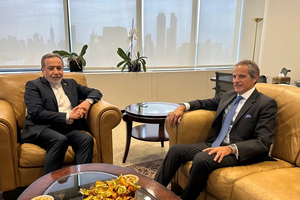
In the meeting between Iranian and European top diplomats in New York, "some ideas and proposals for continuing diplomacy were raised, and it was decided that consultations with all involved parties would continue," according to Iran's Foreign Ministry.
"The course of discussions over the past month aimed at finding diplomatic solutions regarding Iran’s nuclear issue and preventing an escalation of tensions was reviewed in the meeting," the Foreign Ministry statement said.

Iran and European powers held last-ditch talks in New York on Tuesday to try to prevent the revival of UN sanctions on Tehran, though diplomats on both sides cautioned that chances of success remain slim.

Iran and European powers held last-ditch talks in New York on Tuesday to try to prevent the revival of UN sanctions on Tehran, though diplomats on both sides cautioned that chances of success remain slim.
Foreign ministers of Iran, Britain, France and Germany – the so-called E3 – met on the sidelines of the UN General Assembly, joined by EU foreign policy chief Kaja Kallas, amid warnings that a 30-day “snapback” process to reimpose sanctions will expire on September 27.
In the meeting between Iranian and European top diplomats in New York, "some ideas and proposals for continuing diplomacy were raised, and it was decided that consultations with all involved parties would continue," according to Iran's Foreign Ministry.
"The course of discussions over the past month aimed at finding diplomatic solutions regarding Iran’s nuclear issue and preventing an escalation of tensions was reviewed in the meeting," according to the Foreign Ministry statement.
The E3 triggered the process on August 28, accusing Iran of failing to comply with a 2015 nuclear deal designed to prevent it from developing nuclear weapons. Tehran denies it seeks such arms, insisting its nuclear program is for peaceful purposes.
“Iran has been in contact with E3/EU officials and (the UN nuclear chief Rafael) Grossi since this morning at the UN Different ideas have been raised and discussed,” a senior Iranian official told Reuters on Tuesday.
Another Iranian official said “everyone seems to be trying” to find a resolution.


Iranian Foreign Minister Abbas Araghchi warned European states to choose “cooperation or confrontation.”
Speaking on state TV, he said: “They have tested Iran repeatedly and know we do not respond to the language of pressure and threat ... I hope we can find a diplomatic solution in the coming days, otherwise Tehran will take appropriate measures.”
According to diplomats, the E3 have offered to delay reinstating sanctions for up to six months if Iran restores access for UN inspectors, addresses concerns over its stockpile of enriched uranium and agrees to talks with the United States.
But two European envoys said Iran’s leaders have yet to meet these conditions. “The ball is in Iran’s camp,” one diplomat said. “It is up to it to quickly take the concrete steps in the coming days to avert snapback. If not, then sanctions will be reimposed.”
Another diplomat added, “The minimum would be for Iranians to present the special report and allow some token visit of inspectors to some sites, but even then that probably won’t fly – and chances are the US would veto.”
If no extension is agreed, all pre-2015 UN sanctions will automatically return on September 28, compounding economic pressures from US and European measures already in place.
President Masoud Pezeshkian said on Saturday that Iran would “overcome” any reimposition of sanctions. According to an insider cited by Reuters, growing discontent over the economy was rattling Iran’s leadership, with little sign of answers.
In June, following US and Israeli strikes on Iranian nuclear sites, Iran’s parliament passed a law suspending cooperation with the International Atomic Energy Agency. A deal with the IAEA was reached on September 9 to resume some inspections, though diplomats say its scope remains limited.
“I am in New York to use these remaining days for diplomatic consultations that might lead to a solution,” Araghchi said. “If it is not found, we will continue our path.”