Iran and European powers held last-ditch talks in New York on Tuesday to try to prevent the revival of UN sanctions on Tehran, though diplomats on both sides cautioned that chances of success remain slim.

Iran and European powers held last-ditch talks in New York on Tuesday to try to prevent the revival of UN sanctions on Tehran, though diplomats on both sides cautioned that chances of success remain slim.
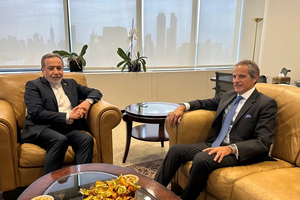
Foreign ministers of Iran, Britain, France and Germany – the so-called E3 – met on the sidelines of the UN General Assembly, joined by EU foreign policy chief Kaja Kallas, amid warnings that a 30-day “snapback” process to reimpose sanctions will expire on September 27.
In the meeting between Iranian and European top diplomats in New York, "some ideas and proposals for continuing diplomacy were raised, and it was decided that consultations with all involved parties would continue," according to Iran's Foreign Ministry.
"The course of discussions over the past month aimed at finding diplomatic solutions regarding Iran’s nuclear issue and preventing an escalation of tensions was reviewed in the meeting," according to the Foreign Ministry statement.
The E3 triggered the process on August 28, accusing Iran of failing to comply with a 2015 nuclear deal designed to prevent it from developing nuclear weapons. Tehran denies it seeks such arms, insisting its nuclear program is for peaceful purposes.
“Iran has been in contact with E3/EU officials and (the UN nuclear chief Rafael) Grossi since this morning at the UN Different ideas have been raised and discussed,” a senior Iranian official told Reuters on Tuesday.
Another Iranian official said “everyone seems to be trying” to find a resolution.


Iranian Foreign Minister Abbas Araghchi warned European states to choose “cooperation or confrontation.”
Speaking on state TV, he said: “They have tested Iran repeatedly and know we do not respond to the language of pressure and threat ... I hope we can find a diplomatic solution in the coming days, otherwise Tehran will take appropriate measures.”
According to diplomats, the E3 have offered to delay reinstating sanctions for up to six months if Iran restores access for UN inspectors, addresses concerns over its stockpile of enriched uranium and agrees to talks with the United States.
But two European envoys said Iran’s leaders have yet to meet these conditions. “The ball is in Iran’s camp,” one diplomat said. “It is up to it to quickly take the concrete steps in the coming days to avert snapback. If not, then sanctions will be reimposed.”
Another diplomat added, “The minimum would be for Iranians to present the special report and allow some token visit of inspectors to some sites, but even then that probably won’t fly – and chances are the US would veto.”
If no extension is agreed, all pre-2015 UN sanctions will automatically return on September 28, compounding economic pressures from US and European measures already in place.
President Masoud Pezeshkian said on Saturday that Iran would “overcome” any reimposition of sanctions. According to an insider cited by Reuters, growing discontent over the economy was rattling Iran’s leadership, with little sign of answers.
In June, following US and Israeli strikes on Iranian nuclear sites, Iran’s parliament passed a law suspending cooperation with the International Atomic Energy Agency. A deal with the IAEA was reached on September 9 to resume some inspections, though diplomats say its scope remains limited.
“I am in New York to use these remaining days for diplomatic consultations that might lead to a solution,” Araghchi said. “If it is not found, we will continue our path.”

Iran’s security chief Ali Larijani said on Tuesday that Tehran had accepted European and Russian proposals to avert the co-called snapback of UN sanctions, but the West triggered international sanctions on Iran nonetheless.
Larijani, who leads Iran's Supreme National Security Council, accused France of reneging on a pledge to hold back on the sanctions push if Iran made a deal with the International Atomic Energy Agency (IAEA).
“France, via the IAEA chief, promised to withdraw snapback demands if Iran agreed with the agency. Iran’s foreign minister signed this in Egypt, under security concerns and parliamentary mandates following bombed nuclear sites. France did not honor this,” official media quoted him as saying.
France, Britain and Germany triggered UN sanctions on August 28 through the so-called snapback mechanism of a 2015 international nuclear deal with Tehran.
On September 9, Iran and the IAEA signed a technical agreement in Cairo, mediated by Egypt, to pave the way for resuming nuclear inspections halted in June.
Ten days later, the UN Security Council rejected a resolution to keep sanctions lifted in a 4–9 vote, paving the way for sanctions to resume on September 28.
“European and Russian proposals, accepted by Iran with conditions, set a six-month negotiation period, but the West pursued snapback at the UN Security Council instead,” Larijani said.
Iran has warned that new attacks or sanctions would void the agreement, though it still sees the deal as a step toward de-escalation.
US missile demands ‘unacceptable’
Larijani also appeared to reveal details of a US proposal, saying Washington had demanded Iran reduce its missile range to under 500 km (310 miles) - “a condition no honorable person could accept,” he said.
For years, Iran has voluntarily limited its missile range, suggesting that 2,000 kilometers is sufficient to reach its main regional target, Israel.
However, a senior advisor to Iran's Supreme Leader suggested last year that the country might abandon its self-imposed missile range limit and could even pursue intercontinental capabilities if it faced an "existential threat".
Larijani made the remarks at the Tehran Chamber of Commerce, signaling preparations for the return of UN sanctions on September 28.
Iran’s Ministry of Intelligence had already issued secret guidance in August instructing ministries and major companies to prepare for the resumption of punitive UN measures.

Officials in Tehran are scrambling to blunt the impact of impending UN sanctions later this month and avert another popular flare-up that even insiders warn is near.
Among the proposals floated by politicians and economists are issuing coupons or smart ration cards to placate the public—especially the younger generation.
Efforts to introduce coupons began nearly a decade ago but stalled as rival factions in parliament and the cabinet fought over control of lucrative contracts.
In recent weeks, however, the idea has regained traction, with President Masoud Pezeshkian publicly backing it.
“We have no choice but to raise prices as subsidies on fuel and other goods are cut,” Pezeshkian said last week. “Issuing coupons will help low-income workers afford essential items.”
The system was used successfully during the 1980s war with Iraq, and many Iranians still credit then-prime minister Mir Hossein Mousavi, who is now under house arrest for nearly 15 years for leading protests against the disputed 2009 election.
‘A silent crisis’
Analysts in Tehran predict another spike in exchange rates once sanctions return on September 27. The government is expected to face a severe shortage of hard currency as oil sales become increasingly difficult.
Tehran’s priority appears to be containing unrest.
On September 18, Vice President Mohammad Reza Aref instructed the Tax Office to ease pressure on businesses and “avoid making people feel oppressed by the government.”
Many firms have already shuttered in recent months due to prolonged power outages and water shortages.
Just hours before the UN vote to reinstate sanctions last week, the reformist website Rouydad24 ran a headline warning of “A Silent Crisis in Iran.”
“Persistent economic problems … and limited access to basic services like electricity and water have severely impacted daily life, fostered a sense of despair and eroded public trust in the government,” the editorial said.
‘Bread riots’
Several academics, including political scientist Ahmad Naghibzadeh and sociologist Taghi Azad Armaki, have warned of “blind protests” and “bread riots” as public dissatisfaction reaches a boiling point.
Yet as economic warnings mount, officials have leaned on cultural gestures many see as unserious.
One initiative was a proposed free-for-all concert by renowned vocalist Homayoun Shajarian at Tehran’s iconic Azadi Square. Hardliners blocked the event, citing security concerns, and also vetoed a proposed indoor venue.
Wooing exiled artists
Once the resolution to extend Iran’s sanctions relief was voted down, government officials floated another gesture: inviting Iranian expatriate singers in Los Angeles to return to Tehran.
“I know that some of them in Los Angeles are struggling financially,” Vice President Aref said. “I invite them to come back freely.”
The administration’s spokeswoman Fatemeh Mohajerani insisted groundwork was being laid for such a move: “God forbid we end up only seeing their bodies brought back to Iran,” she told reporters on Tuesday. “They should be able to come home while they’re alive.”
Since 1979, Los Angeles has been a hub for Iranian musicians, many banned from working in Iran, stripped of homes and assets, and still censored despite their music being widely played in cars, weddings,and parties. Most are now elderly, many no longer able to perform.
No artist has yet responded. Some young users have—wryly.
“You can’t fool the new generation,” one commented on the vice president’s remark. “Even if you brought Lady Gaga to Tehran, she couldn’t make people forget their financial hardships.”

Iran’s top security official Ali Larijani said on Tuesday that France had sent a message through International Atomic Energy Agency chief Rafael Grossi offering to withdraw its request to trigger the snapback mechanism if Tehran reached an agreement with the agency, but failed to honor the pledge.
“France, through the agency’s Director General, sent a message saying that if you reach certain arrangements with the agency, we will withdraw the snapback request. This agreement was reached… Nevertheless, they did not keep their promise,” Larijani said.
He added that Iran later accepted proposals from both European powers and Russia for a six-month negotiation period, but the commitments were not upheld.
"I sent the so-called Supreme Leader a letter making a generous offer. I extended a pledge of full cooperation in exchange for a suspension of Iran's nuclear program. The regime's answer was to continue their constant threats," US President Donald Trump told the United Nations on Tuesday.

"Many of Iran's former military commanders, in fact, I can say almost all of them are no longer with us. They're dead, and three months ago, in operation Midnight Hammer, seven American B-2 bombers dropped the fourteen 30,000 pound-each bombs on Iran's key nuclear facilities, totally obliterating everything," he added.
"We hate to use them, but we did something that for 22 years people wanted to do. With Iran's nuclear enrichment capacity demolished, I immediately brokered an end to the 12-day war, as it's called, between Israel and Iran, with both sides agreeing to fight no longer."