Iran expects Trump's support for new Israeli attacks - state TV
Smoke rises following an Israeli attack in Tehran, Iran, June 16, 2025.
Iran’s state TV reported that Tehran believes Israel seeks further attacks which Trump is unlikely to oppose, as US news outlet Axios cited sources saying Israel sees Trump backing strikes on further nuclear activities.
“The (Israeli) regime seeks war, and we doubt Trump would oppose it. We, too, are in a state of full readiness,” state-run Press TV quoted what they called an informed Iranian source as saying.
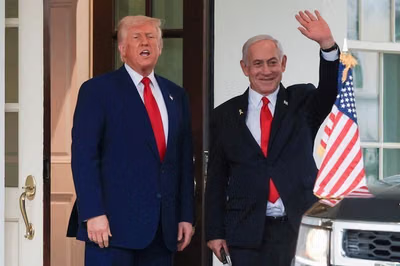
Iran assesses the meeting due for Monday between Israeli Prime Minister Benjamin Netanyahu and US President Donald Trump will be no different from their consultations before the 12-day war, the report cited the source as saying.
The source described such meetings as “deceptive,” adding “everything has been agreed upon in advance.”
“If Trump believes that after a military strike on our nuclear program, we would trust a diplomatic agreement with them, then he is not a good dealmaker,” the source said, referring to the possibility of renewed nuclear talks between the United States and Iran.
The comments came as Axios reported Israeli officials believe Trump could give them the green light for renewed military action if Iran moves to restore elements of its nuclear program.
Israel is preparing for further strikes, with discussions between Trump and Netanyahu expected to focus on future US nuclear negotiations and potential triggers for renewed Israeli attacks, Axios cited two sources with knowledge of the matter as saying.
Israeli officials cited two scenarios: an Iranian attempt to extract enriched uranium from the damaged Fordow, Natanz or Isfahan sites, or efforts to rebuild enrichment facilities, the report said.
According to Axios, Netanyahu’s top adviser Ron Dermer told colleagues he left Washington last week convinced the Trump administration would support Israeli military action under certain conditions.
Dermer held meetings with Vice President JD Vance, Secretary of State Marco Rubio and White House envoy Steve Witkoff.
With the fighting paused, many in Tehran are taking stock of what the Iran-Israel conflict revealed, and Russia’s muted response is coming under growing scrutiny, especially in light of Moscow’s expanding defense ties with countries like India.
Long seen by hardliners as a strategic partner, Moscow is now facing criticism from Iranian media figures and former officials who accuse the Kremlin of offering symbolic support while withholding meaningful military backing.
President Vladimir Putin’s June 19 comments—downplaying the prospect of assistance and noting that Iran had not formally asked for help—have only deepened the sense of betrayal.
Russia, meanwhile, is offering India 117 Su-35 fighter jets and joint production of the Su-57 stealth aircraft with full technology transfer—the kind of advanced cooperation Tehran has long sought but failed to secure.
Backlash in Tehran
“Russia appears neither willing nor able to offer effective mediation or military backing,” Sohrab Saeddin, a European affairs researcher, told Khabar Online on June 30. “Alignment at the UN may raise Tehran’s diplomatic profile, but one cannot expect a more active role.”
Former deputy parliament speaker Ali Motahari was blunter in a July 1 post on X: “Russia gave the S-400 defense system to Turkey and Saudi Arabia but won’t provide it to Iran—because it might be used against Israel.”
He also reminded Moscow of the hundreds of Iranian drones allegedly used in Ukraine. “This is the kind of strategic cooperation Mr. Putin speaks about.”
Hossein Mousavian, a former Iranian diplomat now at Princeton, pointed to the India deal.
“Russia has offered India 117 Su-35M fighter jets and joint production of the Su-57 with full technology transfer—even though India is a U.S. ally,” he posted on X.
“Perhaps this reality can help Tehran gain a better understanding of the 'realities of international relations' and the 'imperatives of national interest.’”
Heshmatollah Falahatpisheh, former head of Iran’s National Security and Foreign Policy Committee, echoed the frustration.
“The Iranian nation has already paid more than its fair share of the price for the Ukraine war,” he told Rouydad24. “When Iran brought balance to the battlefield, the Russians simply said Iran hadn’t asked for anything.”
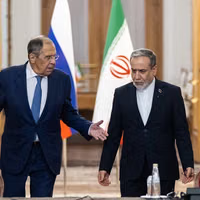
Foreign Minister Abbas Araghchi’s June 23 visit to Moscow—at the height of the fighting—was widely seen as a plea for stronger Russian backing.
But Moscow’s response remained limited, notably omitting any mention of the Su-35 or S-400. It condemned Israel’s attacks, offered to mediate, and proposed taking Iran’s enriched uranium in exchange for nuclear fuel.
Tehran and Moscow’s 20-year strategic partnership, signed in January and ratified in May, lacks a mutual defense clause but commits both sides to joint drills and military-technical cooperation.
Putin reiterated mid-war that the deal does not obligate Moscow to provide military support.
No fighter jets in sight
The stalled Su-35 deal has become another flashpoint. Finalized in late 2023, it was seen as critical to modernizing Iran’s air fleet and countering Israel’s air power.
“The story of the Sukhoi-35 is a tale of a one-sided alliance—one in which Iran delivers critical drones but receives nothing more than hollow promises,” Khabar Online wrote on July 1.
The article claimed Russia is using the jets as leverage in wider negotiations—on Syria, drone cooperation, and the Caspian Sea.
According to Kommersant, Iran received just two of the 50 Su-35s it expected. Delivered in December 2024, the aircraft were transported in parts to Iran’s 3rd Tactical Air Force Base near Hamadan for assembly.
There are no confirmed reports of their use in the conflict.
Russian sources cited production bottlenecks and the Ukraine war as reasons for suspending further deliveries—possibly for up to two years. Not many in Tehran are convinced.
Iranian President Masoud Pezeshkian told US right-wing commentator Tucker Carlson that Israel was seeking to embroil the United States in a Mideast 'forever war', in his first international interview since US and Israeli attacks on Iran.
“Netanyahu, as I said, has his own agenda. He wants to drag the US into forever wars… and to bring more insecurity and unrest to the whole region," Pezeshkian told Carlson in the virtual discussion, referring to the Israeli Prime Minister.
Carlson is an outspoken critic of US military action against Iran and a top dissenter from among President Donald Trump's populist base. The US President dismissed his views as "kooky".
Pezeshkian, a relative moderate, has advocated for greater engagement with Washington but hardline Supreme Leader Ali Khamenei ultimately decides policy.
Responding to a question on whether two senior clerics had issued a fatwa to kill Trump, Pezeshkian said, “To the best of my knowledge, they have not issued decrees or fatwas against any individual or against Donald Trump. It has nothing to do with the Iranian government or the Supreme Leader of Iran."
"What they actually meant by the fatwa was the condemnation of an insult to a religion or religious personalities … It should not be construed or considered as a threat against an individual.”
Last month, Alireza Panahian, a hardline Iranian cleric close to Iran’s Supreme Leader called on Muslims to kill Trump and Netanyahu in response to their threats against Khamenei, citing fatwas that declare him a mohareb, or “enemy of God.”
Najmuddin Tabasi, a member of the Society of Seminary Teachers of Qom, said Trump “must be executed” and warned that “the same hand that fired a shot past his ear can put a bullet through his throat.”
Referring to recent fatwas by Ayatollahs Naser Makarem Shirazi and Hossein Nouri Hamedani, Tabasi said he was confident that “brave youth will deprive Trump of security.”
Pezeshkian also denied Iran had sought to kill Trump in an alleged plot detailed by US law enforcement last year.
'No problem' with reviving talks
Iran has never pursued nuclear weapons, Pezeshkian said, citing religious prohibitions and cooperation with international inspectors.
“We have never been after developing a nuclear bomb—not in the past, not presently or in the future—because this is wrong. And this is in contrast to the religious decree or the fatwa which has been issued by the Supreme Leader … so it is religiously forbidden for us to go after a nuclear bomb.”
Ongoing conflict with Israel had sabotaged nuclear negotiations, he said, adding that talks with the US had been progressing when Israel launched attacks on Iran.
“We were sitting at the negotiating table when it happened. And by doing this, they totally ruined and destroyed diplomacy.”
“We see no problem in reentering the negotiations. But how are we going to trust the United States again? We reentered the negotiations. Then how can we know for sure that in the middle of the talks, the Israeli regime will not be given the permission again to attack us?”
White House envoy Steve Witkoff is planning to meet Iranian Foreign Minister Abbas Araghchi in Oslo next week to relaunch nuclear talks, Axios reported on Thursday, citing two sources familiar with the preparations.
The meeting would mark the first direct engagement since President Trump ordered strikes on Iran’s nuclear facilities last month. Neither side has publicly acknowledged the planned talks.
Alleged Israeli assassination attempt
Pezeshkian said Israel had attempted to assassinate him, describing a strike on a meeting he attended. There was no immediate Israeli or independent corroboration of his claim.
“They did try, yes, and they acted accordingly, but they failed. I am not afraid of sacrificing myself in defense of my country."
Israeli escalation would only deepen regional instability, he warned.
“Will it bring peace and tranquility and stability to the region? It was not the US that was behind the attempt on my life. It was Israel. But as I told you before, it is God who wills when a person will die.”
Pezeshkian framed the conflict as a product of Israeli ambitions and urged Washington to avoid becoming entangled.
“My proposal is that the US administration should refrain from getting involved in a war that is not America’s war. It is Netanyahu’s war that is having its own agenda … an inhuman agenda, and that is having forever wars, wars that go on and on.”
'Death to America' misunderstood
The Iranian president said that “Death to America” slogans were misunderstood. “They don’t mean death to the people of the United States, or even to the officials. They mean death to crime, death to killing and carnage, death to supporting killing others.”
Pezeshkian also said Ali Khamenei has no objection to the operation of US businesses in Iran even under the currency circumstances, and there has never been any limitation from Tehran’s side, attributing barriers to American sanctions.
"The Supreme Leader told me American investors are welcome in Iran. There is no limitation and there's nothing preventing the US investors from coming to Iran to make investments, even presently," he said.
“It is not to be in the interest of the United States to be involved in any kind of war in my region,” he said. “It is up to the United States president to choose … whether to replace war mongering and bloodshed with peace and tranquility.”
Israeli security services have arrested a Tel Aviv resident accused of being involved in an Iran-backed plot targeting the country’s politicians and military bases, as the number of cases continues to rise.
In a statement, Israel Police said: “The Shin Bet and the police emphasize: Iranian agents are trying to recruit Israelis on social media - any suspicious contact should be reported.”
In a paper for the Jerusalem Center for Security and Foreign Affairs, Oded Ailam, a former head of Mossad’s counter terrorism unit, wrote: “Through aggressive mass campaigns on social media, thousands of Israelis are being approached."
"Messages like 'Want to earn some easy cash?' now pepper the digital landscape. No serious screening or background checks, just a Telegram or email message offering money for a 'simple task.' Track a senior figure. Snap a photo of a base. Willing to try? You’re in.”
The latest case is a 27-year-old Tel Aviv resident. Israel Police said he was arrested “on suspicion of carrying out tasks for an Iranian agent, including documenting the homes of elected officials and military bases - in exchange for payment in virtual currencies”.
A prosecutor's statement was filed against him on Monday.
Ailam said that Iran’s Islamic Revolutionary Guard Corps has discarded the slow, resource-heavy traditions of classical espionage.
“No more lengthy vetting, grueling training, or elaborate cover stories. Instead, they’ve embraced a model that’s raw, direct, and disturbingly effective. This is Iran’s version of digital marketing applied to espionage: blanket targeting, no filters."
“And like any marketing effort, only a tiny fraction need to respond for the campaign to succeed. To Tehran, even a one percent success rate from a thousand messages is worth it. It’s a chillingly rational approach: volume will eventually produce the quality they seek. And sadly, it works.”
Last year, Israel saw a 400% spike in alleged Iran-backed spy cases, arresting 27 Israeli citizens in 13 separate cases.
This year, cases continue, with plots including a planned attack on Defense Minister Israel Katz, believed to have been the 20th case since the start of the Gaza war.
In February, two army reservists were caught passing classified information on the country’s Iron Dome defense system to an Iranian operative.
The Israeli military said on Monday it had detained members of an Iranian Quds Force cell — the foreign operations arm of Iran's Revolutionary Guards — in Syria during an overnight raid, the second such operation in a week.
In a statement Monday, the military said that the cell was arrested in the Tel Kudna area of southern Syria, though it did not give further details.
“For the second time in the past week, the division’s troops completed a targeted overnight operation and apprehended several operatives who posed a threat in the area,” the statement said.
The Wall Street Journal reported in January that following the fall of former Syrian president Bashar al-Assad, most Iranian forces and their allies had withdrawn from Syria.
On Monday, the Syrian Observatory for Human Rights reported that multiple operations from Israeli forces had happened Sunday, with convoys searching homes across several villages before making arrests.
“The number of people arrested by Israeli forces in the Quneitra countryside rose to six people, including two children, following an incursion carried out by the forces in the villages of Suwaysa and the vicinity of the town of Nab' al-Sakhr in the central Quneitra countryside,” a statement said.
It comes as the Israeli military carried out overnight attacks on Iran’s Yemeni allies, the Houthis, which continue to carry out regular missile attacks against the Jewish state in its campaign in allegiance with Iran-aligned Hamas in Gaza.
Defense Minister Israel Katz said on X that Houthi infrastructure was targeted.
“The fate of Yemen is the same as the fate of Tehran," he said, referring to a recent Israeli campaign targeting Iran.
"As part of Operation Black Flag, the IDF has now forcefully struck terror targets of the Houthi terror regime in the ports of Hodeidah, Al-Salif, and Ras Isa, the Ras Katib power station, and the ship Galaxy Leader, which was hijacked by the Houthis about two years ago and is currently used for terror activities in the Red Sea.”
The Israeli military said that approximately 20 fighter jets used over 50 munitions in the operation.
A statement from the Houthis’ Telegram channel said the group had repelled the attack.
“Our air defense succeeded in confronting the Zionist aggression against our country and thwarting its plan to target a number of Yemeni cities. This was achieved by forcing a number of combat formations participating in the aggression to leave the airspace, preventing them from launching raids,” the statement said.
The Israeli military said two missiles were launched by the Houthis in the early hours of Monday morning in response, though it had not confirmed an interception.
The Houthi statement said the operation used 11 missiles and drones targeting Tel Aviv’s Ben Gurion Airport, Ashdod Port, Ashkelon power station and the port of Eilat on Israel’s Red Sea coast.
Persian Gulf states are quietly relieved that the 12-day war with Israel has weakened the Islamic Republic, security experts told Iran International, though Tehran's Arab rivals prefer a declawed Iran to a regime change that would lead to instability.
The surprise Israeli attacks that started on June 13 were publicly condemned by Persian Gulf states which oppose Iranian hegemony in the region but seek calm to boost domestic growth agendas.
“These disruptions are of significant concern to Emirati policymakers who place a premium on regional calm and continuity,” said a senior security expert in the United Arab Emirates.
“The UAE remains concerned about the broader implications of regional conflict, economically, socially as well as politically," the expert told Iran International on condition of anonymity due to political sensitivities.
The United Arab Emirates, along with Morocco and Bahrain, is a party to the US-brokered Abraham Accords in 2020 which normalized relations between Israel.
Collective unease with Iran contributed to the historic shift toward normalization, experts say.
Last month, Abu Dhabi publicly condemned the Israeli attacks as a violation of Iran's sovereignty, but the attacks degraded the military might of a rival whose nuclear ambitions its neighbors long feared.
The campaign saw Israel gain control of Iran's airspace within days as it assassinated top military leaders and degraded Iranian missile capabilities.
However, any prolonged conflict or upheaval inside Iran would be viewed as a potential risk to the regional countries' tourism, trade and foreign investment, a taste of which was offered by the closing of air space across the Persian Gulf and crashing stock markets amid the conflict.
The United Arab Emirates is also home to around 500,000-800,000 Iranians who have been a historic force in the country’s trade and commerce concentrated in Dubai.
Interest in relative calm puts Arab capitals potentially at odds with some Iranians' hopes for fundamental change in the wake of the war, which does not appear to be forthcoming despite the punishing air war.
“The UAE takes a pragmatic approach and recognizes that broad systemic change in Iran is unlikely to be externally driven," the expert added.
Risks of regime change in Iran
Iran's southern neighbors are pleased with Tehran's chastisement but will maintain good relations for the sake of regional peace, said Emirati political commentator and academic Abdulkhaleq Abdulla.
The region "is better off now that Iran lost most of its bargaining power, namely its regional proxies, nuclear and missile powers,” he told Iran International.
“But even a weakened Iran remains a key threat to (Persian) Gulf security so the Arab states will continue with their policy of opening up to Iran and show solidarity with its people.”
The fragile ceasefire and the vulnerability of Iran's ruling system is likely to preoccupy Iran's neighbors.
Aimen Dean, of Bahraini-Saudi descent but famous for his deep work for the British spy agency MI6 embedded inside Al Qaeda, said the truce was no panacea.
“The relief isn’t here yet. Not a single government here in this region wants a regime change at least for now,” the managing director of Five Dimensions Consultants in Dubai said.
“They are afraid of two particular scenarios. The first is that an uprising happens and you end up with defections in the army and then the whole country collapses into civil war," Dean added, warning of refugee crisis on Arab shores.
The alternative scenario feared is the possibility of an ethnic breakup of Iran if the government should fall. “Nobody wants that as that also will result in a major flow of refugees and a failed state where people have access to nuclear materials,” Dean explained.
Instead, in the halls of power in the Persian Gulf, from regional juggernaut Saudi Arabia to the tiny island nation of Bahrain, Dean said there is the hope that a “defanged and declawed Iran” would be better contained within its own borders.