Israel urges Tehran residents to stay away from military facilities
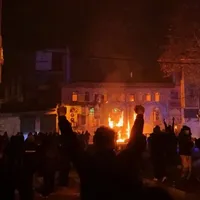
The Israeli military has issued an urgent warning to residents of Tehran, saying that in the coming days, the IDF will continue its attacks on military targets in the Iranian capital.The statement urges citizens to distance themselves from military headquarters and security institutions affiliated with the Islamic Republic for their own safety.
The US and Israel may have altered the trajectory of the Mideast with military strikes on Iran’s nuclear infrastructure—but without a broader strategy for internal change, the window of opportunity could quickly close, experts told Iran International.
Over the weekend, US forces carried out unprecedented airstrikes targeting Iran’s Fordow, Natanz, and Isfahan nuclear facilities. B-2 stealth bombers and Tomahawk cruise missiles were used in a mission that involved more than 120 aircraft—making it one of the largest US military operations against the Islamic Republic in decades.
“This marks a dramatic and consequential shift in the region’s strategic balance,” said Dr. Eric Mandel, founder of the Middle East Political Information Network (MEPIN), a think tank focused on US foreign policy and national security in the Middle East. But he warned military strikes alone were not a strategy for lon-term success.
Mandel emphasized that lasting success depends on political vision, regional coordination, and tangible support for the Iranian people—including support for dissident networks, and a clear set of US conditions for any future negotiations.
The removal of nuclear capabilities from “the world’s most dangerous regime” makes the world safer, argued Jonathan Harounoff, spokesperson for Israel’s Mission to the United Nations and author of Unveiled: Inside Iran’s #WomanLifeFreedom Revolt.
'Rare opportunity' for change
Harounoff, whose family is of Iranian origin, said the Iranian people “deserve a government that cares more about their social and economic wellbeing and safety than in pouring hundreds of millions of dollars into constructing a dangerous foreign policy, a destructive nuclear program and a web of terror proxies across the Middle East.”
“The door has been opened to make sure Iran cannot continue its pursuit of nuclear weapons,” said former US Ambassador John Craig, who was part of the Carter administration’s mission to assess the Shah’s position just prior to the 1979 revolution. While it’s too early to predict long-term outcomes, Craig said Iran’s leadership is now under enormous pressure to either return to negotiations or risk further escalation.
“Iran is in a very, very bad place. The leadership has very few options,” said Craig.
Craig added that internal discontent is growing—but warned that the international community must consider who can credibly lead a push for regime change from within. “Time for the mullahs to go,” he said. “But who leads the way is the real question.”
Experts agree that Israel’s initial strikes—combined with US firepower—shattered the Islamic Republic’s sense of impunity. But they caution that without a coherent American strategy, this moment could be lost.
Unless the United States now moves with strategic clarity—disrupting Iran’s centers of power and actively supporting the Iranian people—this rare opportunity for meaningful change could slip away, Mandel warned.
Houthi military helicopter flies over the Galaxy Leader cargo ship in the Red Sea in this photo released November 20, 2023.
The US and Israel are preparing for a renewed wave of Houthi attacks on American shipping and Israeli territory, following the US nuclear strikes in Iran, as the Iran-backed group announced it had officially entered the war.
The Houthis' official X account posted in Hebrew on Sunday morning, warning Israelis to “leave the country immediately”, with a video of a missile launching and scenes of destruction in Israel from Iran’s recent missile attacks.
Houthis recently brokered a ceasefire with the Trump administration and agreed to cease attacks on US ships and assets in the Red Sea region. In the early hours of Sunday, the ceasefire was over.
"We will officially enter the war - keep your ships away from our territorial waters," an announcement from the group said.
The Houthis had been waging a maritime blockade since the early weeks of the Gaza war in 2023, in what it says is allegiance with the Palestinians in Gaza.
An Israeli intelligence source told Iran International that given the complexity of striking US assets, the Houthis, designated a foreign terrorist organization by the US and others, are more likely to target Israel first.
'Not a big deal'
“It’s a bit early to say but the Houthis would prefer to target Israel first, it’s less complex at this stage, but it’s hard to tell. The next 24 hours will be revealing,” he said.
“There is no major threat from the Houthis,” the intelligence source added. “They’re limited in their capability and while they will try to retaliate for the current situation, it is not a big deal.”
The Israeli military says that more than 40 surface-to-surface missiles have been fired towards Israel since the Gaza war began, with one barely missing Israel’s biggest airport, Ben Gurion, just weeks ago.
Another 320 UAVs had been fired towards Israel, over 100 of which intercepted with two effective hits as of January data. The remainder fell in open areas, failed to reach Israeli territory or caused no significant damage.
Yemeni military journalist Rashid Maarouf, based in Marib city, told Iran International on Sunday that the Houthis' next steps will depend on the extent of the impact of the American strikes on Iran's nuclear reactors.
Targeting Arab nations
He also agrees the group's capabilities are limited. “They are launching missiles at Israel, but the Houthis' missiles are limited. They do not have a large number to launch a large salvo like Iran does. Even if the Houthis struck Israel, they would not be able to strike with more than two to three missiles a day.”
Abdul Basit Al-Baher, the spokesman for Yemen's military in the governorate of Taiz, told Iran International: "The Houthis are in the crosshairs of the US-Iranian escalation, between the tool and the victim."
He says the US attacks on Iran will require the Houthis to launch new attacks on American or associated ships, using drones or missiles, in an attempt to divert attention from the US strike on Iran and to pressure Washington to halt any potential escalation against Tehran.
It may also trigger attacks on Saudi or Emirati targets, the two nations strong US allies, Al-Baher said.
"They are expected to attempt to expand the scope of the confrontation by targeting Arab coalition countries, particularly Saudi Arabia, to send a message that any targeting of Iran will destabilize the entire region," he said.
He warns that the most dangerous scenario would be full engagement in a "proxy war", Iran activating its regional military allies.
"If Iran decides to respond forcefully, it may use the Houthis as an offensive force against Western interests in the Red Sea," he said, including special attacks on commercial and military vessels or even an attempt to threaten oil and energy corridors."
Israeli airstrikes on Monday targeted multiple sites linked to internal security and political control in the heart of Tehran, including the administrative and courtroom sections of Evin Prison — a facility long seen as a symbol of state repression.
The strikes, carried out under the direct orders of Israeli Prime Minister Benjamin Netanyahu and Defense Minister Yisrael Katz, focused on “regime targets and government repression bodies,” according to the Israeli Ministry of Defense.
Among the locations hit were the main gate and administrative buildings of Evin Prison.
There were no reported casualties among inmates, although several staff members were killed, according to information shared with Iran International.
Sources inside the facility confirmed to Iran International that office buildings, visitation areas, and judicial chambers were damaged in the strike.
Following the attack, families of political prisoners and local residents attempted to approach the site, according to witness accounts shared online.
Evin Prison, constructed in the 1970s, has long been associated with political detention and has housed journalists, activists, and dual nationals.
Strikes target multiple security bases
In addition to Evin, Israeli forces also struck a number of other prominent security and ideological institutions across Tehran and its suburbs.
Iran and Israel have not released an official list of the targets. Witness reports said they included the Basij headquarters, part of the IRGC’s paramilitary force, involved in controlling protests; the Tharallah Base (also known as Sarallah Base), an elite IRGC unit responsible for managing civil unrest in the capital; and the Seyyed al-Shohada IRGC base, a key provincial force in Alborz province, as well as the Intelligence Directorate of the national police.
Additionally, Iranian media reported strikes on the state media complex “9 Dey”, a technical hub for Iran’s national broadcasting system, including TV and radio transmission facilities.
Israel says goal is not regime change — but won’t rule out consequences
Israeli officials said on Monday again that the objective of the strikes is deterrence. “Our objective in Iran is not regime change,” a government spokesperson said on Monday. “But that may be the byproduct.”
Israeli Defense Minister Katz added, “For every shot fired at the Israeli home front, the Iranian dictator will be punished, and the attacks will continue with full force. We will continue until our war objectives are fully achieved.”
While Israel has previously struck infrastructure linked to Iran’s domestic security apparatus — including the headquarters of the Special Forces unit of the Islamic Republic’s Internal Security Forces and a main building of the state broadcaster IRIB — the latest campaign marks an escalation in the scope and scale of such attacks.
This wave of airstrikes has more explicitly targeted what Israeli officials describe as the “repression infrastructure” of the Islamic Republic— the institutions at the core of political surveillance, ideological enforcement, and suppression of dissent.
Tensions in the region remain high, with commercial shipping already diverting away from the Strait of Hormuz and Western governments reviewing security postures amid fears of a broader escalation.
According to data collected by rights group HRANA, 950 people were killed and 3,450 injured across Iran as of Monday. In Israel, 24 people were killed and over 2,500 injured.
The United States assesses that Iran could carry out retaliatory attacks targeting American forces in the Middle East soon, Reuters reported, citing two US officials.
One of the officials, who spoke to Reuters on condition of anonymity, said Iran's retaliatory attack could happen within the next day or two.
The report added that the US is still seeking a diplomatic resolution that would see Tehran forgo any attack.
Iran has threatened to retaliate after US bombed its nuclear sites over the weekend.
Iran's supreme leader Ali Khamenei waves at members of parliament, Tehran, Iran, June 11, 2025
The question of succession has taken on new urgency in Tehran since Israeli missile strikes began and the Supreme Leader Ali Khamenei reportedly moved to a secure location as he was threatened by Israeli leaders and President Trump.
But is he truly preparing to loosen his four-decades grip on Iran?
Khamenei has named three senior clerics as potential successors in case he is killed during the war with Israel, the New York Times reported Saturday, citing Iranian officials familiar with his emergency war plans.
Last week, Iran International reported that the 86-year-old leader has delegated authority to the Revolutionary Guards’ high command, effectively empowering the IRGC to manage critical decisions if he dies.
While these steps fall short of a formal emergency decree, they suggest an extraordinary contingency effort as missile exchanges between Israel and Iran enter a second week. Khamenei’s move appears aimed at ensuring continuity of command in the event he is incapacitated or killed.
Defiant messaging, emergency measures
Following the leader’s line, President Massoud Pezeshkian also ordered cabinet ministers last week to delegate some authority to deputies and senior managers.
Yet even as both leaders brace for escalation, Khamenei struck a defiant tone on June 18.
“Normal life is going on in Iran,” he said, rejecting retreat in what appeared to be a response to U.S. President Donald Trump’s call for “unconditional surrender.”
If the IRGC power-sharing reports are accurate, they could mark one of the most significant shifts in Iran’s post-revolution political order. For nearly four decades, Khamenei has centralized power—political, religious, military, and economic—around his office.
A legacy of control—and a quiet succession talk
Even Iran’s clerical seminaries, once independent and funded by religious donations, now fall under state control. Since 1989, Khamenei has turned clerics and seminarians into government employees, paid by his office and subject to dismissal if their loyalty is questioned.
As commander-in-chief, Khamenei exercises unilateral authority over military matters, bypassing the Majles on decisions of war and peace.
He also controls the state broadcaster IRIB, directing both leadership and editorial content. His office oversees several Tehran dailies and scores of newspapers nationwide—all part of a state-aligned media network.
Khamenei’s economic vision, framed around his concept of a “Resistance Economy,” has similarly concentrated power.
Though cabinet ministers exist, all major financial decisions—especially the annual budget—are dictated by his office. Massive state-linked economic conglomerates dominate the landscape and stifle the private sector.
In recent years, he has further sidelined parliament, issuing implicit directives that override legislation and block ministerial impeachments.
Succession has long been the Islamic Republic’s most sensitive—and unspoken—question. Few dared to discuss it openly. But in recent years, and especially in the current crisis, the topic has crept into public discourse.
Khamenei’s son, Mojtaba, is frequently floated in both establishment and opposition circles, though never officially acknowledged.
The Israeli strikes have made the issue more urgent.
One can imagine the question of who—or what—comes next, and whether that includes a possible thaw with the United States, being debated in private among Iran’s ruling elite. But no one dares say it aloud. Not yet.