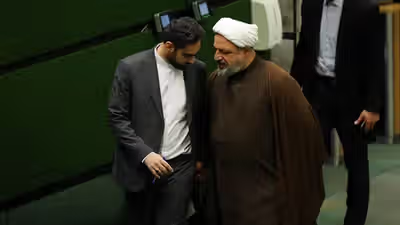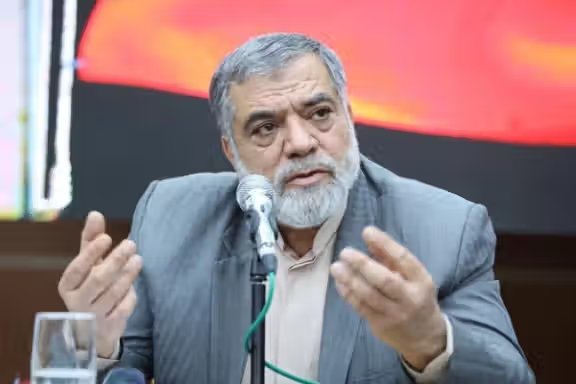
An Iranian lawmaker said on Tuesday that following Supreme Leader Ali Khamenei’s remarks on Iran’s nuclear policy, parliamentarians have no independent position but must help explain and defend the leadership’s stance to the public.
“After the Supreme Leader’s statement, people like me have no standing of our own,” said Salar Velayatmadar, a member of parliament’s national security and foreign policy commission. “Our duty is to clarify his position and explain its dimensions to the people.”
Khamenei said earlier on Tuesday that indirect talks with the United States were unlikely to succeed and warned Washington against trying to dictate Iran’s nuclear program.
Velayatmadar said uranium enrichment was a high scientific achievement and a matter of national pride. “Uranium enrichment stands at the highest level of global scientific progress,” he said. “Only a handful of countries possess this technology, and the Islamic Republic of Iran is one of them.”
He added that any compromise over enrichment would harm Iran’s national dignity and undercut the work of Iranian scientists. “If we step back from this achievement, we undermine our future,” he said.
The lawmaker also rejected the idea of hosting a nuclear consortium outside Iran. “If such a consortium is formed, it must be on Iranian soil. The knowledge and the technology belong to us.”
Velayatmadar said the outcome of nuclear talks would depend on the sincerity of the other side. “We are ready for dialogue, but not at the cost of our rights. If the talks fail, the consequences will be theirs.”


The fate of negotiations between Iran and the US hinges on one unresolved issue: uranium enrichment. As a former Iranian diplomat told Rouydad24, despite early momentum in the talks, a single unresolved point may now unravel months of diplomacy—proving that “the devil is in the details.”
Former diplomat Qassem Mohebbali said enrichment has become more than a technical issue—it’s now a political and symbolic one.
“The core of the talks is uranium enrichment,” Mohebbali said. “Iran doesn’t even have a nuclear power plant needing large-scale enrichment, yet the issue has taken on enormous significance. It’s a matter of national pride.”
He outlined two possible compromise models: a deal similar to India’s with direct US oversight, or a heavily monitored approach like Japan’s. Without such a solution, he said, Iran must weigh whether enrichment is worth risking war.
“If Iran exits the talks, the snapback mechanism could be triggered, reviving UN sanctions and increasing the risk of military confrontation,” he said, arguing that even without war, escalating sanctions could push Iran’s economy beyond its limits.
“This is no longer a game of ‘no war, no peace,’” he said. “The choice now is between war and peace.”

Israel’s Defense Minister Israel Katz said a spy plot against him had been thwarted in what Israel says is the 20th Iran-backed operation thwarted in the country since the Gaza war began.
“Iran is the head of the terrorist octopus that promotes terrorist activity directly and through the terrorist organizations it supports against leaders and against all citizens of the state of Israel,” Katz said in a statement Tuesday.
Two Israeli suspects, Roy Mizrahi and Almog Atias, both 25 and childhood friends, were arrested at the end of April accused of intelligence-gathering missions and placing explosives in the community where Katz lives.
Israel Police said in a statement on Tuesday: “The investigation revealed that during 2025, Roy was in contact with Iranian terrorist elements and carried out a large number of different security missions for them, some of them together with his friend Almog, while the two understood that they were acting under Iranian direction and that their actions were intended to harm the security of the state due to financial gain.”
The police statement said that Mizrahi was communicating with his handler through a dedicated application on a new cell phone he had bought for the operation.
“Later, he was asked by his handlers to move a bag buried in the ground from one point to another, which, according to his understanding, contained an explosive device. Roy carried out the transfer of the bag in accordance with his handlers' instructions,” the statement said.
Israel's Mako reported that after carrying out minor tasks such as photographing street signs, the pair’s activities included trying to install cameras at the minister’s home.
“The more serious task, which came after they successfully completed the first tasks, was purchasing a camera with a SIM card that allows for remote control, and installing it outside the defense minister's home,” the report said.
“First, they installed the cameras throughout Haifa and Nesher and gave the Iranians a code with which they could remotely control the cameras. Another time, they arrived at the driveway outside Minister Katz's house to install the camera - then they saw a Shin Bet vehicle and fled the scene," Mako added.
The case is the latest in a string of plots foiled since the start of the Gaza war in October 2023, with dozens of Israelis allegedly hired by Iranian operatives to carry out operations targeting the country’s top political and military echelons.
Other targets have included the Prime Minister Benjamin Netanyahu and head of the Shin Bet intelligence agency, Ronen Bar.
In the coming days, the Central District Attorney's Office is expected to file a serious indictment against the two suspects.
Italian Foreign Minister Antonio Tajani said on Tuesday that Italy is willing to host future nuclear talks involving Iran and the United States.
In a post on X, Tajani said he spoke by phone with Rafael Grossi, head of the International Atomic Energy Agency (IAEA), to receive an update on the negotiations.
“We are closely following developments in the US-Iran talks and are convinced that the issue of Iran’s nuclear program must be resolved through dialogue,” he wrote, stressing Italy’s “full support” for the IAEA’s work.
Tajani said he had confirmed Italy’s “availability to once again host future talks in Rome.”


Iran’s parliament on Tuesday condemned a motion by over 550 British lawmakers calling to label the Islamic Revolutionary Guard Corps (IRGC) a terrorist group, warning of legal repercussions from Tehran.
The statement, read aloud by parliamentary presidium member Ahmad Naderi during an open session, described the UK’s move as “reckless and hostile”.
“The UK’s potential designation of the IRGC violates fundamental principles of international relations and will provoke lawful, reciprocal action by the Islamic Republic of Iran,” Naderi said.
The parliament’s response came amid rising tensions between Tehran and London following the arrest and charging of three Iranian nationals in the UK under its National Security Act.
British authorities allege the men acted on behalf of Iranian intelligence and conducted surveillance targeting journalists from Iran International, a London-based Persian-language broadcaster critical of the Islamic Republic.
The charges follow counter-terrorism raids earlier this month in which eight people, including seven Iranian nationals, were detained.
UK Home Secretary Yvette Cooper said on Monday that the Islamic Republic poses an “unacceptable threat” to Britain’s domestic security.
“We will not tolerate growing state-backed threats in the UK,” Cooper told parliament.
Amid pressure from lawmakers, UK officials are reviewing options to strengthen legal measures against IRGC affiliates.
A government terrorism advisor on Monday proposed new powers to sanction individuals and entities linked to the IRGC, calling for measures to criminalize public displays of support, including insignia, and expand arrest and deportation capabilities under what he termed a "Statutory Alert and Liability Threat (SALT)" notice.
The Iranian parliament’s statement listed a long history of grievances against the UK, including the 1953 CIA- and MI6-backed coup against Prime Minister Mohammad Mossadegh, the occupation of Iran during World War II, the 1917 famine, and British support for Iraqi leader Saddam Hussein during the Iran-Iraq war.
“These black marks in British history against the Iranian people are undeniable and shameful,” the statement said.
It also warned that if the UK proceeds with the designation, Iran would respond under Article 7 of a 2020 domestic law mandating reciprocal measures.
According to the law, British military forces and bases in West Asia and the Persian Gulf could be labeled as hostile entities and subjected to retaliatory measures.
“The Revolutionary Guards are a constitutional and sovereign force charged with defending Iran’s territorial integrity,” the statement read. “Labeling them as terrorists amounts to aggression against Iran’s national sovereignty and a breach of the UN Charter.”
Lawmakers in Tehran ended the session with chants of “Death to England,” and Parliament Deputy Speaker Hamidreza Haji Babai said: “The British have never stood with the Iranian people. They have always been our enemy.”
The UK has not formally designated the IRGC a terrorist organization, though it has imposed sanctions on many of its commanders and affiliated institutions. The United States added the IRGC to its list of foreign terrorist organizations (FTOs) in 2019.
Former CIA Director and US CENTCOM Commander David Petraeus said on Tuesday that a new nuclear deal with Iran may be achievable, but the idea that Iran could be reintegrated into the international community the way Syria has been is “overly optimistic.”
Asked at the Qatar Economic Forum whether Iran could be “brought back into the fold” like Syria, Petraeus responded: “That’s overly optimistic.”
He said there is “a chance that there could be a nuclear deal that doesn’t have some of the shortcomings of the previous nuclear deal,” which could lead to phased sanctions relief and, over time, a more constructive role for Iran in the region.
“That could lead to them being a more constructive player in the region than they certainly have been for many decades,” Petraeus said, pointing to damage caused by Iran's regional armed allies, including actions by the Houthis.
He also noted signs of movement in nuclear diplomacy: “No enrichment whatsoever is the US opening. Maybe that ends up being for three years… but you can actually see this deal starting to come together.”
“A CIA director learns really quickly that you have to deal with the world the way it is, not the way you'd like it to be,” he added. “And I never thought that regime change was at all realistic, frankly.”
Read more here.