US senators cite alleged Trump murder plot to argue for tough Iran deal
"They lie over and over and over again. It's worth noting the Ayatollah right now today, is actively trying to murder Donald J. Trump, has hired hit men trying to murder the president United States," Senator Ted Cruz said in an interview on Fox News.
"These are not people who can be trusted, which is why the objective must be full dismantlement, must be the centrifuges disassembled, destroyed, taken out."
The US Justice Department in November unsealed murder-for-hire charges against an Afghan national it said was tasked by Iran’s Islamic Revolutionary Guard Corps with assassinating Trump.
"President Trump is in a position to demand a good Iran deal because the Ayatollahs are scared to death of him," Senator Tom Cotton wrote on X.
"That's why Iran tried to kill him. And President Trump has been very clear: Iran must never have a nuclear weapon," the Arkansas Republican added.
Vessels sail past Malta-flagged Iranian crude oil supertanker "Delvar" (L) anchoring off Singapore March 1, 2012.
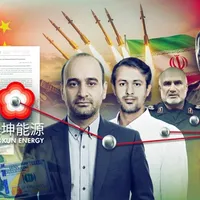
A Tehran-based company working on behalf of the Iranian military has spawned a network of shell companies to sell sanctioned Iranian oil to Asia and did business with a Netherlands-based firm that was aware of its government ties.
Business documents and emails obtained by Iran International reveal a layered network of shell companies used to mask the military links and channel the sanctioned oil through foreign intermediaries.
The firm, Sepehr Energy Jahannama Pars, was incorporated in November 2022 in Tehran. Within months, two affiliated companies—Sepehr Energy Paya Gostar Jahan and Sepehr Energy Hamta Pars—were registered in the same building.
Corporate records identify Sepehr Energy Jahannama Pars as the controlling shareholder in both. Registered firms in Iran are required to have four names.
Individuals central to the operation include Majid Azami, Elyas Niroumand Toumaj, Farshad Ghazi, Majid Rashidi, and Mojtaba Hosseini. The US Treasury added Azami and Niroumand to its sanctions list in November 2023. The others have not been designated.
In an appeal sent days after the sanctions were imposed, Azami and Niroumand denied any military affiliation, saying there was a misunderstanding based on similar naming.
They told the US Treasury their companies were involved in civil construction and trade and had been “experiencing harassment from both sides” since the designation.
However, Farsi-language draft contracts and internal memoranda contradict their argument. One agreement 2023 identifies Sepehr Energy Hamta Pars as acting on behalf of the Iranian armed forces' general staff in negotiations with Persian Gulf Star Oil Company.
Another set of shipping documents shows the same military body guaranteeing Sepehr Energy Jahannama Pars’ obligations in chartering vessels from the National Iranian Tanker Company.
To obscure these links, the network appears to have operated through a proxy firm in Hong Kong. In April 2023, Xin Rui Ji was registered there, with a nominal Chinese executive listed in filings. Yet, communications from Xin Rui Ji were routinely copied to Niroumand and other Sepehr managers.
One August 2023 letter requested the National Iranian Tanker Company deliver crude to Xin Rui Ji without a bill of lading—critical for cargo tracking—via ship-to-ship transfer in Singapore.
The transfer of cargo from one ship to another is a method used by the Islamic Republic to obscure its role in the sale of oil and petroleum products in order to evade sanctions.
Often in Malaysian and Singaporean waters, it is relabeled as oil originating from Iraq, the United Arab Emirates, Oman or particularly Malaysia.
The same contact information and domain used by Sepehr Energy appeared on Xin Rui Ji contracts, pointing to a unified operation.
Xin Rui Ji sought buyers across Europe, China, and the Persian Gulf. One such client was the Netherlands-based Gemini Group, which advertises global reach in oil and energy trading. In September 2023, Gemini delayed payment for a crude shipment citing banking concerns and “rumors online about sanctions.”
In one email dated 30 October 2023, Gemini representative Niek Tersteeg confronted his Iranian counterpart Elyas Niroumand about a delayed payment. While citing confusion over contract terms, Tersteeg made clear that the problem was not procedural.
“The only reply we are getting are your statements that your side is governmental,” he wrote.
Tersteeg added: “This morning I personally will call my contacts inside the Government in Tehran to check if they can assist finding a solution.”
The email indicated that Gemini had longstanding experience dealing with sanctioned Iranian entities.
“Let us not talk about the 'commission payments' behind the curtain. In short: please forgive my honesty and directness, we are the ones working, financing, taking all the risks while lots of people are waiting in their rocking chairs for their pockets to be filled,” added Tersteeg in his email.
Five days later, on 5 November, Tersteeg followed up in another message addressed to Niroumand and Majid Azami, both of whom were sanctioned by the US government. He expressed appreciation for their collaboration and emphasized the depth of their partnership: “We are not the enemy. We are true friends and brothers ready, willing and able to take any risk.”
Tersteeg then recounted his own arrest in the Netherlands for dealings with Iran. “I myself was in put jail in 2013 by the Dutch secret service for my trading activities with your beautiful country on special, urgent request of the USA Government.
"They didn’t break me. I kept my mouth shut. After several days the Dutch secret service and Dutch Government found out that I did nothing wrong and they released me from prison with written apologies. The USA Government did not apologize and placed me on certain lists. I am not allowed to travel and enter the USA and Israel. No problem for me.”
Contacted by Iran International, Tersteeg denied any contractual ties with Sepehr Energy. He said personal and commercial links with Iranian officials were confidential.
The documents depict a sanctions evasion structure that operated with strategic cover and foreign complicity, exposing vulnerabilities in enforcement mechanisms meant to isolate Iran’s military-linked commerce.
The drop in Iran's oil exports comes as the government, led by Masoud Pezeshkian, plans for daily exports of 1.85 million barrels this year.
Before US sanctions in 2018, Iran exported 2.5 million bpd. This figure plummeted to 350,000 bpd by the final months of Donald Trump's presidency in 2020. However, Iran’s oil exports gradually increased under his successor.
A builder works on the construction of the Dehshir gas pressure-boosting station in Yazd Province
A gas deal inked last month between Moscow and Tehran to transfer vast Russian volumes by pipeline via Azerbaijan faces the same logistical and financial obstacles that have sunk decades of energy deals between them before.
During a visit to Moscow Iran’s Oil Minister announced that Russia has agreed to export 55 billion cubic meters (bcm) of gas annually to Iran, claiming that this would turn Iran into a regional gas hub.
Mohsen Paknejad said on April 25 that various routes were considered and it was finally agreed that the gas would be delivered via land through the Republic of Azerbaijan, with Russia’s gas handed over to Iran in Astara.
While the Mozdok–Baku pipeline can transfer Russian gas to Azerbaijan, and the Baku–Astara pipeline can transport it to Iran, the combined daily capacity of these pipelines is only about six million cubic meters per day (mcm/d).
By contrast, Iran faces a gas shortfall of approximately 150 mcm/d during warmer months—rising to double that amount in colder seasons.
This means that the proposed Russian gas deliveries to Iran would not even cover a small portion of the country’s gas deficit—let alone turn Iran into a regional gas hub.
Paknejad has described this as the “first phase” of the gas deal, implying that new pipelines will be required to realize the full annual export volume of 55 bcm, which equals around 150 mcm/d.
The key issue here is that Gazprom, Russia’s state-run gas company meant to supply the gashas suffered massive losses of $18 billion over the past two years after losing its European markets following Russia's full-scale invasion of Ukraine.
Gazprom lacks the funds to complete an even more politically desirable “Power of Siberia 2” pipeline to China designed for the same annual capacity of 55 bcm.
Building a new pipeline connected to Russia’s main gas transmission network to deliver gas to Iran would require a stretch of at least 1,000 kilometers, demanding more than $10 billion in investment. If the pipeline were to cross the Caspian Sea, the cost could exceed $20 billion.
Another crucial point is that to become a regional gas hub, Iran must receive large volumes of gas from Russia and sell it to neighboring countries.
But Turkey already receives Russian gas directly via two pipelines, and most of Iran’s other northern and southern neighbors are gas producers or exporters themselves. Iran’s only potential customers would be Iraq, Pakistan, and Afghanistan.
Iraq plans to eliminate its need for gas imports within the next few years. Pakistan, despite a gas deal with Iran signed in 2009, has not built the pipeline due to sanctions.
Under the current contract, Iran would export only 7.5 bcm annually to Pakistan—raising questions about what Iran plans to do with the rest of the gas received from Russia.
Iran suffers from a gas deficit of 150 mcm/d in summer and 300 mcm/d in winter, and it could use Russian gas to meet its domestic needs.
However, 55 bcm of gas is worth around $15 billion, and Iran simply doesn’t have the money to pay for such a massive volume of gas. Even if it did, the government would need to provide enormous subsidies for its domestic use, given that gas prices in Iran’s domestic market are extremely low.
To illustrate, the Iranian government plans to sell 240 bcm of gas to the domestic market this year, earning only about 3,300 trillion rials in revenue—which, at the current exchange rate, amounts to less than $4 billion.
More Hollow Claims of New Oil Deals
Iran’s oil minister also announced that $4 billion in oil contracts have been signed with Russian companies.
Over the past two decades, Russian firms have signed more than a hundred contracts and memoranda of understanding (MoUs) with Iran, but almost none of the projects have ever gotten off the ground.
Paknejad provided few details, merely stating that “four contracts worth $4 billion have been signed with Russian companies for the development of seven oil fields.”
However, three years ago, Mohsen Khojastehmehr, then-CEO of the National Iranian Oil Company, made a similar announcement, saying that “contracts with Russian companies for the development of seven oil fields, worth $4 billion, have entered the operational phase.”
This strongly suggests that the contract Paknejad is referring to had already been signed years earlier—yet no action has been taken by the Russian side, contrary to Khojastehmehr’s assertions.
Back then, Iran and Gazprom had also signed 40 oil and gas memoranda of understanding, none of which led to any contracts or actual projects.
At the time, Iranian oil officials under President Ebrahim Raisi described the MoUs as being worth “$40 billion”, calling them “the largest deal in the history of the country’s oil and gas sector.”
Unlike formal contracts, MoUs do not carry any binding legal obligations, nor do they typically have a defined financial value—they are merely frameworks for studies and future negotiations aimed at signing actual contracts.
"I warn those enemies who are sometimes under the illusion that they can threaten Iran: you may be the ones to start a conflict, but it will be Iran that decides how it ends—when, where, and in what manner the battle continues," Chief of Staff of Iran's Armed Forces Mohammad Bagheri said on Monday.
"Any miscalculation will come at a heavy and regrettable cost for the aggressors."
The top military official was visiting Islamic Revolutionary Guard Corps (IRGC) and other military installations on a tour of the Persian Gulf coast.
"Based on field assessments and on-site inspections of army and IRGC units, we have gained full confidence that, in terms of intelligence dominance, combat capability, morale and operational planning, we are at the highest possible level."
Iran's foreign minister Abbas Araghchi warned Britain, France and Germany against triggering United Nations sanctions over Tehran's nuclear activities, saying such a move could spark what he called an irreversible escalation of tensions.
"Iran has made its position clear. We have officially warned all JCPOA signatories that abuse of the snapback mechanism will lead to consequences — not only the end of Europe's role in the agreement, but also an escalation of tensions that could become irreversible," Araghchi wrote in the French magazine Le Point.
Araghchi was referring to a 2015 nuclear deal to which the countries were signatories, enabling any of them to trigger the so-called snapback of sanctions should they deem Iran non-compliant.
Hezbollah has asked Iran to withdraw officers from its Islamic Revolutionary Guard Corps (IRGC) currently based in Lebanon following growing fears over potential Israeli assassination attempts, Al Arabiya reported on Monday.
According to regional sources cited by Al Arabiya and Al Hadath, the Lebanese armed group, closely aligned with Tehran, is monitoring ongoing nuclear negotiations between Iran and the United States in Oman.
Hezbollah apparently fears that any Israeli strike targeting IRGC personnel could derail the talks and put Iran in a difficult diplomatic position, according to the report.
“Israeli Prime Minister Benjamin Netanyahu is expected to use every possible means to pressure Tehran and obstruct its nuclear progress,” the sources said, suggesting that any high-profile Iranian casualty in Lebanon could serve as a pretext for escalation.
IRGC officers are believed to reside in discreet locations in Beirut’s southern suburbs and in the Bekaa Valley, and typically move under strict security protocols.
Israeli intelligence has previously succeeded in targeting IRGC-linked figures and Hezbollah commanders during recent conflicts in Lebanon.
Neither Hezbollah nor Iranian officials have publicly confirmed the reported withdrawal request.
Last year, seven senior IRGC commanders and officials were killed in an Israeli strike on the Iranian consulate complex in Damascus, triggering Iran's first ever direct airstrike on the Jewish state.