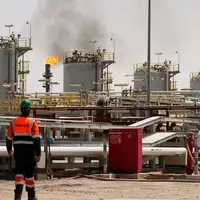
Iran's Islamic Revolutionary Guard Corps (IRGC) is seeking to sell oil stored in China before US president-elect Donald Trump can block sales with tougher sanctions, an informed source told Iran International.
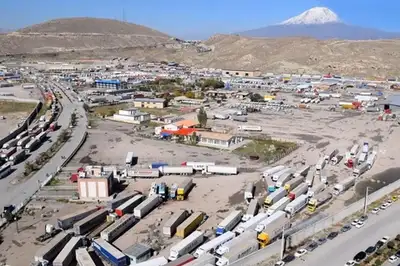
Iranian authorities have instructed the IRGC to sell the sanctioned oil stored at Dalian Port in northeast China through intermediary firms, the source speaking on condition of anonymity said.
“The directive stems from concerns that a return of Donald Trump to power and the reimposition of his ‘maximum pressure’ policy might freeze access to these reserves, estimated to be worth around $1 billion," the source said.
"The sale of these reserves is reportedly being facilitated through financial guarantees provided by Iranian companies operating in China.”
Data from tanker-tracking firm Vortexa shared with Iran International show that after a decline in oil sales, Iran's floating oil reserves have surged from approximately 36 million barrels in mid-September to 48 million barrels this month - an increase also valued at nearly $1 billion.
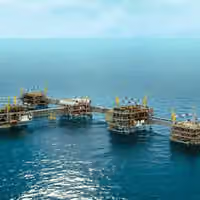
Per the Iranian budget, at least 12.6 billion dollars of Iran's oil exports are earmarked for the IRGC, empowering the paramilitary body to sell the oil to Chinese customers and use the revenue to bolster its armed capabilities and militia allies in the Middle East.
Iran’s oil, sanctioned by the United States and its allies, is often rebranded using tankers from a so-called dark fleet.
Often in Malaysian and Singaporean waters, it is relabeled as oil originating from Iraq, the United Arab Emirates, Oman or particularly Malaysia. This rebranded oil is then shipped to China’s smaller independent refineries, known as teapots.
Shandong Port in China serves as the primary hub for this rebranded oil. However, tanker-tracking companies have observed a significant rise in shipments to Dalian Port this year.
The US Treasury Department this month blacklisted 45 tankers for aiding Iran in circumventing sanctions. According to industry sources, these tankers were primarily used to transport Iranian oil to Shandong Port.
Despite this, over 100 large vessels remain unsanctioned in the dark fleet remain unsanctioned according to Vortexa data and continue to carry Iranian oil to China, albeit at reduced volumes.
Iran International reported earlier this month that Iran's daily oil exports had dropped by over half a million barrels per day (bpd) compared to September, falling to approximately 1.3 million bpd in November.
Data from Kpler, a commodity analytics firm, shows that Iran’s average daily oil exports this year stood at about 1.6 million barrels, with almost all of the exports directed to China.
This marks an increase of 300,000 bpd compared to last year. However, the volume of oil delivered to China has plummeted in recent weeks. Additionally, Iran has ceased oil shipments to Syria following the fall of Bashar al-Assad.
Tanker Trackers recently reported that, coinciding with Assad’s downfall, the last Iranian oil tanker carrying 750,000 barrels returned from the Suez Canal to Iran.
The future of Iran's oil exports to China remains uncertain. Yet, Vortexa data shows that Iran's unsold floating oil reserves continue to rise.
Most of Iran's floating oil is stored in Singaporean waters, awaiting brokers and buyers for shipment to China.
The drop in Iran's oil exports to 1.3 million barrels comes as the government, led by Masoud Pezeshkian, plans for daily exports of 1.85 million barrels next year.
Before US sanctions in 2018, Iran exported 2.5 million bpd. This figure plummeted to 350,000 bpd by the final months of Donald Trump's presidency in 2020. However, Iran’s oil exports gradually increased under his successor.
Top figures in the incoming Trump administration have pledged to renew his maximum pressure policy against Iran.
Donald Trump’s maximum pressure policy was never aimed at regime change, his last special envoy for Iran told Iran International. It was about making a deal.
Achieving a comprehensive plan to halt Iran’s nuclear and regional ambitions is likely the endgame for Trump’s second presidency, said his former special representative for Iran during the first Trump administration.
Elliott Abrams, a veteran hawk, told the Eye for Iran podcast that most people remember maximum pressure but do not properly comprehend what the goal was.
“For better or worse, it was not the overthrow of the regime,” said Abrams “His criticism of the Obama deal was that it was time bound, and it was not comprehensive. It didn't deal with Iran's missile program or Iran's support for terrorism.”
The president-elect is still striving for such a deal, according to Abrams.
The former Iran envoy fears Trump’s zeal for a deal could get him dragged into meaningless negotiations which buy Tehran time to advance its nuclear program.
Tehran
“Iran will trap him [Trump] in negotiations that will go on and on and on and on and on while they are trying to advance with their nuclear program.”
Iran Foreign Minister Abbas Araghchi said that they are prepared to cooperate with the United Nations nuclear watchdog. Araghchi made the remarks during a telephone conversation with the International Atomic Energy Agency (IAEA)’s Director-Genral Rafael Grossi on Monday.
Trump’s former Iran envoy believes Iran's sudden willingness to cooperate with the IAEA after shunning its inspectors and boosting its uranium stockpile is all part of Iran’s plan to get the president-elect to the negotiating table.
Abrams sees some of Trump’s cabinet picks like senator Marco Rubio for secretary of state and Mike Waltz as national security adviser as guards against any feints by Iran. Both are seen as hawkish Republicans and long-standing critics of Iran.
“They have robust records of understanding Iran and understanding the evil of the regime. And so, they are obstacles to that happening, which is a very good thing,” he said. "I'm just hoping that people like Waltz and Rubio will say to the president when he becomes president again, this is the Iranian game. Don't fall for it.”
But the possibility of the president-elect being fooled is not inconceivable, according to Abrams, and the new administration will have some divergent voices such as Tulsi Gabbard, Trump’s pick of director of national intelligence. Gabbard has expressed sympathy for the outlooks of Syria’s former ruler Bashar Al-Assad and Russian president Vladmir Putin.
“The regime in Tehran knows this and they're very clever and they will try to play off of this,” added Abrams.
The choices the Islamic Republic faces are difficult.
With Iran’s axis of resistance clearly on the backfoot after 14 months of Israeli attacks, the loss of its most important Arab ally Syria after Assad's swift collapse and Israel's destruction of Iran’s air defense and missile facilities in October leaves Tehran with little room to maneuver.
Will Iran decide to cooperate with the US and adopt a more dovish tack? It seems unlikely to Abrams, who also worked with George W. Bush on US policy in the Mideast.
This spanned the invasion of Iraq over the threat from weapons of mass destruction which were never found, leading to the deaths of thousands of American troops and hundreds of thousands of Iraqis in a war critics say sapped US influence abroad.
A dash to become a nuclear power is the more likely and worrying scenario, he said, cautioning that the Soviet Union’s nuclear status did little to stop its collapse.
Abrams said Tehran must now ask itself in the words of Henry Kissinger: “will they decide to be a nation rather than a cause?"
Iranian politicians and media are grappling with the implications of Assad's fall on Tehran's future relations with Damascus. Simultaneously, the Iranian government is attempting to justify its substantial expenditures in Syria since 2011.
Both developments are overshadowed by the broader changes and challenges Iran faces in this new geopolitical reality, which has prompted a shift in the rhetoric of some analysts and officials.
Hassan Beheshtipour, a conservative commentator who frequently appears on Iran's state TV, told Nameh News that Assad had distanced himself from Iran in recent months under the influence of the United Arab Emirates. He explained that the UAE had convinced Assad that, while Iran stood by him during the long war, his Arab neighbors could provide stronger support in times of peace.
Beheshtipour described the future of Iran-Syria relations as uncertain, warning of a rocky path ahead marked by potential instability in Syria and the region. He added that Syria's transitional period could extend for an extended and unpredictable duration.
While many Iranian commentators outside Iran, such as Ali Hossein Ghazizadeh, speaking to Iran International TV, have predicted that Iran’s Supreme Leader Ali Khamenei could be the next to exit the regional political scene, the state-monitored media in Tehran avoid discussing such scenarios. For them, analyzing the impact of Assad's fall on Iran's political future remains a taboo subject.
Meanwhile, numerous Iranian commentators outside the country, including Morad Veisi, Mehdi Mahdavi Azad, Jaber Rajabi, and Mohsen Sazegara, have highlighted widespread dissatisfaction among Iranians over the estimated $30 to $50 billion that Khamenei has allocated to support Assad in Syria. Within Iran, Heshmatollah Falahatpisheh, the former chairman of the National Security and Foreign Relations Committee in parliament, had been one of the few politicians bold enough to openly criticize Khamenei for this substantial expenditure. However, he now appears to have softened his stance, possibly due to political pressure.
In an interview with Iranian media earlier this week, widely covered by various outlets, Heshmatollah Falahatpisheh suggested that Iran should work to restore diplomatic ties with Syria as a way to reclaim the billions it has spent in the country. However, convincing the incoming government in Damascus—once formed—to repay the funds provided to the ousted president will likely prove challenging. Moreover, even if Bashar al-Assad had remained in power, Iran was unlikely to formally pursue such a claim.
Falahatpisheh also revealed that he faced insults and threats from certain Iranian politicians when a few years ago he initially spoke out about Tehran's multi-billion-dollar expenditures in Syria.
In another development government spokeswoman Fatemeh Mohajerani told the press on Tuesday that the spending in Syria was meant to serve Iran's national interests. However, she made it clear that such decisions are made by officials higher up in the system [meaning Khamenei] and the presidential administration simply carries out those decisions.
Both Beheshtipour and Falahatpisheh advised Iran to steer clear of political developments in Syria for the time being and commended the decision to abstain from military intervention to save Assad. Beheshtipour cautioned that Syria could become a quagmire for Iranian forces, while Falahatpisheh praised the restraint shown in ignoring calls from hardliners, including members of the ultraconservative Paydari Party, who last week and over the weekend urged for troops to be deployed to Syria.
Beheshtipour also suggested that Iran and the broader "axis of resistance" should explore alternative routes outside Syria for maintaining communication and logistical networks. Additionally, he proposed that Tehran work with Turkey, Russia, and the United States to establish a democratic political order in Syria. However, he did not elaborate on why these major players would be inclined to involve Iran in such a process.
Addressing the same issue, Hossein Ali Hajideligani, a conservative member of the Iranian parliament, remarked: "The presence of the conquerors of Syria poses a significant challenge for us. If we cannot continue our past activities in Syria, it is natural that they, too, will be unable to sustain their efforts in the long run."
Some Iranian ultra-hardliners online are blaming the ouster of Tehran's Syrian allies on the Revolutionary Guards and the commander of its foreign arm the Quds Force in cautious but rare social media broadsides at a key ruling institution.
Ultra-hardliners who refer to themselves as 'arzeshi' or guardians of Islamic Republic's values were venting their frustrations against Esmail Qaani in closed groups such as the homegrown Eitaa cast platform and on Telegram.
“Why doesn’t anyone say anything? Why were Iran Air’s flights to Damascus and Iraq to Damascus halted? Why was the Lebanese border to Syria blocked? Why didn’t they let us go there [to fight]?” one user wrote, asking why has the Quds (Qods) Force - the regional spear of Iran's Islamic Revolutionary Guards had not acted or spoken up.
Deploying the hashtags Qaani and Quds Force on Tuesday, another user snapped: “Leaders of Hezbollah were martyred, the Axis of Resistance withdrew from Syria, yet no one heard anything from the Quds Force commander."
Others pointed out that Qaani was not present at the Parliament’s closed meeting with the Revolutionary Guards’ Commander-in-chief General Hossein Salami on Thursday and wondered whether he had been dismissed by Supreme Leader Ali Khamenei.
Qaani has been seen in public only rarely since October.
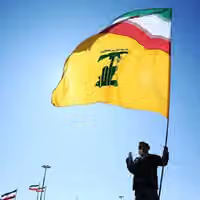
Commentators at the time viewed his absence as a sign of possible disfavor given huge setbacks dealt to Hezbollah by Israel including the assassination of its leader Hassan Nasrallah alongside a top Quds force commander.
The last time Qaani appeared was at a mourning ceremony on the death anniversary of Prophet Mohammad's daughter, Fatima, at Khamenei’s residence on Dec. 7. Iranian media noted that Qaani appeared in civilian clothing, unlike other military commanders at the ceremony.
Iranian Islamic Revolutionary Guard Corps (IRGC) forces and foreign militias such as the Fatemiyoun and Zeynabiyoun brigades were deeply involved in defending Assad during Syria’s civil war for over a decade.
Unusually, state television did not give live coverage of the speech and only aired two excerpts as the Islamic Republic faced some of the biggest blows to its regional influence in its near half-century existence.
Assad’s fall has presented a serious challenge to commentators who claim to be guardians of so-called Islamic revolutionary values on how to interpret the events but steer clear of questioning the system's ultimate ruler Khamenei.
Most have directed their ire toward the country’s military institutions according to a commentary titled in part, “Has the Revolutionary Current Lost Its Trust in the Military?” by the relatively independent Rouydad24 news website on Thursday.
“With the fall of Damascus and the end of Bashar al-Assad’s rule in Syria, groups in cyberspace which until now interpreted the equations in the Middle East in Iran's favor are facing an analytic crisis and blaming parts of (the Iranian) government,” the commentary added, noting that many among the arzeshi groups are silent “mostly because they do not dare to speak openly” about the matter.
Iran's Attorney General’s Office on Thursday warned media outlets and online activiststo avoid discussions of the downfall of Tehran's ally Bashar al-Assad in Syria that could undermine domestic security. Iranian media on Thursday reported that the judiciary has indicted at least eight commentators, journalists, and activists in relation to their social media comments in this relation.
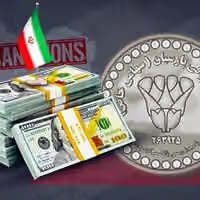
Iran faces the threat of tougher sanctions as Britain, France, and Germany warn of a potential snapback of UN measures against Tehran that were lifted as part of the 2015 nuclear deal.
Iran has ramped up enrichment of uranium to up to 60% purity, edging closer to the 90% needed to be weapons grade, according to the UN nuclear watchdog chief, Rafael Grossi.
If successful, a “snap back” by the group known as the E3, would force Iran to suspend all nuclear enrichment-related and reprocessing activities, including research and development, and ban imports of anything that could contribute to those activities or developing nuclear arms delivery systems.
"Iran must deescalate its nuclear program to create the political environment conducive to meaningful progress and a negotiated solution," the UN ambassadors of Britain, Germany and France wrote in a December 6 letter to the Security Council.
"We reiterate our determination to use all diplomatic tools to prevent Iran from acquiring a nuclear weapon, including using snap back if necessary," they said.
Earlier this year, Grossi warned Iran is "weeks not months" away from a nuclear weapon.
A “snap back” would also see a conventional arms embargo reimposed, banning Iran from developing ballistic missiles capable of delivering nuclear weapons and revive targeted sanctions on dozens of individuals and entities.
Iranian shipments would also be more heavily scrutinized globally with threats of cargo being seized.
As the diplomatic crisis deepened, European and Iranian diplomats met late last month to discuss whether they can work to defuse regional tensions, including over Tehran's nuclear program, before Donald Trump's return to the White House, which promises a “maximum pressure” stance on Iran.
Iran has pushed back against the action by the E3, its UN ambassador, Amir Saeid Iravani, urging the group to "abandon their ineffective and failed policy of pressure and confrontation," saying they "should embrace diplomacy and focus on rebuilding the trust essential to resolving the current impasse."
The E3 has intensified its pressure on Iran following the Russian war in Ukraine, as Tehran's military support for Russia has prompted additional sanctions from the international community.
Iran’s ally Russia also criticized the E3's actions, with UN Ambassador Vassily Nebenzia asserting on Tuesday that Britain, Germany, and France had no authority to invoke the "snapback" of sanctions. He described their suggestion of potentially using the "snapback" mechanism as both unjustified and irresponsible.
In his biannual report to the UN Security Council on the implementation of the 2015 nuclear deal, known as the JCPOA, Antonio Guterres, the UN Secretary General, warned of a "critical need for a peaceful solution to the Iranian nuclear issue" while conflict and instability continues across the Middle East.
During his first term, Trump quit the nuclear deal in 2018, and now, threatens to toughen down further. He has already enlisted a range of figures known to be tough on Iran and on Wednesday, Reuters reported that the President-elect is now considering Richard Grenell, his former intelligence chief, to be a special envoy for Iran.
However, Grenell denied the report, writing on X: “This is made up.”
A prominent centrist figure in Iran says that the ongoing deadlock over enforcing the new hijab law and lifting censorship on the Internet has effectively paralyzed the Pezeshkian administration.
Meanwhile, Reformist commentator Abbas Abdi argues that these issues highlight the hard-liners’ resistance to Masoud Pezeshkian's efforts to bridge the gap between the people and the government.
Abdi also criticized the President, holding him personally accountable for the continued censorship of social media in Iran.
Ali Rajaei, a centrist figure within Iran's Islamic political establishment, stated in an interview with the Khabar Online website in Tehran that no significant progress has been made in Iran's foreign relations or the government's cultural and economic policies since Pezeshkian assumed office four months ago. However, he emphasized that all Iranians should work together to strengthen the government and help it preserve its social capital.
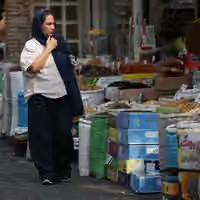
"People measure the government's success by seeing how it tackles the problems of hijab and filtering [of the Internet]. At the same time, the government's opponents do not allow it to solve the problems," Rajaei said, adding that "the President cannot do much about other problems if he cannot stand by his promises to lift the filtering and prevent violent hijab enforcement."
He also argued that Iranians see no change in the situation of their livelihood and the government, and the parliament have done very little to improve the situation.
Rajaei said that he does not see any bright prospect for the hijab problem as the President appears to be lacking the bargaining power to convince the hardliners to step back from the new hijab enforcement law.
Meanwhile, Khabar Online website quoted Vice President Mohammad Jafar Ghaempanah as saying that at least 60 percent of Iranians oppose internet restrictions and collectively spend approximately 200 trillion rials (around $300 million) annually on VPNs to bypass the filtering. Ghaempanah also told the Reformist daily Arman Melli that all 15 members of the Supreme Council of Cyberspace are opposed to lifting the restrictions.
According to Reformist commentator Abbas Abdi, the statements by the vice president indicate that there is no short-term solution for the problem of filtering. Abdi added that President Pezeshkian and his administration should be hold accountable. "If there are individuals who can continue to enforce the filtering against the calls made by the President and his aides to lift the censorship, this means that other promises made by Pezeshkian are unlikely to be met," Abdi said.
Abdi further argued, "If a government backed by the people's vote cannot fulfill its promises, it might as well step aside and allow the hardliners to implement their policies." He questioned, "Did Pezeshkian not realize he couldn't uphold his promises when he made them? His excuses now are unacceptable." Abdi added, "It is not enough for the President and his aides to merely oppose internet filtering. People voted for them with the expectation that they would bring about meaningful change."
Motahaeh Shafiei, the lead columnist for Arman Melli newspaper, wrote that based on the Vice President's remarks and Pezeshkian's track record, lifting internet censorship is likely to become increasingly challenging.
Meanwhile, hardline commentator Abbas Nalimi-Namin suggested that the executive and legislative branches should postpone implementing the new hijab enforcement law, as both have acknowledged ambiguities in its enforcement. He further argued that hardliners like Ahmad Alamolhoda, the Friday Prayers Imam of Mashhad, who demand the law's immediate implementation, do so from within an insular circle disconnected from Iranian society and public sentiment.