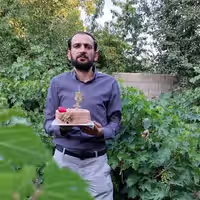
Even if the United States smiles and speaks kindly, it remains Iran’s enemy, said Nadergholi Ebrahimi, an Iranian parliamentarian from Arak.
Reacting to Donald Trump’s demand for the dismantling of Iran’s nuclear program, Ebrahimi said, “Whether America smiles, frowns, speaks gently, or holds bullets in its hands, it is still our enemy and we must not be lulled into excessive optimism or neglect.”
He added that negotiations should continue only if they lead to the lifting of sanctions, but warned, “If Trump’s insistence on dismantling our nuclear facilities continues, we will call for the talks to be cut off.”

Any decision on reaching a deal with the United States ultimately lies with Supreme Leader Ali Khamenei, said Asadollah Badamchian, head of Iran’s Islamic Coalition Party.
“If tomorrow Khamenei says we shouldn’t sign a deal with America, we must say yes, sir,” he told supporters.
Dismissing warnings of a possible US military strike, Badamchian said, “They say America wants to attack—attack what? A few power plants? Even Israel couldn’t hit us.”
He also demanded the US return frozen Iranian assets and questioned its right to block Tehran’s trade with other countries.
He defended discounted oil sales to China, saying Iran has the right to offer lower prices in exchange for essential imports.

Israeli Foreign Minister Gideon Saar said on Sunday that Iran, which he described as "the most dangerous regime in the world," must not be allowed to obtain nuclear weapons.
At a press conference in Jerusalem, Saar said, “Iran is the most dangerous state in the world... The most dangerous regime must not be allowed to obtain the world’s most dangerous weapon."
Saar called for the dismantling of Iran’s uranium enrichment facilities and urged international partners to ensure the Islamic Republic is not permitted to acquire additional weaponry.
“Tehran's enrichment infrastructure must be dismantled,” he said. “Iran must not be allowed to acquire new weapons or further entrench its military capabilities.”

A senior adviser to Iran’s foreign ministry said on Sunday that maintaining the country’s domestic uranium enrichment program is a non-negotiable demand of the Iranian people.
Hossein Ranjbaran, an adviser to Foreign Minister Abbas Araghchi, cited recent public opinion surveys as evidence of strong national support for Iran’s nuclear program. He did not provide further details about the surveys.
“Multiple credible polls over the past two weeks show an overwhelming majority of Iranians support preserving the domestic uranium enrichment cycle,” Ranjbaran wrote in a social media post that included footage of Araghchi speaking at a regional dialogue in Doha.
Speaking at the event, Araghchi said, “The Islamic Republic of Iran has declared the development and use of nuclear weapons as religiously prohibited and continues to abide by the global non-proliferation regime."


Iran warned that nuclear talks with the United States could collapse if Washington insists on what Tehran called “excessive demands,” as negotiators from both sides gathered in Oman for a fourth round of indirect discussions.
The talks, facilitated by Omani officials and held behind closed doors in Muscat, come amid escalating rhetoric from both capitals and ahead of a high-stakes Middle East trip by US President Donald Trump.
Before departing for Muscat, Iranian Foreign Minister Abbas Araghchi said Tehran had submitted a proposal intended to reassure the international community of the peaceful nature of its nuclear activities. He warned, however, that the talks would fail if the United States continues to push beyond nuclear weapon-related commitments.
“If demands exceed assurances against nuclear weapons, the talks could stall,” Araghchi told reporters in Tehran. “We hope the other side comes with a clear negotiating logic. Talks should remain at the table, not in the press.”
He added, "Iran has well-known positions based on clear principles... We hope to reach a decisive stance in Sunday's meeting.”
Araghchi also accused the United States of adopting contradictory positions. “There are actors pushing for conflict—we understand this, but it is their problem,” he said. “If there are concerns, we are ready to build trust.”
The latest discussions follow weeks of diplomatic shuttle visits and were initially scheduled to take place in Rome on May 3 but were postponed for logistical reasons.
Iran has emphasized that its delegation is operating “in accordance with directives and frameworks issued by the country’s decision-making hierarchy,” according to Foreign Ministry spokesman Esmail Baghaei.
“The team is committed to preserving Iran’s valuable achievements in peaceful nuclear energy while pursuing the removal of unjust economic sanctions,” he said.
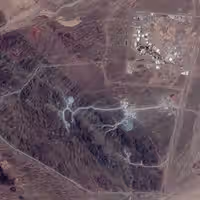
Tensions have mounted in recent days following comments by US envoy Steven Witkoff, who told Breitbart News last week that Washington's red line remains “no enrichment,” effectively calling for the dismantling of Iran’s nuclear infrastructure in Natanz, Fordow, and Isfahan.
Iranian state media and outlets affiliated with the Islamic Revolutionary Guard Corps (IRGC) reacted sharply to Witkoff’s remarks. The hardline Javan newspaper dismissed them as coercive, saying: “This is no longer called negotiation, it’s a stick.”
A member of Iran’s negotiating team told Lebanon’s Al Mayadeen network that Tehran would walk away if the US deviates from previously agreed frameworks.
A separate source quoted by Iraq’s Baghdad Al-Youm said the talks could “fail before they even begin” if Washington refuses to acknowledge Iran’s right to peaceful uranium enrichment.
Iran, which has consistently maintained that its nuclear program is peaceful, says it will not relinquish its enrichment capabilities. “The blood of our nuclear scientists has been shed for enrichment. This right is not negotiable,” Araghchi said before leaving for Muscat on Sunday.
Iran has accelerated its enrichment activities since 2019, exceeding limits set under the 2015 nuclear deal, which the US exited unilaterally in 2018. The UN nuclear watchdog has confirmed Iran’s enrichment of uranium to levels approaching weapons-grade, a move Tehran says is reversible if sanctions are lifted and credible guarantees are provided.
Trump has signaled openness to a diplomatic resolution but also warned of potential military action if diplomacy fails.
Trump is scheduled to visit Saudi Arabia, Qatar, and the United Arab Emirates from May 13 to 16. Analysts say the outcome of the Muscat talks could influence the trajectory of regional diplomacy and the future of Iran-US engagement.
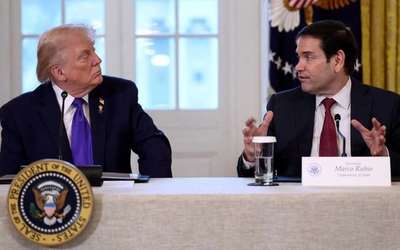
Ahead of the fourth round of indirect negotiations between Iran and the United States, Iranian Foreign Minister Abbas Araghchi met with his Omani counterpart in Muscat.
During the meeting, Araghchi outlined Iran’s core positions and key dimensions of the upcoming talks, as reported by the Iranian media.
The Omani foreign minister, who is mediating the negotiations, briefed Araghchi on the logistical and procedural arrangements prepared for this round.