Iran still considers Donald Trump its top assassination target, according to former US national security adviser John Bolton, who said Tehran maintains a list of current and former American officials marked for revenge.
Bolton, speaking on a podcast hosted by Sky News’ Yalda Hakim, said Iran's “terror network is really quite extensive in Europe and the United States,” and warned of Tehran’s persistent intent to avenge the killing of Qassem Soleimani, the IRGC commander slain in a 2020 US drone strike ordered by Trump.
The US Justice Department in 2022 charged Iranian national Shahram Poursafi with attempting to hire a hitman—who turned out to be an FBI informant—to kill Bolton.

President Donald Trump plans to announce that the US will begin officially referring to the Persian Gulf as the “Arabian Gulf,” the Associated Press reported — a move condemned by Iran as a politically motivated affront to its national identity and historical legacy.
The move, which comes amid a broader effort to deepen ties with Persian Gulf Arab states, marks a break with long-standing international convention, prompting sharp rebuke from Iran, which shares the longest coastline along the body of water.
Foreign Minister Abbas Araghchi called the reported decision politically motivated and historically inaccurate, saying, “The name Persian Gulf, like many geographical designations, is deeply rooted in human history.”
"Politically motivated attempts to alter the historically established name of the Persian Gulf are indicative of hostile intent toward Iran and its people, and are firmly condemned. Such biased actions are an affront to all Iranians, regardless of their background or place of residence,” Iran's top diplomat said on X.
Two US officials familiar with the matter, who spoke on condition of anonymity, said the announcement would be made while Trump visits Riyadh as part of a regional tour that includes Qatar and the United Arab Emirates—countries that have long pushed for the geographic name change.
“The president is expected to unveil what he calls a ‘historic reorientation’ of US nomenclature to better reflect regional alliances,” one of the officials said.
Trump himself teased a major announcement during a meeting at the White House on Tuesday. “It’ll be one of the most important announcements that have been made in many years about a certain subject, a very important subject,” he said.
Known globally as the Persian Gulf since at least the 16th century, the name of the inland sea has become a politically and culturally charged issue. Arab states often use “Arabian Gulf” in official documents and maps, while Iran considers the historical term a matter of national identity.
“The Persian Gulf is not just a name. It is part of who we are,” an Iranian diplomat in Tehran said on condition of anonymity. “Changing it under pressure from petrodollars will not erase thousands of years of history.”
In 2017, during Trump's first administration, his first reference to what he called the "Arabian Gulf" led to public backlash from Tehran.
The Iranian foreign minister at the time, Mohammad Javad Zarif, said: “Everyone knew Trump’s friendship was for sale to the highest bidder. We now know that his geography is, too.”
Iran’s then-president, Hassan Rouhani, also criticized the phrasing, saying Trump should “study geography.”
The US military has unilaterally used “Arabian Gulf” in communications for years, but the White House’s official adoption of the term would represent a new level of endorsement, likely increasing tensions with Tehran.
Under international maritime law, the designation of sea names is handled by the International Hydrographic Organization (IHO), which currently recognizes the body of water as the “Persian Gulf.” The United Nations and most world maps do the same.
While Trump can direct US federal agencies to use a different name, he cannot enforce the change globally. Congressional legislation would be required to make the shift permanent in US law, and a future administration could easily reverse it.
“Trump can rename it on White House letterhead, but that won’t change global consensus,” said Lisa Barry, a professor of international law at Georgetown University.
The renaming announcement is part of a broader push to align more closely with Persian Gulf Arab monarchies as Trump seeks increased investment from the region and backing for his policies on Iran and Israel.
The announcement also follows a controversial decision earlier this year to rename the Gulf of Mexico as the “Gulf of America” in US government usage—a move that led to a legal battle with the Associated Press.
A federal judge ultimately ruled that the AP could not be denied access to government events for refusing to adopt the administration’s preferred terminology, citing First Amendment protections.
The inland sea in question spans about 251,000 square kilometers (97,000 square miles) and borders eight nations: Iran, Iraq, Kuwait, Saudi Arabia, Bahrain, Qatar, the UAE, and Oman. Iran alone accounts for more than 1,600 kilometers (1,000 miles) of its coastline.
Trump is scheduled to travel to Saudi Arabia, Qatar, and the UAE from May 13 to 16. The announcement is expected to be made during a keynote speech in Riyadh, though officials said the precise timing remains fluid.
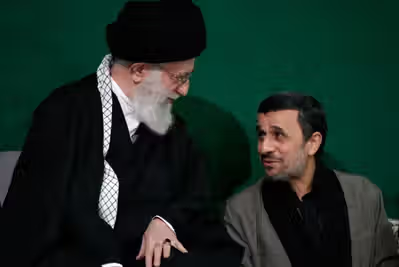
US President Donald Trump is expected to announce during his upcoming visit to Saudi Arabia that the United States will begin officially referring to the Persian Gulf as either the Arabian Gulf or the Gulf of Arabia, The Associated Press reported Tuesday citing two US officials.
"It is Iran's right to possess peaceful nuclear energy, and Trump cannot decide for our country whether we should have nuclear energy or not," Behrouz Kamalvandi, the spokesman for Iran's atomic energy organization, said on Tuesday.
He emphasized the "peaceful nature" of Iran's nuclear program and said: "We are currently constructing nuclear power plants across the country to produce nuclear electricity, and we are seriously pursuing this matter."

The arrest of five Iranian nationals on terror charges across the UK has led to renewed calls by lawmakers to designate Iran’s Islamic Revolutionary Guard Corps (IRGC) as a terrorist organization.
Security Minister Dan Jarvis told Parliament on Tuesday that the arrests marked "the first Iranian nationals arrested under the National Security Act.”
He said the Iranian state—including the IRGC and the Ministry of Intelligence and Security—had previously been placed on the enhanced tier of the foreign influence registration scheme.
“Anyone in the UK who works for the Iranian state must declare it or they will be committing a serious criminal offence,” he added.
The arrests, made on May 4 in London, Rochdale, Swindon, Manchester and Stockport, involved five men held under the Terrorism Act 2006 and three more under the National Security Act. Four remain in custody. Authorities believe the group was only hours away from attacking a specific location.
The Telegraph reported that at least one of the suspects is closely tied to the Islamic Republic’s leadership and comes from a prominent business family.
Jarvis said MI5 and police have responded to 20 Iran-backed plots since January 2022.
Liberal Democrat MP Lisa Smart criticized the government, saying, “Over recent years Members have been called to this Chamber to discuss plots to commit acts of terror on Britain’s streets at the hands of the Iranian regime—but consecutive Governments are yet to proscribe the Islamic Revolutionary Guard Corps as a terrorist organization.”
“If now is not the time for proscription, when should the House expect a further update?” she asked.
Labor’s Matt Vickers recalled the Home Secretary’s previous commitment to impose “appropriately targeted proscription-style restrictions” on state-linked entities such as the IRGC.
Labor and Co-operative MP Alex Sobel protested that he “asked many times for proscription of the IRGC, as it is certainly one of the bodies in Iran that is responsible for transnational repression,” while Labor MP Jon Pearce raised concerns that UK-based charities may be used to fund terrorism.
According to the government, a review of legal options by Jonathan Hall, an independent barrister, has been completed and will be published soon. Ministers have said they will not hesitate to act based on the findings.
Meanwhile, exiled Iranian prince Reza Pahlavi called the arrests further proof of what he calls Tehran’s global threat. “The arrest of Islamic Republic agents in the UK, on the brink of another terror attack, reinforces the need to proscribe the IRGC as a terrorist organization,” he wrote on X.
“This regime has proven, once again, that it will not change its behavior. It continues to spread terror not only in the Middle East but to target innocent civilians across Europe and the United States.”
"Any deal that lets Iran enrich uranium, keep centrifuges, or build missiles isn’t a deal—it’s a delay. Real peace requires real dismantlement," Republican Senator Tom Cotton said on Tuesday.