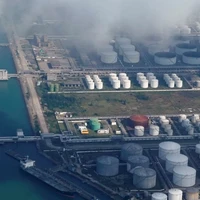
Iranian officials said several scenarios are being investigated as possible causes of the explosion at Shahid Rajaei port in Bandar Abbas, and the exact reason has not yet been confirmed.
Mohammad Ashouri, governor of Hormozgan province, said, "Several scenarios are being examined by the relevant authorities, and the cause will be announced once confirmed."
Following the blast, Iran’s First Vice President Mohammadreza Aref ordered an urgent investigation, speaking separately by phone with the provincial governor and the head of the Red Crescent. Interior Minister Eskandar Momeni also called for a special inquiry and dispatched the head of the National Crisis Management Organization to the area.
Iran’s customs authority has ordered all customs offices to halt the dispatch of export and transit shipments to Bandar Abbas’s Shahid Rajaei port until further notice, local media reported on Saturday.
Earlier, customs officials said trucks that had already completed customs formalities were being allowed to leave the port area.
The number of people injured in the explosion at Iran’s Shahid Rajaei port has risen to 281, Babak Yektaperest, spokesman for Iran’s emergency services, said on Saturday.
Many of the injured were transferred to hospitals across Hormozgan province, local outlets said.

Iran’s political and religious establishment is closing ranks to defend Supreme Leader Ali Khamenei’s backing of renewed negotiations with the United States, with clerics and hardliners urging the public to view flexibility as a continuation of revolutionary goals.
Khamenei on Thursday invoked a historic concession by Shia Islam’s second Imam, Hasan ibn Ali, who signed a controversial peace treaty with Mu'awiya in 661 CE. Without directly mentioning the ongoing US nuclear talks, he said the treaty was temporary and necessary to safeguard Islam’s future.
“Some people would come forth with complaints and objections when Imam Hasan made peace with Mu’awiya … it was temporary,” Khamenei said, signaling acceptance of tactical diplomacy.
The allusion mirrors Khamenei’s 2013 justification for the 2015 nuclear deal, when he framed negotiations as an act of “heroic flexibility.” His tone marks a significant shift from February, when he denounced engagement with the United States as “unwise and dishonorable.”
Analyst Hamed Moafagh Behrouzi, in an article published Saturday by the IRGC-linked Fars News Agency, interpreted Khamenei’s recent remarks as a reaffirmation of the Islamic Republic’s unwavering path, warning against simplistic readings of tactical shifts.
He wrote that evolving methods should not be mistaken for a change in objectives, adding, “The Islamic system is exactly on the same divine path.”
Mohammad-Javad Larijani, a senior Iranian political figure, praised the decision to open talks through Omani mediation.
He called the move “shrewd” in an interview with the IRGC-linked Tasnim News Agency, saying, “Diplomacy is, in fact, at the service of the country's security, military, defense, political, economic, and cultural objectives.”
Clerics during Friday prayers echoed the recalibration. Sermons widely broadcast across Iranian media stressed the need for accurate understanding of global conditions.
Tehran’s interim Friday prayers leader Mohammad-Hassan Aboutorabi-Fard said “Without the slightest doubt, the negotiations began from a position of dignity and power.”
Further endorsement appeared in a commentary by the hardline Kayhan newspaper, which operates under Khamenei’s supervision. The article described the apparent contradiction between opposing direct US talks and later allowing indirect negotiations as “two sides of a battlefield and part of real negotiation tactics.”
“Khamenei at the time did not regard negotiations as honorable or wise but, with steadfastness like Imam Ali’s, forced new conditions upon the enemy,” added the daily.
According to Kayhan, Khamenei “humiliated Trump” by imposing and cementing several strategic frameworks, then allowed indirect talks to “disarm the American president from using any pretext to claim Iranian nuclear military activity.”
Hardline reactions, however, have not been uniformly supportive. Some ultra-conservative figures have voiced frustration, accusing sections of the establishment of weakening the Islamic Republic's position.
In further comments Thursday, Khamenei appeared to address internal dissent, warning, “Our loose lips, our failure to help, our needless protests ... can sometimes have an impact. One must be very careful.”
Commentators noted that while Khamenei’s authority remains unchallengeable, dissatisfaction lingers among hardliners. “He is trying to warn and to provide a rationale (for his decisions) to his radical supporters,” US-based analyst Ali Afshari told Iran International TV.
Mostafa Pourmohammadi, a veteran conservative and former minister, separately defended Khamenei’s decision on Friday, likening negotiations to a real estate bargaining process where success depends on patience and strategy.
Taken together, the coordinated messaging from political insiders, clerics, and IRGC-linked outlets signals a broader effort to shield Khamenei’s shift from criticism.
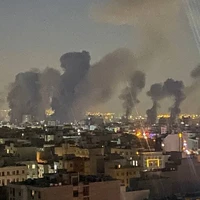
A powerful explosion rocked the Shahid Rajaee port in Iran’s southern city of Bandar Abbas on Saturday, coinciding with the start of the third round of indirect negotiations between Tehran and Washington in Muscat, Oman, local media reported.
The blast shattered windows several kilometers away, according to Fars News Agency. Tasnim news agency reported that the explosion was caused by a fuel tank for "unknown reasons."
At least 115 people have been injured and transferred to hospitals, Iran’s national emergency services chief told local media.
At least 115 people have been transferred to hospitals following the explosion at Iran’s Shahid Rajaee port, Yektaperast, head of Iran’s national emergency services, told Daneshjoo news agency on Saturday.