US technical team to discuss 'granular details' of Iran deal - CNN
A team of approximately 12 working-level experts from various US government agencies will discuss more granular details about a path to a new nuclear agreement, CNN reported Friday, citing a source familiar with the matter.
The talks in Oman on Saturday will cover elements including the scope of sanctions relief on Tehran and limitations on Iran’s nuclear program, the report added.
On Thursday, State Department spokesperson Tammy Bruce said Michael Anton, the department’s head of policy planning, will lead the US technical team in the upcoming talks.
Earlier, The Washington Post reported that a team of around a dozen representatives from various departments — including State, Treasury, and the intelligence community — convened at the State Department for the first time this week to discuss the still-undetermined parameters of the administration’s demands on Iran, which are awaiting a final decision from President Donald Trump.
A top Iranian cleric has described ongoing talks with the administration of US President Donald Trump led by his special envoy and fellow property magnate Steve Witkoff as akin to a real estate negotiation in which Iran will prevail.
Mostafa Pourmohammadi, secretary of the Combatant Clergy Association and a former interior and justice minister, said Iran would get a fair deal after initial posturing and an expected back and forth.
“You want to buy a house. The seller says one million. You walk away. He tells you to wait and brings in a broker. Then suddenly the asking price drops. In your mind, you're thinking 500 or 600 is reasonable. The broker says 750, and the deal is done,” the veteran insider and conservative said in comments carried by state media.
“Neither the seller really intended to sell for 750, nor were you ready to buy at that price. But in the end, it gets resolved. That’s negotiation.”
Pourmohammadi broadly defended Supreme Leader Ali Khamenei’s approval of negotiations with the United States, in remarks that appeared aimed at easing concerns in conservative quarters.
Khamenei’s evolving stance, he said, reflected “wise leadership” in a rapidly changing world. “You cannot say the Leader’s words at one time apply to all times and all cases,” Pourmohammadi said in remarks carried by local media.
“The world is turning moment by moment. We must have the power to make wise and timely decisions. This is the logic.”
Khamenei had in February called negotiations with Washington “unwise, undignified, and dishonorable.” His recent support for talks mediated by Oman and taking place during Donald Trump’s return to the presidency marks a notable shift, particularly given longstanding hardline distrust of US intentions.
Pourmohammadi said President Trump’s public threats were part of a broader political strategy. Referring to a letter Trump sent to Khamenei in March, he said: “If Trump had written in his letter what he said in public, he would never have received a reply. But his formal letters had a different tone, revealing his real politics.”
The cleric framed the current moment as part of a broader strategic contest. “It’s not as if there’s only one moment, one issue,” he said. “This is a psychological war, and the Leader is managing it with wisdom.”
Pourmohammadi has held several senior roles across administrations but is widely known for his involvement in the mass execution of political prisoners in 1988 while serving on a state-appointed committee at Evin Prison.
Human rights organizations and exiled dissidents have linked him to the killings, which Amnesty International described as crimes against humanity. Pourmohammadi has defended the executions in past interviews, saying they were in line with the Islamic Republic's wartime policy.
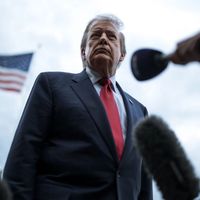
"Iran I think is going very well. We'll see what happens," US President Donald Trump told reporters on Friday.
Trump criticized former President Joe Biden for failing to resolve tensions with Tehran during his term.
"We're working on plenty of things that shouldn't be worked on, because none of this stuff should've happened. This should've been taken place by Biden. It should've been fixed by Biden. But he couldn't do it," Trump said.
Iran's Foreign Minister Abbas Araghchi and his delegation have arrived in Muscat for a third round of talks with the United States set to begin on Saturday, according to a spokesman for the Iranian Foreign Ministry.
"We are resolved to secure our nation's legitimate & lawful right to use nuclear energy for peaceful purposes while taking reasonable steps to demonstrate that our program is entirely peaceful," Esmaeil Baghaei said in a post on X announcing Araghchi's arrival.
"Termination of unlawful & inhumane sanctions in an objective and speedy manner is a priority that we seek to achieve," he added.
A senior Iranian lawmaker said Tehran could consider reopening embassies with the United States if direct negotiations and trade ties resume.
“If an agreement with the United States takes shape and commercial relations are established, it is natural that the two countries would reopen their consulates and embassies,” said Beytollah Abdollahi, a member of parliament’s Planning and Budget Committee, according to the Iranian news outlet Rouydad24.
Abdollahi also appeared to push back against the notion that direct talks with Washington are off-limits. “It’s not like a verse from the Quran that says we must never negotiate directly with America,” he said.
Senior Iranian clerics signaled guarded optimism toward renewed indirect talks with the United States over Iran’s nuclear program, while voicing the Islamic Republic's uncompromising stance on national sovereignty and sanctions relief.
Speaking at Friday prayers in Tehran, interim Friday prayer leader Mohammad-Hassan Aboutorabi-Fard said that Iran’s nuclear policy is rooted in a religious and political doctrine that prioritizes peaceful development while resisting external pressure.
"The Islamic Republic’s strategy is based on transparency about the peaceful nature of its nuclear program, the development of nuclear technology, and the lifting of oppressive sanctions," he said.
His remarks come against the backdrop of renewed indirect negotiations between Tehran and Washington, facilitated by Oman, with the second round held in Rome and third slated for Muscat on Saturday.
According to Aboutorabi-Fard, the talks were initiated "at the repeated request of the highest-ranking US official and are proceeding with caution due to America’s repeated breaches of previous commitments, especially the unilateral withdrawal from the JCPOA in 2018."
Iranian Foreign Minister Abbas Araghchi has characterized the Muscat-hosted dialogue as a test of American sincerity. "The talks in Oman are a test to gauge the seriousness of the US," Aboutorabi-Fard quoted the minister as saying. "Complete sanctions relief and legal guarantees can pave the way for real progress."
The Omani Foreign Ministry, which hosted the recent talks in Rome, said the goal is to reach a “fair and lasting nuclear agreement” that ensures Iran is free of nuclear weapons and also free from sanctions—while maintaining its right to peaceful nuclear development.
Tehran views the Omani statement as aligning closely with its own strategic roadmap. "This declaration reflects the correct direction of negotiations in line with Iran’s strategy," Aboutorabi-Fard added.
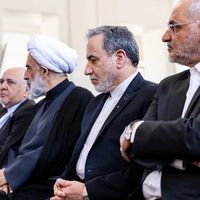
Cleric Mohammad-Hassan Aboutorabi-Fard during Tehran Friday prayers at the University of Tehran on April 25, 2025
The Tehran cleric, like several other Friday prayer leaders representing the Supreme Leader, portrayed the current diplomacy as a product of strength.
“Without the slightest doubt, the negotiations began from a position of dignity and power,” he said. “Iran has the upper hand in defining the topics and principles of the negotiations.”
Aboutorabi-Fard added that effective diplomacy must be backed by national strength—particularly technological and military power. “Diplomacy without power is ineffective in securing national interests,” he said. “The accumulation of scientific capacity, especially in nuclear technology, is one of the pillars of Iran’s national strength.”
He added that the country’s deterrent military capabilities bolster the negotiating team. “Our defensive power and enhanced deterrent strength are reliable assets for the Muscat negotiations.”
While advocating for the removal of sanctions, Aboutorabi-Fard echoed Khamenei’s frequent warnings against relying too heavily on external negotiations to solve domestic problems.
“Sanctions relief can help create conditions for sustainable economic growth,” he said, “but without transforming our economic and administrative structures, and without cutting the dependency of the budget on oil, real economic progress will remain out of reach.”
He urged the parliament and government ministers to focus on structural reforms regardless of the outcome of talks with the United States.
Other Friday prayer leaders across Iran echoed similar sentiments, praising Iran’s scientific achievements while cautioning against overreliance on diplomacy.
The cleric in Ilam quoted Khamenei, saying: “The diplomacy apparatus should do its work, but don’t tie the country’s future to the negotiations.”
In Yezd, Mohammad-Reza Naseri warned: “Don’t trust the enemy’s slogans. Real progress comes from self-reliance and heeding the Leader’s advice.”
And in Shiraz and Shahrud, Friday prayer leaders marked the anniversary of the failed US military operation in Tabas in 1980 -- Operation Eagle Claw -- as a reminder of “divine protection” and resilience against foreign intervention.
Mashhad firebrand cleric Ahmad Alamolhoda questioned whether, "After witnessing so many miracles, is it right to still hinge our hopes on America as a problem solver?""Conditioning our lives on negotiations demonstrates a lack of faith in God's power."