Iran will not negotiate over military power, Revolutionary Guard says
Iran’s Revolutionary Guards said the country’s military strength and national security are not subjects for discussion or negotiation under any circumstances, Iranian media reported on Tuesday.
“In no circumstance will there be negotiations about Iran’s national security and military power,” said IRGC spokesman Brigadier General Ali Mohammad Naeini, marking the anniversary of what Tehran calls Operation True Promise 1, Iran's airstrikes on Israel.
He described the event as “the largest drone operation in the region, with a range of over 1,000 kilometers.”
Iran's first direct attack on Israel, which Tehran referred to as Operation True Promise 1, took place on April 13 and involved more than 300 missiles and drones targeting military installations. The strike caused minimal damage and was launched in retaliation for the killing of two Iranian generals in Damascus.
A man holds an anti-US banner during a rally, as people gather in support of Gaza, in Tehran, Iran April 11, 2025.
Iranian Foreign Minister Abbas Araghchi invited US Special Envoy Steve Witkoff to Tehran during their talks in Muscat on Saturday, according to a report by Israel Hayom.
The report cited international sources as indicating that Witkoff did not reject the invitation.
The report said that during the meeting, Witkoff conveyed President Donald Trump's preference to resolve disputes through a deal, suggesting that Iranian engagement could lead to significant Western investment.
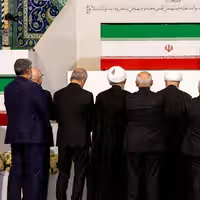
Supreme Leader Ali Khamenei praying at the Sharine of Masoumeh in Qom on the day of Muscat talks
Many Iranian officials, political elites, and many public figures appear to be cautiously optimistic as Tehran and Washington prepare for the next round of nuclear talks, set to take place on April 19.
The optimism stems from what appears to be a shift in Supreme Leader Ali Khamenei’s position—evidenced by his authorization of earlier negotiations in Muscat—and US President Donald Trump’s insistence that Iran must either accept a deal or face serious consequences. Notably, Khamenei made no mention of the talks during his meeting with military commanders following the Oman round, echoing hissilence on other contentious issues such as the mandatory hijab in recent months.
“God willing, the negotiations will move forward in the right direction, public anxiety will ease, and the country can return to a state of calm so businesses can operate with more motivation and confidence,” said Mahmoud Alavi, special aide to President Masoud Pezeshkian and former intelligence minister, on Tuesday. Alavi added that a deal seems plausible because Trump, now positioning himself for the international stage, may prefer being remembered as a “peace hero” rather than a “war hero.”
The former head of Iran’s Atomic Energy Organization, Ali-Akbar Salehi, expressed similar optimism. He said both Tehran and Washington appear determined to reach a positive outcome and dismissed the likelihood of military conflict, adding that Trump has no interest in engaging the US in another war.
Azar Mansouri, head of the Reform Front, echoed this hopeful sentiment in a post on X, describing a “general feeling of optimism” within society. She emphasized that the talks were being coordinated by “all pillars of governance”—a veiled reference to Khamenei and his close circle—and described the process as constructive so far.
Abbas Golrou, a member of the parliament’s National Security Committee, also pointed to consensus within the political establishment. “The entire sovereign system has endorsed the talks,” he said, again alluding to Khamenei’s involvement. “This is the right thing to do.”
In interviews with the reformist daily Ham-Mihan, several former diplomats expressed cautious hope. “This may be the first time we can [realistically] hope for all sanctions—not just nuclear-related ones—to be lifted if the negotiations fully succeed,” said Qasem Mohebali, former Director General of the Foreign Ministry’s Middle East and North Africa Division.
Still, concerns remain. Mansouri warned of potential disruption from hardline factions with significant access to state media and public platforms such as Friday prayer pulpits.
The influence of ultra-hardline opponents of US engagement, including former nuclear negotiator Saeed Jalili and the Steadfastness Front (Paydari Party), appears to be waning amid internal divisions. Even among some hardliners, resistance to negotiations has softened, as outright opposition could now be interpreted as defiance of Khamenei’s authority.
Facing a deepening economic crisis, President Pezeshkian has publicly acknowledged that sanctions must be lifted for any meaningful recovery. As a result, many ordinary Iranians are also pinning their hopes on the success of the talks.
“People are hopeful, cautious, angry, and anxious all at once—but I think most of them are taking the possibility of a deal very seriously,” said Amir-Hossein, a Tehran-based businessman, in an interview with Iran International.
“You can see it in the market,” he added. “People are starting to sell the dollars they were holding onto, which shows they believe the rial might strengthen if sanctions are lifted," he said, adding that in his view Khamenei has realized that he has no option other than capitulating to save himself and the Islamic Republic from annihilation.
Indeed, the Iranian rial has appreciated in recent days, and the main index of the Tehran Stock Exchange has rebounded sharply—surpassing its all-time high from January after months of decline.
China supports a new nuclear agreement with Iran based on the framework of the 2015 Joint Comprehensive Plan of Action (JCPOA), Chinese ambassador to Tehran Cong Peiwu said on Tuesday, according to Iranian state media.
“China once again believes the only right choice for resolving Iran’s nuclear issue is a political and diplomatic path, and we support a new agreement based on the JCPOA framework,” Peiwu said during a press conference at the Chinese embassy in Tehran.
Since the United States pulled out of the JCPOA in 2018, efforts to revive the deal have repeatedly stalled. Peiwu said Washington should show political goodwill and engage with mutual respect.
The Islamic Revolutionary Guard Corps (IRGC) has rejected reports that its senior commanders are overseeing the US-Iran nuclear talks, according to Fars News Agency, which is affiliated with the IRGC.
The report followed a tweet on Monday by Mahmoud Sadeghi, a reformist politician and former lawmaker, who wrote: “The advantage of this round of Iran-US talks is that the foreign minister is working under the direct supervision of the Supreme Leader and a team of senior IRGC commanders, while the president and cabinet are barely involved. If a deal is reached, there will be no room for doubt, unlike the JCPOA.”
Fars quoted informed sources as saying the talks are being led by the Foreign Ministry in line with official state policy, and that IRGC commanders are not involved.
A hacker group reported breaching the customer database of Iran's largest mobile operator, Mobile Communications Company of Iran (MCI), and accessing the personal data of 30 million of its subscribers.
The hacker group, named ShadowBits, also said to have obtained information about the employees of the MCI.
Digiato, a website active in Iran’s tech news industry, initially reported the breach but later removed the article.
ShadowBits shared an image of the Digiato article in a Telegram post and said that “pressure from intelligence agencies” led to its removal.
The group added that the data includes personal information such as names, surnames, date and place of birth, national ID numbers, birth certificate numbers, and full postal addresses.
London-based security expert Nariman Gharib confirmed the breach through his research, adding that telecom companies like MCI have close ties to the country’s intelligence and security agencies, and that telecom data is often used for surveillance of citizens.