EU sanctions Iranian officials, organizations over detention of EU citizens
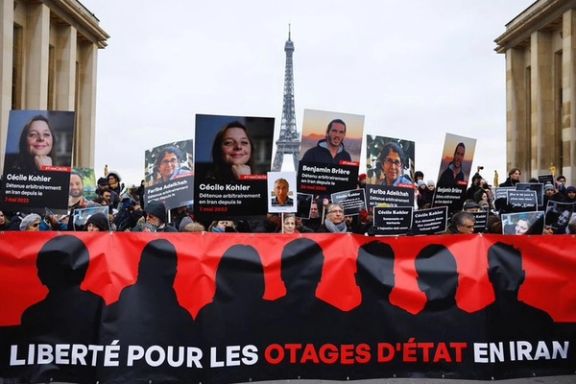
Supporters and relatives of French citizens detained in Iran, Cecile Kohler, Benjamin Briere, Jacques Paris and Fariba Adelkhah, gather in front of the Eiffel Tower during a rally demanding their release, in Paris, France, January 28, 2023
The European Union has imposed sanctions on seven Iranian individuals and two organizations in response to the detention of EU citizens, which the bloc has described as a policy of state-sponsored hostage-taking.
The sanctions, approved by EU foreign ministers on Monday, target key figures involved in the imprisonment of foreign nationals in Iran.
According to Reuters, among those sanctioned are the director of Tehran's Evin prison, several judges, and other judicial officials.
Additionally, the main prison in Shiraz has been added to the list of organizations facing sanctions.
Around twenty Westerners are currently held in Iran, AFP reported last month citing a French diplomatic source.
Other European detainees include Ahmadreza Jalali, an Iranian-Swedish dual national and scientist, who was detained during a visit to Iran in April 2016. Jalali, who was granted Swedish citizenship while in prison, was sentenced to death in 2017 on charges of espionage for Israel's Mossad.
British couple Craig and Lindsay Foreman were arrested in January 2025 in Kerman, Iran, on charges of espionage while on a motorcycle journey from Armenia to Pakistan. Iranian authorities allege they were collecting intelligence under the guise of tourism.
British-Iranian activist Mehran Raoof is also among those currently detained in Tehran's Evin prison. Arrested by Iran's Revolutionary Guards (IRGC) on 16 October 2020, he has been held in prolonged solitary confinement, according to rights group Amnesty International.
Last month, a source from the German Federal Foreign Office told Iran International that the German embassy in Tehran is investigating reports of the detention of a German national and has raised the matter with Iranian authorities, without providing further details.
Two women without hijab walk past a building in Tehran displaying a large mural with the slogan "Death to America".
Some Iranians are questioning whether US-Iran talks will alleviate persistent economic hardship and political repression.
The talks took place on Saturday and were led by Iran’s Foreign Minister Abbas Araghchi and Donald Trump’s Middle East envoy Steve Witkoff.
While both sides described the exchange as “positive and constructive,” Iranians interviewed anonymously by Iran International or in the form of messages to its submission service questioned the impact of the discussions on their lives.
“This negotiation won’t lower prices or fix the economy,” said one citizen in a video message showing a small grocery purchase costing over ten million rials (around $11).
“Even if billions are unfrozen, not a single rial will reach the people. It’s all in the name of the people, but for the benefit of the regime,” another added.
Iran's economy has been in crisis since 2018, when Trump exited the JCPOA nuclear deal and imposed heavy sanctions on Iran. Tens of millions subsist at poverty level, with workers making around $120 a month.
Some pointed to systemic mismanagement and repression as the root of Iran’s crises, not international sanctions. They criticized the West for engaging diplomatically with a government they believe is at its weakest.
“Why negotiate when the regime is vulnerable?” asked one voice message. “Why not support the Iranian people and end this nightmare?”
The move toward talks, despite Supreme Leader Ali Khamenei’s longstanding opposition to negotiations with what he has repeatedly called a untrustworthy United States, was seen by some as an act of desperation.
“Khamenei once said Qasem Soleimani’s shoes were worth more than Trump,” said a citizen to Iran International, referring to the IRGC commander killed in 2020 on Trump's orders. “Now he negotiates with the man he called Soleimani’s killer.”
As Trump continues to press for a new deal—recently warning that Iran must comply or face consequences—many Iranians say the clerical rulers have caved to external pressure for the sake of survival.
“They refused American vaccines during COVID, but now they’re ready to shake Trump’s hand to stay in power,” said another.
Several messages also highlighted a growing sense that the only path to change may be confrontation. “We’re even ready for war,” said one citizen. “If that’s what it takes to end this regime.”
Images circulating online captured public sentiment, including a Tehran banner reading: “With or without a deal, this executioner republic will fall by the will of the Iranian people.”
Iran's President Masoud Pezeshkian and Foreign Minister Abbas Araghchi
Amid mounting domestic and economic pressures, Iranian officials appear to be trying to entice the United States into a new deal favorable to Tehran by offering potential access to Iranian markets for US investors.
By publicly extending an olive branch to American investors, Iranian officials maybe testing Washington’s appetite for a broader détente—one that moves beyond nuclear containment toward economic normalization. Whether this message reflects a genuine shift or strategic posturing, and whether it leads to meaningful progress, will likely depend on what both sides are prepared to offer in talks that began in Oman on April 12.
However, a wide array of US sanctions, combined with deeply unfavorable conditions inside Iran, would make investment by the US—or any developed country—extremely difficult.
A bigger deal than 2015?
Recent comments by President Masoud Pezeshkian and Foreign Minister Abbas Araghchi suggest that Iran is seeking more than relief from secondary US sanctions—reimposed after Washington’s 2018 exit from the JCPOA—and is also pushing for the removal of primary sanctions that have long restricted American trade and investment in Iran.
In May 2018, President Donald Trump unilaterally withdrew the United States from the JCPOA nuclear agreement between Iran and world powers and reimposed the secondary US sanctions that had been lifted under the deal. These sanctions aim to penalize any third parties breaking US restrictions on Iran.
Under current conditions, with both primary and secondary sanctions in place, no US company or individual is permitted to invest in Iran. Any such investment would only be possible after a nuclear agreement is reached and Iran begins implementing its commitments. Washington is unlikely to lift all sanctions upfront without Tehran first dismantling at least part of its uranium enrichment infrastructure and reducing or transferring its stockpile of highly enriched uranium.
What Iranian officials said about US investment
In October, President Pezeshkian said Iran needs at least $100 billion in foreign investment to reach an annual economic growth rate of eight percent. He emphasized that improving foreign relations is key to attracting such investment. Iran has averaged less than 3% annual growth throughout the 46 years of clerical government.
In a more pointed message this week, Pezeshkian said that Supreme Leader Ali Khamenei has “no objection to American investors” entering the Iranian market. “Let them come and invest,” he said. “But we oppose plotting, regime change efforts, and destructive policies. Iran is not a place for conspiracies or espionage followed by assassinations. [All] investors are welcome to invest in our country.”
Foreign Minister Abbas Araghchi reinforced this line in a Washington Post op-ed, arguing that the onus is on Washington to allow American companies to tap into what he described as a “trillion-dollar opportunity” in Iran, though he did not offer specifics.
While Khamenei has not commented on the talks or investment prospects, as Iran’s top decision-maker on foreign policy, he has authorized indirect negotiations with Washington and is expected to be closely involved in determining their scope and terms.
What type of US sanctions on Iran are in place?
After the 2015 nuclear deal the US lifted most of nuclear-related secondary sanctions. However, the primary US sanctions—which date back as far as the 1980s and ban nearly all trade and financial dealings between US persons and Iran—remained in force even after the deal.
These sanctions made it virtually impossible for American companies to invest in or trade with Iran, even during the brief JCPOA implementation period, unless they obtained special licenses from the US Treasury’s Office of Foreign Assets Control (OFAC).
For instance, Boeing was able to sign an agreement with Iran in 2016 to sell commercial aircraft after receiving a special OFAC license under the Obama administration. The company could not have even provided maintenance services without such an exemption under regulations like the Iranian Transactions Regulations (ITR).
Much to the dismay of Iran, Boeing’s aircraft were never delivered, and the license was revoked after the Trump administration exited the JCPOA.
Similar restrictions under the Export Administration Regulations (EAR), enforced by the US Commerce Department, also prevented non-US companies like Airbus from selling aircraft to Iran if they contained more than 10 percent US-origin components—unless licensed by OFAC.
Domestic impediments to investments
Beyond sanctions, one of the most significant barriers to American and broader international investment in Iran is the structure of its state-controlled economy. The system is riddled with opaque regulations, inconsistent enforcement, and non-transparent business practices. Key sectors are dominated by economic conglomerates affiliated with Supreme Leader Ali Khamenei and the Islamic Revolutionary Guard Corps (IRGC), creating an uneven playing field and discouraging foreign entrants.
Iran’s economy is effectively closed, especially when it comes to consumer-facing industries. Even domestic investors face serious risks due to unclear rules, political interference, and limited legal protections. While foreign companies can occasionally secure contracts for state-backed infrastructure projects—such as revamping oil and gas facilities—these are tightly controlled by government-linked entities and offer little access to Iran’s broader market. This model does not allow for the kind of real, diversified investment that would benefit Iran’s private sector or broader population.
A nuclear agreement, while potentially reducing the immediate risk of conflict and unlocking limited economic engagement, is not enough to attract serious Western investment. For that to happen, Iran would need to implement deeper reforms. This includes recalibrating its foreign policy, scaling back the IRGC’s grip on the economy, and creating a more transparent and rules-based business environment. Without such changes, the prospect of meaningful, long-term foreign investment will remain remote.
USA and Iranian flags are seen in this illustration taken, September 8, 2022.
Two senior Iranian political figures warned that internal disunity and vested domestic interests could undermine negotiations with the United States, as officials from both sides resume contacts in Oman.
The talks should be treated as a national decision rather than a partisan initiative, said the former Deputy Speaker of Iran’s Parliament Ali Motahari.
“These talks are a decision by the entire system and must not be portrayed as imposed by one faction,” said Motahari, a conservative politician known for outspoken views, in an interview with Rouydad24 on Saturday.
Motahari pointed to the 2015 nuclear agreement as an example of what could be achieved through engagement but also how easily it could unravel.
Former Iranian lawmaker Ali Motahari
“In the two years the JCPOA was implemented, we saw single-digit inflation and higher economic growth,” he said. “Let’s not allow partisan competition sabotage this round.”
The outcome of this round would signal whether “the negotiations are on a constructive track and whether the other side seeks a fair resolution or talks from a position of dominance,” he said.
From the Reformist camp, a former official also called for sidelining powerful domestic actors who benefit from Iran’s continued isolation.
Reformist figure Mohammad Hashemi
“To advance negotiations and end sanctions, the government must disarm the so-called sanctions profiteers,” said Mohammad Hashemi, the brother of former president Akbar Hashemi Rafsanjani, in an interview with Khabar Online website.
Hashemi warned that these groups, though few in number, wield significant influence and have actively worked to destabilize the new government.
“Their power lies in chaos. Without confronting them, real progress is impossible,” he added.
He also offered a cautious assessment of US President Donald Trump.
“Trump has no credible track record. He tore up the nuclear deal and ordered the killing of IRGC commander Qasem Soleimani,” Hashemi said.
“But he’s also a businessman, not a warmonger. He prefers deals over war.”
A general view of the Bushehr main nuclear reactor, 1,200 km (746 miles) south of Tehran, August 21, 2010.
Iran’s nuclear program has dominated global headlines for over two decades, drawing in multiple US presidents, triggering waves of sanctions, and raising persistent fears of a regional war.
Iranian officials insist the program is peaceful, but Tehran's uranium enrichment expansions have concerned Western powers and led to warnings from Israel and the United States of possible military action.
When and why did Iran start its nuclear program?
Iran's nuclear activities began in the 1950s under Shah Mohammad Reza Pahlavi as one component of a US-supported initiative to promote civilian nuclear power in allied nations. The United States helped Iran build its initial research reactor at Tehran University under the Atoms for Peace initiative. The shah envisioned a grid of reactors to power Iranian cities, coupled with enhancing the scientific stature of the country.
Iran had by the 1970s signed with France and West Germany a deal to build a number of reactors. America had in principle agreed to allow Iran to establish a full nuclear fuel cycle, including uranium enrichment and reprocessing — technology that is sensitive as it could be used to produce fuel for civilian reactors or weapons.
Western countries considered Iran a reliable ally at the time, and little global outcry was expressed over the program. That all changed with the Islamic Revolution in 1979.
What happened to the program after the Islamic Revolution?
When the shah was overthrown and Ruhollah Khomeini established the Islamic Republic, most of Iran's nuclear activities came to a halt. Foreign suppliers stepped back. Several nuclear facilities were abandoned or left unfinished. Iran's new leaders, wary of Western influence and burdened with war against Iraq, relegated nuclear development to the bottom of their agenda.
But by the late 1980s and early 1990s, Iran began to restart its program. The Islamic Republic signed agreements with Russia and Pakistan and ramped up activity at facilities like Natanz and Arak. These efforts raised suspicions, especially because Iran was operating some of its facilities clandestinely.
The IAEA was not aware of all the construction, and suspicions mounted about whether Iran's intentions were strictly civilian or not.
A general view shows the Natanz uranium enrichment facility in Natanz, about 322km (200 miles) south of Tehran March 9, 2006.
What contributed to the nuclear standoff?
The dissident opposition group National Council of Resistance of Iran revealed in 2002 two secret Iranian nuclear sites at Natanz and Arak. The revelation shocked Western intelligence and led to a request by the UN nuclear watchdog agency, the International Atomic Energy Agency (IAEA), for an inquiry.
Inspectors confirmed the existence of indications that Iran had conducted activity pertinent to acquiring a nuclear weapon — such as experiments on high-explosives and possible models for missile warheads.
Iran said it intended to acquire only nuclear power and not an atomic bomb. Yet its concealment of the operations from reporting contravened Iran's safeguards treaty to the Nuclear Non-Proliferation Treaty (NPT) that it had signed.
As a counter, the UN Security Council imposed a set of resolutions that insisted Iran stop suspending its reprocessing and enrichment. Sanctions were enforced upon Iran's defense, energy, and banking. The confrontation hardened over the decade that followed.
What was the purpose of the 2015 nuclear accord?
After years of negotiations, Iran and six of the world's top powers — US, UK, France, Germany, Russia, and China — agreed on the Joint Comprehensive Plan of Action (JCPOA) in July 2015.
Nuclear deal negotiators pose for a photo at the UN building in Vienna, Austria. (2015)
Under the deal, Iran agreed to restrict uranium enrichment to 3.67% purity — well short of weapons-grade. The deal also limited Iran's partially enriched uranium stockpile to 300 kilograms. It dismantled and stored thousands of centrifuges. It agreed to intrusive IAEA inspections such as supply chain tracking and declared facilities.
In return, Iran gained relief from international sanctions, including the unfreezing of billions in foreign assets and re-entry into international oil markets.
The US administration's allies greeted the deal as a major non-proliferation achievement. President Barack Obama called it "a long-term deal that will prevent Iran from obtaining a nuclear weapon."
Different models and generations of Iranian centrifuges.
The United States why pulled out of the deal?
The United States withdrew from the 2015 Iran nuclear deal in May 2018, when then-President Donald Trump announced that the agreement had failed to prevent Iran from expanding its ballistic missile program or aiding armed groups across the region.
Announcing the deal "a disaster," Trump reimposed sweeping sanctions in what his administration described as a "maximum pressure" campaign to push Iran to accept more restrictive terms.
“Iran’s leaders will naturally say that they refuse to negotiate a new deal. That’s fine. I’d probably say the same thing if I were in their position. But the fact is, they’re going to want to make a new and lasting deal,” Trump said at the White House at the time of the withdrawal announcement.
The International Atomic Energy Agency (IAEA) confirmed in a series of quarterly reports that Iran remained in compliance throughout the remainder of Trump's term — including May, August, and November 2018 inspections, as well as early 2019.
Tehran's gradual erosion of the accord came only after Joe Biden's election. On January 4, 2021, just over two weeks before Biden took office, Iran resumed 20% enrichment at its Fordow plant. In February, it prevented IAEA inspectors from visiting its facilities and began producing uranium enriched to 60% by mid-April — far beyond the limit of the accord's 3.67%, but short of the 90% necessary for weapons-grade material.
Iran currently has a reserve of enriched uranium above the Joint Comprehensive Plan of Action (JCPOA) threshold, enriched to 60% purity, according to the IAEA.
Although Biden officials have spoken of Trump's withdrawal as the trigger for the deal's collapse, timelines show that Iran did not commit serious violations until the end of Trump's presidency.
How close is Iran to developing a nuclear weapon?
According to US intelligence estimates Tehran is now able to produce enough highly enriched uranium for a single nuclear weapon within weeks if it were to decide to do so.
Iran's Supreme Leader Ali Khamenei and Iranian military commanders
In a recent TV interview, Ali Larijani, the Supreme Leader's chief adviser warned that Iran will be able to make weapons if pushed into a corner. “If you make a mistake regarding Iran’s nuclear issue, you will force Iran to take that path, because it must defend itself,” he said.
The IAEA has expressed concern about traces of uranium that remain unidentified at undeclared locations and reports that Iran has not provided sufficient explanations on a number of issues that remain outstanding.
What is the official position of Iran?
Iran continues to say that its nuclear program is peaceful. "The official stance of Iran in rejecting weapons of mass destruction and regarding the peaceful nature of the Islamic Republic’s nuclear program is clear," foreign ministry spokesman Esmail Baghaei said.
But officials generally follow such statements with warnings regarding self-defense. Baghaei cited a recent speech of the Supreme Leader to the effect that Iran would arm itself "to the extent necessary for the defense of Iran."
Iranian leaders present the US and Israel as the aggressors. "The enmity from the US and Israel has always been there. They threaten to attack us, which we don’t think is very probable, but if they commit any mischief, they will surely receive a strong reciprocal blow," Khamenei said in March 2025.
Why are the US and Iran negotiating now?
US and Iranian officials conduct talks in Oman hoping to revive the nuclear talks. The discussions, President Trump announced, will be direct, while Iranian Foreign Minister Abbas Araghchi announced that communication would be through intermediaries.
US President Donald Trump speaks in the Oval Office, on the day he signs executive orders, at the White House in Washington, DC, US March 6, 2025.
The diplomatic push coincides with rising tensions. Trump has sent a letter to Khamenei threatening to punitive military strikes if there is no deal. “I’ve written them a letter saying, ‘I hope you’re going to negotiate because if we have to go in militarily, it’s going to be a terrible thing,’” Trump said.
What is Israel's role in the nuclear standoff?
Israel has always opposed the JCPOA and sees a nuclear Iran as an existential threat. Israel is believed to have orchestrated sabotage plots against Iranian nuclear facilities and assassinations of Iranian nuclear scientists in the last two decades, based on intelligence officials quoted by several Western news outlets.
Although Israel has not publicly taken responsibility of all the incidents, it has committed to acting if diplomacy fails. Iran has, in turn, correlated its nuclear stance with the danger of Israel's undeclared nuclear capacity and record of strikes.
What's on the line now?
With Iran's uranium enrichment to new record levels and diplomacy at an impasse, the threat of escalation hangs perilously close. The deployment of US B-2 bombers to the region, as well as Tehran's threat to employ its underground cities of missiles as a counter-attack, is what accentuates the mounting tension. The crisis has been amplified by further incendiary language against Iran from Donald Trump.
Iranian ballistic missiles are displayed during the ceremony of joining the Armed Forces, in Tehran, Iran, August 22, 2023.
Both sides still express a preference for negotiation, but there is profound mutual distrust. America wants tighter terms; Iran demands sanctions relief and guarantees the deal won't collapse like before.
The success of current efforts has the potential to decide not just Iran's nuclear future but the broader dynamics of Middle Eastern security for decades to come.
Iran's Supreme Leader Ali Khamenei clutches the muzzle of a rifle while delivering a speech
Supreme Leader Ali Khamenei's oft stated mantra of "no war and no negotiations" with the United States became untenable when US President Donald Trump gave a stark ultimatum that he reach a nuclear deal or face attack.
But his acquiescence to US-Iran talks in Oman on Saturday is no wholesale foreign policy rethink or road to Damascus moment: it’s a calculated attempt to buy time.
With Trump back in office and US military power amassing in the region, Khamenei is reverting to a familiar strategy: de-escalate just enough to avoid war, preserve the Islamic Republic’s strategic position, and wait out American pressure.
The meeting on Saturday in Muscat is not aimed at resolving the nuclear standoff or reimagining Iran’s regional role. It’s about lowering the temperature while holding onto the core pillars of Iranian power: the nuclear program, the missile arsenal and the regional proxy network.
This is a playbook Khamenei has used for decades: resist until pressure becomes untenable then pause, rebrand retreat as “heroic flexibility,” and regroup.
The phrase was deployed in 2013 to justify his negotiations with the Obama administration, casting diplomacy with Tehran's hated enemy as in line with precedent set by beleaguered Islamic leaders in times past.
Hibernation
In 2019, when Japan’s Prime Minister Shinzo Abe brought a message from then-President Trump, Khamenei publicly trashed him: “I do not consider Trump a person worthy of exchanging messages with.”
At the time, there was no imminent threat of war. Today is different. US B-2 stealth bombers are within striking distance and two carrier strike groups patrol the region.
When a message reportedly containing a direct threat was delivered recently via an Emirati official, Khamenei studied it and the circumstances closely.
His assent to talks is less a pursuit of detente and more a strategic hibernation.
Khamenei knows war is the one scenario that could shatter the domestic control and regional clout the wily 85-year-old autocrat has built up for decades.
Slowing enrichment, muzzling proxies and entering talks buys him time without sacrificing his accomplishments.
The Islamic Republic is weakest on its home front. Sanctions have ravaged the economy. Sporadic protests from 2017 to 2022 - all quashed with deadly force - have exposed cracks in the edifice of his rule.
A war could push those toward breaking point.
A tactical negotiation, by contrast, offers the topmost leadership breathing space on the streets, among elites and within the ruling system.
Survival instinct
A keen survival instinct has defined Khamenei’s rule. Since becoming President in 1981 and then Supreme Leader in 1989, he has outlasted seven US presidents and weathered assassination attempts, sanctions, cyberattacks, sabotage, isolation and bombing.
Key to his longevity is adjusting tactics, but never core goals.
The 2015 nuclear deal was not a concession but a gain. Iran accepted temporary caps on enrichment but secured international recognition of its right to enrich—a red line Khamenei had long defended.
The 3.67% cap was low, but the principle was enshrined. A higher percentage could wait. When Trump left the deal in 2018, Khamenei didn’t escalate immediately, but bided his time.
Once Biden, perceived as less belligerent, came to office, Iran accelerated its program. Enrichment rose to 60% by the end of his term, advanced centrifuges were installed, and underground facilities expanded.
According to the United Nations nuclear watchdog, Iran now possesses enough highly enriched uranium to build several nuclear weapons if it chooses to.
De-escalate, regenerate
With Trump back in power and military pressure mounting, Khamenei is adapting to survive. The hope is likely to de-escalate, rein in the nuclear program, quiet the proxies, and preserve its infrastructure to avoid provoking direct confrontation.
Iran’s influence in the region has eroded significantly. Hezbollah is under pressure. Hamas is boxed in. Perhaps most significantly, Iran has lost Syria as a key ally, depriving it of a key pillar of its regional axis.
Still, Iran does not see these setbacks as irreversible. Israeli officials often describe the Islamic Republic as an octopus with a head in Tehran and limbs spread across the region. When an octopus loses a limb, they can grow back.
Khamenei believes that if the system survives Trump, its regional reach can regenerate.
Time and money
Key to those hopes will be mollifying the United States for as long as Trump is in office - a goal which could plausibly be achieved by restraining nuclear activity and scaling back proxy operations, with or without a deal.
If that restraint can be packaged into an agreement, all the better.
A deal would formalize what he is already prepared to do and buy yet more time. If it comes with sanctions relief or cash, it will be no compromise but an outright win: a payment to wait Trump out.
But the red lines remain. If Trump’s team demands the dismantling of Iran’s nuclear infrastructure, permanent limits on missile capabilities or the disbanding of its regional allies, talks will collapse.
Khamenei seeks not peace in our time but more time on the clock.
Diplomacy, in this context, is not a gateway to a new regional order but a heat shield against a blowup. The goal is not to settle but to survive.
A calculated pause could mark the start of another cycle of hibernation in a long game in which confrontation is still the overall policy of a supreme leader who knows war is the only thing he cannot afford.