Border guard killed in attack in Iran's restive southeast

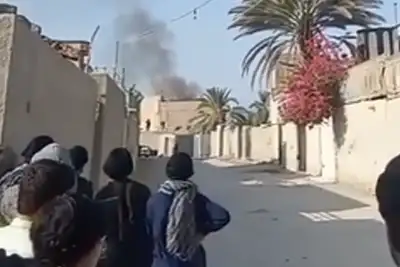
Gunmen killed a border guard on Thursday in Mirjaveh County, located in Iran's restive southeastern province of Sistan-Baluchestan, state-run media reported.

Gunmen killed a border guard on Thursday in Mirjaveh County, located in Iran's restive southeastern province of Sistan-Baluchestan, state-run media reported.
The province, which borders Afghanistan and Pakistan, has been a hotspot for sporadic deadly clashes involving militant groups, armed drug traffickers, and Iranian security forces.
Among the groups active in the region is Jaish al-Adl, known for ambushes, bombings, and other violent operations that have claimed the lives of civilians and security personnel.
Jaish al-Adl advocates for an independent Baluchestan, encompassing Baluch populations on both sides of the Iran-Pakistan border, and has carried out numerous attacks in southeastern Iran.
Sistan-Baluchestan is one of Iran’s least developed regions, with strained relations between its predominantly Sunni Muslim population and the country’s Shiite-led establishment.

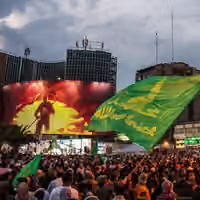
Azerbaijan's President Ilham Aliyev criticized Iran for a slew of alleged affronts, in a sign of mounting tension between the neighbors, including a jibe by a preacher accusing Baku of conspiring with Israel.
“The cleric from the city of Ardabil has repeatedly used insulting expressions against Azerbaijan, the Azerbaijani people and me,” Aliyev said during a press briefing on Tuesday.
Referring to Seyyed Hassan Ameli, the Friday Prayer Leader of Ardabil, Aliyev questioned Iran's leadership, asking, “What is his reaction, does he support this or not, and who will apologize to Azerbaijan? Will they apologize or not?”
The controversy stems from a recent event broadcast on IRIB News, where a local eulogist insulted both Aliyev and Turkish President Recep Tayyip Erdoğan, alleging that Aliyev had engaged in a "multi-billion dollar gamble with the Israelis", with whom Baku has good relations.
In December, Azerbaijan’s ministry of foreign affairs summoned Iran’s chargé d’affaires in Baku to formally protest the incident.

A day after Aliyev's remarks, Ali Akbar Ahmadian, Secretary of Iran’s Supreme National Security Council, arrived in Baku for what Iranian media described as "security diplomacy aimed at strengthening political-security relations with South Caucasus countries."
Ahmadian is expected to meet with President Aliyev and Azerbaijani officials before continuing to Yerevan for discussions with Armenian Prime Minister Nikol Pashinyan.
Long-standing disputes and security concerns
Aliyev's criticism extended to broader grievances, including Iran's facilitation of fuel transfers to Nagorno-Karabakh via Armenia, which Azerbaijan considers a violation of its sovereignty.
“We began to see that fuel trucks from Iran were regularly making trips to Karabakh from Armenia,” Aliyev said. After private efforts to stop the shipments failed, Azerbaijan made the issue public, exposing what Aliyev described as sloppy forgeries involving fake Armenian license plates on Iranian vehicles.
The Azerbaijani leader also criticized Iranian military exercises near their shared border, which he viewed as an attempt at intimidation. “If any military training is held on our border, we did the same on this side. We showed that we are not afraid of anyone,” he said.
Embassy attack and accountability
Aliyev revisited the January 2023 attack on Azerbaijan’s embassy in Tehran, labeling it an organized terrorist act. He pointed to a delayed police response and the immediate declaration of the assailant as mentally ill as evidence of a cover-up.
“We were officially promised...that the person would be sentenced to death,” Aliyev said. “But they deceived us again. The case was sent back to court for investigation. We know that death sentences in Iran are pronounced for less serious crimes and are immediately executed.”
Aliyev dismissed Iran’s expression of regret over the Ardebil cleric’s remarks as insufficient, demanding tangible consequences.
“We believe that the provincial mullah should be punished, at the very least dismissed from his post and made to apologize to Azerbaijan,” he said.
Aliyev’s remarks and Ahmadian’s visit to Baku highlight the complexity of Azerbaijan-Iran relations. While Ahmadian’s trip suggests Tehran’s interest in mitigating tensions, the outcomes of his discussions in Baku and Yerevan may shape the future trajectory of the strained ties.

Two senior IRGC commanders said this week that the Islamic Republic is currently unable to retaliate against Israel's October air strikes due to financial constraints and the loss of key regional ally Syria.
Iranian political and military officials have repeatedly threatened to launch a large-scale retaliation against Israel, referring to the operation as “True Promise 3.” The codename refers to two earlier missile and drone strikes carried out against Israel in 2024.
An IRGC general who until recently was stationed in Syria told Iranian media that such an operation should have been launched earlier, and now Iran is not in a position to ignite a large-scale conflict with Israel.
"I do not know why the operation was not launched or who decided against responding to Israel," General Behrouz Esbati who heads the Iranian armed forces Cyberspace Headquarters, told the conservative Tabnak news website.
"However, as someone who was on the ground in Syria, I can say that we would be in a much better position today if Iran had retaliated against Israel's attack."
Iranian troops quit Syria last month in the face of a surprise rebel offensive which toppled the ruling Assad dynasty, Iran's faithful ally for decades.
The loss was among the heaviest to Iran's so-called Axis of Resistance in 15 months of war with Israel. Tehran describes the armed front as legitimate resistance against Israel and has been keen to avoid all-out conflict with its better armed fow.
"I believe the current situation makes it impossible to carry out Operation True Promise-3," Estate added. "Under the present circumstances, it is not in the interest of the Resistance to drag the region into a war. If we initiate a new operation, the enemy will respond with renewed attacks."
Addressing the reasons behind Assad's fall, Esbati remarked, "Assad lacked the motivation to fight. Despite Khamenei’s assurance that Iran would support him if he resisted, Assad was unwilling to engage in battle."
He also criticized Assad's military leadership, saying, "His army commanders were corrupt and accepted bribes from everyone." Esbati further accused Russia of betrayal, saying, "Russia betrayed both Assad and Iran." He added that "after Iran's first retaliation against Israeli attacks, Russia was aligned with Israel."
The Didban Iran news website in Tehran quoted also General Esmail Kowsari, an IRGC officer and member of the Iranian parliament's National Security Committee, as saying, "The Islamic Republic's hands are tied; otherwise, we would have responded to Israel and carried out Operation True Promise-3."
Highlighting the United States' $921 billion military budget, Kowsari remarked, "If we were in a better financial position, we would have launched Operation True Promise-3 and even Operation 4."
Meanwhile, Etemad newspaper cited Foreign Minister Abbas Araghchi, who stated, "Iran must learn a lesson from Assad's fall in Syria." He added, "The Syrian army was defeated before it even considered fighting or resisting." The foreign minister warned, "Syria's defeat should serve as a lesson for us, and we must not allow the enemies to spread despair within Iran."

The United States has not made any formal extradition request for Iranian businessman Mohammad Abedini, who is detained in Milan, Italy's justice minister said in an interview published on Thursday.
"The matter of Abedini is purely legal ... regardless of the (freeing of Italian journalist) Cecilia Sala. It is premature to talk of extradition, also because no formal request has been sent to our ministry so far," Justice Minister Carlo Nordio told daily La Stampa.
Abedini, accused of transferring drone technology to Iran, was arrested at Milan Airport under a US warrant in December. Washington alleges that the technology was used in a February attack near the Jordan-Syria border, which killed three American soldiers—an accusation Iran denies.
His arrest has been linked to the detention of Italian reporter Cecilia Sala, who was seized in Tehran last month while working under a standard journalistic visa and released on Wednesday.

The Canadian government said Wednesday it continues to call on Tehran to take full responsibility for its actions, including by making reparation for the harm caused by the downing of the Ukrainian Flight PS752 in 2020.
"Foreign Minister Melanie Joly met with family members of victims... to remember the victims and reaffirm the government’s unwavering commitment to justice, accountability, transparency, and solidarity with the families," the government said in a statement marking the fifth anniversary of Iran's downing of Flight PS752.
The Ukrainian airliner was shot down by the IRGC in January 2020, killing all the 176 people on board.

Iran is pivoting toward arming Palestinian militants in the occupied West Bank following the downfall of Tehran’s ally Bashar al-Assad in Syria, Israel’s Defense Minister said on Tuesday.
"Judea and Samaria has become a central arena in the map of threats to Israel and we are preparing to respond accordingly," Katz said, using the Biblical names for lands on the west bank of Jordan River which Israel seized in a 1967 war.
"We are seeing increasing efforts to promote Palestinian terrorism in Israel through the smuggling of advanced weapons, funding and guidance both on the part of the Iranian axis and on the part of the radical Sunni Islamic axis that is strengthening its grip on the region after the events in Syria,” he added.
Violence in the West Bank has spiked in recent weeks as Iran copes with military losses dealt by Israel to its armed allies in the region, especially in Syria, which had provided a key strategic and military base for Tehran.
In Lebanon, Iran's most powerful ally Hezbollah suffered a huge blow after Israeli bombardment of critical infrastructure and the group’s leadership since September, while Hamas in Gaza has been weakened since its attack on Israel on October 7, 2023, led to the longest Gaza war since the group took control of the enclave in 2007.
The series of setbacks to Iran's network of military allies has, according to Israel, led to a renewed focus on the West Bank as part of Tehran's war against its archenemy.
“Iran-backed terrorist groups, including Islamic Jihad, al-Aqsa Martyrs' Brigades, and Hamas, have proliferated in number and strengthened their presence in the West Bank in recent years," Joe Truzman, an expert on Palestinian militants wrote in The Long War Journal.
“Iranian arms and funding have primarily fueled this violent escalation,” he added, saying the groups have established armed cadres in the West Bank cities of Nablus, Jenin, Tulkarm and beyond.
”Iran has established itself in our sector and over half a million citizens of the State of Israel are sitting on a ticking time bomb," Israel Ganz, a top leader of Israeli settlers in the occupied West Bank, said on Tuesday.
"We must not continue to live here with the same concept that existed on the sixth of October.”
The announcement comes on the back of a deadly attack which saw three Israelis killed in a shooting on a car and bus near the settlement of Kedumim this week.
In the latest 2024 statistics, Israel’s internal security agency the Shin Bet said it had thwarted 1,040 significant attacks in the West Bank and Jerusalem during 2024.
These included 689 shooting attacks, 326 bomb attacks, 13 stabbing attacks, nine rammings and a kidnapping. It was a 40 percent increase in 2023, it said.
Since the Oct. 7 attack, dozens of Israelis and hundreds of Palestinians have been killed in the West Bank.