Khamenei blames US and Israel for Assad's fall in first public remarks
In his first public remarks since the overthrow of Syria’s Bashar al-Assad, Iran’s ruler Ali Khamenei blamed the United States and Israel for conspiring to remove Tehran’s close ally from power.
Speaking on Wednesday to a group of followers, Khamenei said, “There should be no doubt that what has happened in Syria is the result of a joint American and Zionist plan.
Iran's Supreme Leader Ali Khamenei met Syrian President Bashar al-Assad in Tehran on May 30, 2024.
Iran’s Supreme Leader Ali Khamenei accused the United States and Israel of orchestrating the overthrow of Bashar al-Assad, Syria's longtime president and a close ally of Tehran.
The remarks were Khamenei's first since Assad fled the country for Russia on Sunday in the face of a shock rebel advance, but offered little indication of what Iran's next strategic move would be after suffering the epochal setback.
“There should be no doubt that what has happened in Syria is the result of a joint American and Zionist plan. Yes, a neighboring country of Syria has played a clear role in this regard, continues to do so even now—this is evident to everyone. But the main conspirator, the primary planner, and the central command rooms are in the US and the Zionist entity," he said in his first remarks on the Syrian uprising since Assad's departure on Sunday.
Khamenei’s reference to a neighboring country was widely interpreted to mean Turkey. Over the years, Turkey has been a key backer of Syrian armed opposition groups. The power vacuum created by Assad’s fall has boosted Ankara’s regional position, weakening the influence of Iran and Russia on Syrian affairs.
“The aggressors I mentioned each have their own motives. Their goals are different—some seek to occupy land in northern or southern Syria, while America aims to solidify its foothold in the region," Khamenei added.
"These are their objectives, and time will show that, God willing, none of them will achieve these goals. The occupied regions of Syria will be liberated by the brave Syrian youth; have no doubt, this will happen,” he said.
Assad’s ouster has not only deprived Tehran of a strategic ally but also disrupted Iran’s ability to transport weapons to its biggest military ally, Hezbollah in Lebanon, through its land corridor. This route was a cornerstone of what is described as Iran’s Shia crescent, linking Tehran to the Mediterranean via Baghdad and Damascus.
In spite of the massive setbacks Israel has inflicted in recent months on both Hezbollah and Hamas in Gaza, also supported by Tehran, Khamenei said the Resistance - a term for Iran-backed militias across the region - would grow stronger.
"The more pressure you exert, the stronger the resistance becomes. The more crimes you commit, the more determined it becomes. The more you fight against it, the more it expands," Khamenei said. "Iran is strong and powerful—and will become even stronger."
The new government in Damascus, comprised of Sunni insurgents, signals a significant shift in the balance of power in the region. Syria's significance for Iran and the Islamic Republic's support for Hezbollah in Lebanon were so substantial that, over the years, Israel has also targeted several IRGC commanders in Syria as part of its efforts to counter Tehran and its regional influence.
In April, Israel struck the Iranian consulate compound in Damascus, killing Quds Force commander Mohammad Reza Zahedi, and other senior IRGC figures, triggering Iran's first ever direct attack on Israel in the same month.
Even after Assad's fall, Israel has continued to deliver significant blows to the remnants of both Assad's military forces and arsenal, and IRGC facilities, with around 300 airstrikes carried out since Sunday as Israel destroys any potential weapons falling into the hands of Syria's new extremist groups.
Iranian Islamic Revolutionary Guard Corps (IRGC) forces and militias such as the Fatemiyoun and Zainabiyoun brigades were deeply involved in defending Assad during Syria’s civil war.
These militias, composed mainly of Afghan and Pakistani recruits residing in Iran, were promised financial incentives and residency permits in exchange for their service. Despite Iran’s consistent denials of direct military intervention, these groups played a critical role on the ground.
The Iranian rial has hit new lows in the wake of Bashar al-Assad’s fall in Syria, in a sign that the ouster of Tehran's main Arab ally may be hollowing out economic confidence.
The dollar was trading at more than 730,000 rials in Tehran’s free exchange market on Tuesday, up from 700,000 just a week ago.
The downfall of Assad, whose ruling family has been the one of the Islamic Republic's earliest and strongest allies since 1979, severs Iran's land corridor to Lebanon which supplied weapons to Hezbollah for its periodic confrontations with Israel.
The slide adds to Iran’s vulnerabilities and could indicate its relative weakness in the region.
In addition to recent regional setbacks, the Islamic Republic faces the imminent challenge of Donald Trump assuming office in the United States, who will likely ramp up economic pressure on Tehran.
The euro was trading at almost 770,000 rials, as most other hard currencies rose in tandem with the US dollar in Tehran. The rial has fallen 18-fold since 2018, when the United States withdrew from the JCPOA nuclear deal and imposed sanctions on Tehran.
Before the establishment of the Islamic government in 1979, the US dollar was worth just 70 rials.
The rial’s steady decline signals further price hikes in Iran as imports grow more expensive, with inflation already nearing 50 percent. Meanwhile, oil exports constrained by sanctions have fail to generate sufficient foreign currency to stabilize the rial.
The only recourse for Tehran is to convince the US to lift its economic sanctions, but so far, Iran has not made sufficient concessions on its ambitious nuclear program or its regional policies to sway Washington.
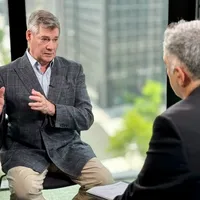
"Those who think Iran has been weakened with Assad's fall rely on the flawed assumption that the resistance is a proxy force for Iran," Iran's Vice President for Strategic Affairs and former foreign minister, Mohammad Javad Zarif said in an interview with Didar News.
His remarks represent the most high-level official Iranian comments yet on the upheaval in Syria which deprived Tehran of its top Arab ally.
"The resistance was neither created by Iran nor dependent on it for its continuity. Its driving force is Israel's occupation and apartheid," he added.
"Assad's downfall resulted from his pride in defeating the armed opposition and his failure to turn that military victory into a win-win political agreement and establish an inclusive government."
Iran's flag among the flags in front of the IAEA headquarters in Vienna, Austria
Iran's Foreign Ministry has rejected the joint statement issued by the United Kingdom, France, and Germany criticizing Tehran for enriching uranium to near weapons-grade, saying Tehran was acting within its international rights.
Iran’s decision to employ advanced centrifuges and enrich uranium to higher levels falls within its rights under the Non-Proliferation Treaty (NPT), the ministry 's spokesperson Esmail Baghaei argued on Tuesday. These measures comply with International Atomic Energy Agency (IAEA) oversight protocols, he added.
"The Islamic Republic of Iran, as a responsible member of the IAEA, has proven its commitment to cooperation with this body," Baghaei said, referring to recent discussions with IAEA Director General Rafael Grossi in Tehran.
"It is regrettable that these European countries, instead of building on the constructive engagements, continue with unhelpful and confrontational approaches."
The European trio, collectively known as the E3, issued a statement on Tuesday condemning Iran's actions as undermining the Joint Comprehensive Plan of Action (JCPOA), the 2015 nuclear deal. Their statement highlighted concerns over uranium enrichment at the Fordow facility to near-weapons-grade levels and an increase in the number of centrifuges in operation.
"Iran’s actions have further hollowed out the JCPOA," they wrote, urging Tehran to reverse course and adhere to international safeguards.
Baghaei dismissed these remarks, insisting that the current nuclear standoff stems not from Iran’s actions but from the US's withdrawal from the JCPOA in 2018 and the failure of European signatories to uphold their commitments under the deal.
Iran has long contended that its nuclear program is peaceful and that its uranium enrichment—reported to have reached 60% purity, just short of the 90% threshold for weapons-grade material—serves civilian purposes. However, this has been met with skepticism from Western nations, who argue there is no credible civilian justification for such enrichment levels.
The ongoing dispute has fueled fears of regional instability. IAEA Chief Rafael Grossi has acknowledged in recent statements that dialogue with Iran is indispensable.
However, he has warned that the lack of implementation of safeguards continues to pose significant challenges.
While the IAEA continues its efforts to mediate between Tehran and the west, diplomatic progress remains elusive.
Iran and Hezbollah were Syria's bulwark against an Israeli incursion which is now unfolding, the Tehran-backed militant group's media outlet al-Manar said in a news analysis on Tuesday.
The comments were among the first from the group after Bashar al-Assad's downfall at the hands of armed insurgents, an upheaval that deprives it and the Islamic Republic of their main Arab ally and key nexus for Lebanon-bound weapons.
"A suspicious and insolent silence regarding the aggression is taking place, except for some voices here and there in addition to those who have a history of confronting this enemy and knowing its ambitions very well, such as the Islamic Resistance in Lebanon (Hezbollah) and the Islamic Republic of Iran," al-Manar said.
"The enemy unleashed its ambitions, immediately starting a military operation to nibble away at areas in southern Syria, including Mount Hermon and a number of cities and villages, in addition to a wide-scale air aggression that included almost all of the Syrian army’s capabilities, specifically its advanced weapons," it added.
"So where are those who care about Syria’s freedom?"
Israeli airstrikes have sunk the Syrian fleet targeted Syrian military bases and alleged chemical weapons facilities in the days since Assad fled the country for Russia on Sunday. Its ground forces also plunged into a buffer region on the Golan Heights in place since a 1974 war.