Hope and hedge: Tehran braces for decisive Geneva talks

The mood in Tehran on the eve of the third round of talks with Washington appears to be a mix of guarded hope and tightening anxiety.
Iran International

The mood in Tehran on the eve of the third round of talks with Washington appears to be a mix of guarded hope and tightening anxiety.
Negotiators are set to meet in Geneva on Thursday in discussions that could prove decisive, particularly if reports are accurate that Washington has set informal deadlines for progress.
Public messaging inside Iran reflects both anticipation and unease as officials brace for what could be a pivotal round.
Late Tuesday, just before departing for Geneva, Foreign Minister Abbas Araghchi struck an optimistic tone.
“We have a historic opportunity to strike an unprecedented agreement that addresses mutual concerns and achieves mutual interests,” he wrote on X. “A deal is within reach, but only if diplomacy is given priority.”
Government-aligned newspapers such as Iran and Etemad described the talks as “an exit route for both sides” and “the last resort to prevent military confrontation.” The phrasing carried urgency — and an implicit acknowledgment of rising stakes.
At the same time, outlets close to security circles worked to downplay the prospect of imminent war.
Tabnak, run by a former IRGC commander, and Nour News, affiliated with senior adviser Ali Shamkhani, dismissed Western reporting on possible US military action as “media terrorism inspired by Trump’s manifesto in The Art of the Deal.” The suggestion was clear: Washington’s threats are part of a pressure campaign, not a prelude to attack.
The heightened tone followed President Donald Trump’s State of the Union address, in which he referenced Iran’s nuclear and missile programs — remarks that reverberated quickly across Iranian media and political circles.
Other commentary reflected a careful hedge. Fararu and Iranian Diplomacy, which is close to the Foreign Ministry, outlined potential military scenarios—from limited symbolic strikes to targeted attacks on infrastructure or senior officials—but argued that the cost of escalation makes a prolonged conflict unlikely.
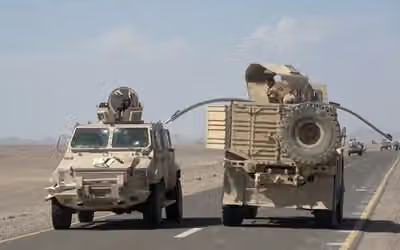
Official rhetoric has remained firm. ISNA reported that Iran warned the United Nations it would “respond swiftly to any aggression,” including attacks on “all assets and military bases of belligerent parties in the region,” which Tehran would treat as legitimate targets.
Yet markets betrayed public sensitivity to the tension. The dollar climbed to 1,660,000 rials amid the renewed uncertainty.
Among the more measured assessments was an article in Fararu by Mohsen Jalilvand, who argued that “there will be no war,” and that the likelihood of regional countries joining a confrontation is “near zero.”
Still, he acknowledged the impasse. “There is a wide gap between the demands of the two sides,” he wrote, warning that even if sanctions were lifted immediately, “it would take at least 15 years for the country to return to normal conditions.”
His closing note captured the broader sentiment: “We cannot afford excessive optimism.”


Iranians at home and abroad watched President Donald Trump’s State of the Union address late Tuesday searching for clues about war or peace—and emerged more uncertain than before.
Across Iran and the diaspora, many stayed up through the night to follow the speech via satellite television and livestreams, many hoping to detect signals about the likelihood of a US military strike in the coming days.
By morning, Persian-language social media reflected a swirl of alarm, anticipation and skepticism.
In his address, Trump accused Tehran and its proxy forces of spreading “terrorism and hatred” and said Iran continues to pursue missile and nuclear capabilities despite years of US pressure.
“As president, I will make peace wherever I can, but I will never hesitate to confront threats to America wherever we must,” he added.
For some Iranians, the balance of menace and ambiguity less than two days before the third round of talks between Tehran and Washington suggested escalation was near.
“President Trump issued the order for a military strike and put the final nail in the coffin of the Islamic Republic,” one user wrote on X. “In the coming hours, we will certainly witness very important events.”
Another focused on Trump’s reference to ballistic missiles—an issue Tehran insists should not be part of current negotiations—arguing it signaled the likelihood of military action may be greater than that of a deal.
“When Trump explicitly declares that the missiles of this criminal cult will soon reach American soil, it means that all paths of diplomacy have reached their final dead end,” a third wrote.
Yet others pushed back against what they saw as over-interpretation.
One user described the speech as “a bucket of cold water poured over warmongers,” arguing that Trump largely repeated familiar themes without announcing new measures.
“This speech, in no way, met the expectations of those who were waiting for a new step,” he wrote.
Another suggested Washington’s military buildup in the region told a different story than the speech itself. “The negotiations are less about reaching an agreement and more a tool for managing public opinion and buying time to prepare militarily,” he argued.
The divergence in reactions underscored the high stakes ahead of Thursday’s talks in Geneva, widely seen as a potentially decisive round amid reports that Washington has set informal timelines for progress.
Iranian officials sought to project steadiness.
President Masoud Pezeshkian said negotiations were proceeding under the guidance of Supreme Leader Ali Khamenei and expressed hope the country could move beyond its current state of “neither war nor peace.”
Foreign Minister Abbas Araghchi struck a similar dual tone. “
The Islamic Republic is prepared for both war and peace,” he told India Today, warning that any confrontation could quickly escalate into a “devastating” regional conflict while insisting that a “fair, balanced, and just” agreement remains attainable.
Parliament Speaker Mohammad Bagher Ghalibaf, however, warned that Iran would respond forcefully if the United States took military action while talks are underway.
Outside official circles, analysts also offered competing readings. Jason Brodsky, policy director at United Against Nuclear Iran, wrote on X that Trump appeared to be laying “public groundwork” for a military strike.
While there was “a brief nod to diplomacy,” he said, most of the speech underscored “the threat and the lethality of the regime,” suggesting limited optimism about negotiations.
As interpretations ricocheted across platforms, one post seemed to capture the broader mood: “These words reeked of war. May God preserve Iran.”
Tehran’s political commentariat continues to issue warnings about social fragmentation, economic collapse and recurring unrest, despite little sign that such appeals are influencing decision-makers at the top.
Weeks after the January 2026 protests, Supreme Leader Ali Khamenei has shown no indication that he intends to open dialogue with a restless public or adjust course in response to mounting domestic criticism.
On Tuesday, February 24, prominent moderate figure Saeed Hajjarian—long regarded as a key strategist of Iran’s reform movement—warned that the political system “has lost the ability to predict and prevent the waves of protest that continue to emerge one after another.”
He added that since 2021, Iranian presidents have effectively functioned as “chief executives for Khamenei.”
Former President Ebrahim Raisi described himself as the Supreme Leader’s “soldier,” while President Massoud Pezeshkian has repeatedly said he is in office to implement Khamenei’s policies.
According to Hajjarian, protest waves will persist “as long as the system remains incapable of tolerating reforms, even those emerging from within.” His remarks pointed to a deeper concern: not simply public anger, but institutional rigidity.
That rigidity, critics argue, extends beyond politics. Khamenei’s resistance to reform has long been evident, but more striking to some observers is the continued dismissal of economic warnings amid a worsening financial crisis.
Earlier in the week, the news website Fararu warned leaders about the growing fragmentation and polarization of Iranian society.
Rather than easing tensions, authorities deployed Basij forces to suppress student protests on university campuses, effectively placing groups of young Iranians in confrontation with one another.
Fararu cautioned that “polarization reduces the chances for dialogue and increases violence in society.” Without meaningful dialogue, it argued, opposing groups increasingly view one another as “enemies,” making disputes far more difficult to resolve.
Economic concerns have followed a similar pattern.
One of the latest warnings came from economist Hossein Raghfar. In an interview with Khabar Online, Raghfar argued that although the January protests had political dimensions, they were primarily driven by deepening economic hardship and government inefficiency.
Without naming Khamenei directly, he said: “The government is certainly responsible, but major decisions are made elsewhere,” referring to the Supreme Leader’s office. While acknowledging the government’s role, he added that “it is obvious that the entire responsibility does not rest with the government.”
Like many Iranian economists, Raghfar warned that removing subsidies on essential goods—and the unrest that followed—has left Iran weakened at a moment of heightened external pressure. Economic mismanagement, he argued, has pushed the country “to the brink of war” while fueling public dissent to unprecedented levels.
Despite earlier warnings going unheeded, Raghfar again urged authorities to avoid inflicting another shock on society by cutting subsidies on staples such as gasoline and bread to offset chronic budget deficits.
Taken together, the cautions from reformists and economists suggest a political system increasingly confronted with recurring unrest yet reluctant to recalibrate—even as social polarization deepens and economic strain intensifies.
A stuffed rat hung by protesting students at Tehran’s Sharif University and removed by a Basij-affiliated student signaled that supporters of Supreme Leader Ali Khamenei have effectively acknowledged and amplified a mocking nickname that chips away at his authority.
Students at several Iranian universities held a third consecutive day of protests on Monday, chanting against Ali Khamenei. At Amir Kabir, Tehran and Alzahra universities, students set fire to the flag of the Islamic Republic. At some of these universities, including Tehran University, Basij forces attacked students.
The image – a Basij-aligned student climbing up to pull down a stuffed animal – spread quickly online. More than a campus scuffle, it suggested a phrase that began on social media is now being contested in the physical arena of protest and counter-mobilization.
From meme to material symbol
The nickname Rat-Ali gained traction during the June war with Israel, when Khamenei largely disappeared from public view and state media aired only prerecorded video messages. Reports that he had taken shelter in fortified underground facilities during military escalation and later unrest fueled the metaphor.
In Persian, “moush” connotes hiding and evasion. By pairing it with the Supreme Leader’s name, critics flip the state’s image of firm leadership.
On Monday, that inversion took tangible form. The rat was not only an online meme but an object displayed and physically removed.
Political satire often loses force when ignored. Authority can neutralize insult through indifference. The decision by a Basiji student to climb the tree and take down the toy had the opposite effect: it signaled that the symbol was perceived as threatening enough to confront.
Precedent in protest language
Iran’s protest culture has repeatedly transformed ridicule into durable shorthand. After the 2020 US drone strike that killed IRGC Quds Force commander Qasem Soleimani, some Iranians referred to him as “cutlet,” a darkly comic reference to the condition of his remains. The term proved difficult to suppress despite official efforts to preserve Soleimani’s image as a national icon.
However, Moush-Ali carries sharper political implications because it targets the apex of the system. Khamenei’s authority rests not only on constitutional powers but also on cultivated distance – a blend of religious stature and institutional control.
Mockery compresses that distance. A rat hanging from a tree reduces a figure positioned as untouchable into a repeatable visual punchline.
Authoritarian systems rely in part on aura – an impression of inevitability and psychological dominance. When that aura becomes vulnerable to parody, the cost of reaction rises. Suppression can amplify visibility; indifference can appear weak.
The scene at Sharif involved a toy, a tree and a handful of students. Yet the rapid spread of the image suggested a broader recalibration of political language.
The new academic term in Iran has begun under heavy tension, with students at several major universities staging anti-government protests and forcing authorities to confront a familiar dilemma: suppress dissent or risk wider unrest.
In early January, shortly after protests that began over economic grievances spread nationwide, authorities moved classes online in what officials described as a seasonal measure but which students widely viewed as an effort to preempt campus mobilization.
Now, with in-person classes resumed, memorial gatherings for those killed in January’s violent crackdown have evolved into open defiance on campuses in Tehran, Mashhad and Isfahan. Some have escalated into stand-offs between protesting students and pro-establishment groups.
In a notable shift, recent rallies have included chants naming Reza Pahlavi, the exiled son of Iran’s last monarch, as “the leader of Iran’s revolution,” and calling for the restoration of monarchy nearly five decades after the 1979 revolution.
On Monday, students at the University of Tehran organized a ceremony for Mohammad Reza Mohammadi Ali, a master’s student in theology. A group known as United Students reported that the Basij student organization sought to appropriate the event, claiming the deceased had supported the government.
Opposing students responded with chants including “This flower has fallen, a gift to the homeland,” “Woman, Life, Freedom,” and “By the blood of our comrades, we stand to the end.”
At Sharif University of Technology, a silent candlelight vigil turned confrontational after university cultural officials broadcast Quran recitations and music over loudspeakers. Students holding photos of the dead protested what they described as an attempt to drown out the gathering.
Videos circulating online show rival groups facing off. Pro-government students chanted support for Supreme Leader Ali Khamenei and slogans such as “Allahu Akbar” and “Death to America,” while calling for the expulsion of those they labeled “rioters.”
Opposition chants targeted the Islamic Republic, Khamenei, and institutions such as the Basij and the Islamic Revolutionary Guard Corps.
Symbols have become vivid markers of division. Pro-government students carried the flag of the Islamic Republic and burned U.S. and Israeli flags during demonstrations. Opposition students, by contrast, covertly brought in the pre-revolutionary lion-and-sun flag — replaced after 1979 — and raised it during gatherings this week. On Monday, students at three Tehran universities also set fire to the Islamic Republic flag.
Students at two Tehran universities and one in Isfahan have also called for the restoration of their pre-1979 names, which referenced members of the Pahlavi royal family before being changed after the revolution.
University security offices — and, according to student accounts, plainclothes forces believed to be operating from outside campuses — have been present during several confrontations, at times appearing to side with pro-establishment students.
Students report identification cards being photographed and participants filmed, actions widely interpreted as intimidation. Some universities have allegedly sent text messages barring certain students from campus and warning of possible disciplinary proceedings.
The renewed campus unrest places Iran’s leadership in a delicate position. A forceful intervention risks inflaming tensions and pushing protests beyond university gates. Yet allowing sustained mobilization at institutions long regarded as incubators of political activism could embolden broader opposition.
That dilemma is complicated by a longstanding legal safeguard.
A 2000 law prohibits military, police and security forces from entering university campuses to conduct operations, make arrests or use weapons without formal authorization. The measure was enacted after the July 1999 unrest, when vigilantes and plainclothes security forces stormed dormitories at the University of Tehran, triggering nearly a week of nationwide turmoil.
Despite the law, human rights groups and media outlets have documented repeated instances over the years in which security forces entered campuses without authorization, including during recent protests.
As cartel violence grips Mexico following the death of a top drug lord, experts tell Iran International that Tehran-linked networks may be intertwined with the criminal infrastructure fueling instability across Latin America.
Mexico has deployed thousands of troops after coordinated attacks erupted across at least 20 states following the capture and death of Jalisco New Generation Cartel leader Nemesio Oseguera Cervantes, known as El Mencho.
Cartel fighters torched buses, blocked highways and clashed with security forces, leaving dozens dead and forcing authorities to mobilize nearly 10,000 personnel nationwide.
While Mexican authorities frame the unrest as cartel retaliation, security analysts say such episodes increasingly unfold within transnational financial and trafficking systems that extend beyond Mexico’s borders.
Those systems, experts say, have in some cases intersected with Iranian state-aligned networks operating across Latin America.
“There are longstanding money-laundering and trafficking ecosystems that connect Latin American cartels, Iranian state-aligned networks and global criminal finance,” investigative journalist Sam Cooper told Iran International, pointing to investigations linking criminal actors across North and South America.
Cooper who has reported extensively on transnational crime networks, stressed that the overlap does not necessarily indicate direct operational control by Tehran but reflects a convergence of interests that could benefit the theocracy during periods of heightened pressure.
“I don’t have direct evidence their intelligence would be involved in helping the cartel push back against the Mexican state,” he said. “But I do believe the Iranian regime would want to benefit very much from increasing the turmoil in Mexico.”
That convergence of illicit finance and geopolitical competition, analysts say, creates openings for states such as Iran to benefit from regional instability.
'Using gangs for dirty work'
Janatan Sayeh, a research analyst at the Foundation for Defense of Democracies focusing on Iranian domestic affairs and regional influence, says the Islamic Republic frequently advances its objectives indirectly, relying on criminal intermediaries to apply pressure while maintaining distance from direct involvement.
“They (Iran's regime) do try to put a distance between themselves and their criminal activity, specifically assassination plots,” Sayeh said.
“They increasingly are leveraging some of these gangs… to do the dirty work.”
In 2011, US officials brought charges against several Iranian nationals, among them an operative linked to the IRGC’s Quds Force, accusing them of conspiring to kill the Saudi ambassador in Washington.
According to prosecutors, an Iranian go-between attempted to recruit individuals he thought were tied to a Mexican drug cartel, offering payment to carry out the assassination. Those individuals were in fact informants working with the U.S. Drug Enforcement Administration.
Networks built over decades
Analysts say many of these connections trace back decades, particularly through Iran’s partnership with the former regime ruling Venezuela, where Iranian Revolutionary Guard-aligned networks and Hezbollah operatives established financial and logistical footholds across Latin America.
Hezbollah has long been accused of running criminal networks in Latin America that intersect with drug trafficking routes.
Dr. Walid Phares, a foreign policy expert and co-secretary general of the Transatlantic Parliamentary Group, said those networks gradually expanded into cooperation with organized crime groups operating across the region.
“Hezbollah had developed relationships with similar organizations across Latin America, Brazil, Colombia and beyond,” Phares told Iran International. “But the most important move backed by the IRGC regime was in Mexico.”
According to Phares, access to trafficking routes and financial channels allowed militant networks to expand their reach while maintaining distance through criminal intermediaries.
“The most important goal of Hezbollah was to get to the American and Mexican border,” he said.
Sayeh added that Western governments often mischaracterize the threat by treating such activity solely as organized crime rather than part of a broader national security challenge.
“A lot of times when it comes to the Americas it is treated as a criminal network, not a terrorism network,” he said. “Accurately labeling it for what it is important.”
For Iran, "it’s anything anti-America… and cartel is just part of that paradigm for them,” he said. “Any opportunity just to exert pressure on the Americas.”
Crime and geopolitics converge
Security specialists say the convergence has blurred the traditional boundary between criminal activity and geopolitical competition. Networks originally built for sanctions evasion and terror financing can also serve narcotics trafficking and money laundering operations, creating mutually beneficial partnerships between state and non-state actors.
For Cooper, the violence unfolding in Mexico reflects a wider shift in the Western Hemisphere, where criminal networks increasingly intersect with global rivalries.
“The level of threats that are emerging in the Western Hemisphere right now,” he said, “is all related.”
As Mexico contains the fallout from El Mencho’s death, experts say the episode highlights how criminal violence in the Western Hemisphere increasingly intersects with global power competition.


