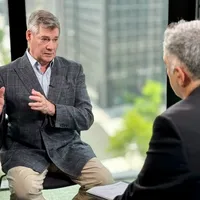
"Those who think Iran has been weakened with Assad's fall rely on the flawed assumption that the resistance is a proxy force for Iran," Iran's Vice President for Strategic Affairs and former foreign minister, Mohammad Javad Zarif said in an interview with Didar News.
His remarks represent the most high-level official Iranian comments yet on the upheaval in Syria which deprived Tehran of its top Arab ally.
"The resistance was neither created by Iran nor dependent on it for its continuity. Its driving force is Israel's occupation and apartheid," he added.
"Assad's downfall resulted from his pride in defeating the armed opposition and his failure to turn that military victory into a win-win political agreement and establish an inclusive government."
Iran's flag among the flags in front of the IAEA headquarters in Vienna, Austria
Iran's Foreign Ministry has rejected the joint statement issued by the United Kingdom, France, and Germany criticizing Tehran for enriching uranium to near weapons-grade, saying Tehran was acting within its international rights.
Iran’s decision to employ advanced centrifuges and enrich uranium to higher levels falls within its rights under the Non-Proliferation Treaty (NPT), the ministry 's spokesperson Esmail Baghaei argued on Tuesday. These measures comply with International Atomic Energy Agency (IAEA) oversight protocols, he added.
"The Islamic Republic of Iran, as a responsible member of the IAEA, has proven its commitment to cooperation with this body," Baghaei said, referring to recent discussions with IAEA Director General Rafael Grossi in Tehran.
"It is regrettable that these European countries, instead of building on the constructive engagements, continue with unhelpful and confrontational approaches."
The European trio, collectively known as the E3, issued a statement on Tuesday condemning Iran's actions as undermining the Joint Comprehensive Plan of Action (JCPOA), the 2015 nuclear deal. Their statement highlighted concerns over uranium enrichment at the Fordow facility to near-weapons-grade levels and an increase in the number of centrifuges in operation.
"Iran’s actions have further hollowed out the JCPOA," they wrote, urging Tehran to reverse course and adhere to international safeguards.
Baghaei dismissed these remarks, insisting that the current nuclear standoff stems not from Iran’s actions but from the US's withdrawal from the JCPOA in 2018 and the failure of European signatories to uphold their commitments under the deal.
Iran has long contended that its nuclear program is peaceful and that its uranium enrichment—reported to have reached 60% purity, just short of the 90% threshold for weapons-grade material—serves civilian purposes. However, this has been met with skepticism from Western nations, who argue there is no credible civilian justification for such enrichment levels.
The ongoing dispute has fueled fears of regional instability. IAEA Chief Rafael Grossi has acknowledged in recent statements that dialogue with Iran is indispensable.
However, he has warned that the lack of implementation of safeguards continues to pose significant challenges.
While the IAEA continues its efforts to mediate between Tehran and the west, diplomatic progress remains elusive.
Iran and Hezbollah were Syria's bulwark against an Israeli incursion which is now unfolding, the Tehran-backed militant group's media outlet al-Manar said in a news analysis on Tuesday.
The comments were among the first from the group after Bashar al-Assad's downfall at the hands of armed insurgents, an upheaval that deprives it and the Islamic Republic of their main Arab ally and key nexus for Lebanon-bound weapons.
"A suspicious and insolent silence regarding the aggression is taking place, except for some voices here and there in addition to those who have a history of confronting this enemy and knowing its ambitions very well, such as the Islamic Resistance in Lebanon (Hezbollah) and the Islamic Republic of Iran," al-Manar said.
"The enemy unleashed its ambitions, immediately starting a military operation to nibble away at areas in southern Syria, including Mount Hermon and a number of cities and villages, in addition to a wide-scale air aggression that included almost all of the Syrian army’s capabilities, specifically its advanced weapons," it added.
"So where are those who care about Syria’s freedom?"
Israeli airstrikes have sunk the Syrian fleet targeted Syrian military bases and alleged chemical weapons facilities in the days since Assad fled the country for Russia on Sunday. Its ground forces also plunged into a buffer region on the Golan Heights in place since a 1974 war.
Israeli Prime Minister Benjamin Netanyahu warned Syria's new rulers not to follow in Bashar al-Assad's footsteps and allow Iran to "re-establish" itself in the country.
"If this regime allows Iran to re-establish itself in Syria, or permits the transfer of Iranian weapons or any other weapons to Hezbollah, or if it attacks us -– we will respond forcefully, and we will exact a heavy price," Netanyahu said in a video statement from Tel Aviv.
"What happened to the previous regime will happen to this one."
A prominent international football referee has left Iran due to threats and pressure from the country’s security forces, according to information exclusively obtained by Iran International.
The revelation that Mahsa Ghorbani departed follows a recent interview with the Shargh Network in which she highlighted challenges faced by female referees in Iran.
"I cannot continue my work or life in a country where my safety is constantly under threat," Ghorbani was quoted as saying.
Ghorbani could not be reached for comment and Iranian authorities have yet to comment on the case.
Iranian sport news website Tarafdari quoted a former Iranian referee as saying that Ghorbani intends to live in Europe but will not be seeking political asylum.
The referee had been slated to participate in high-profile competitions such as last year’s Tehran derby, officiating in the VAR room. However, opposition from government authorities and state-affiliated media prevented her involvement.
Ghorbani also missed the chance to officiate at the 2022 Qatar World Cup because she was barred from overseeing men’s matches in Iran due to her gender.
Last month, 15-year-old table tennis player Baran Arjmand sought police protection in Denmark, refusing to return to Iran after participating in a championship.
Iranian judoka Saeid Mollaei and alpine skier Atefeh Ahmadi have similarly sought asylum in recent years, citing political and social pressures.
Ghorbani’s departure underscores rising tension between Iranian authorities and professionals in sports, the arts and academia, many of whom are leaving the country due to safety concerns and economic hardships.
Israeli Defense Minister Israel Katz said Tuesday that the country's navy had destroyed Syria's fleet in the Mediterranean on Monday night.
Photos released by news agencies showed sunken Syrian naval ships in Latakia, with smoke billowing from the wreckage after they were laid to waste by the Jewish state's airstrikes.