Israeli Defense Minister Israel Katz said Tuesday that the country's navy had destroyed Syria's fleet in the Mediterranean on Monday night.
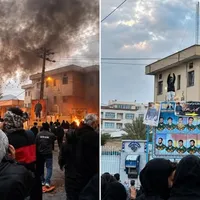
Photos released by news agencies showed sunken Syrian naval ships in Latakia, with smoke billowing from the wreckage after they were laid to waste by the Jewish state's airstrikes.
"I have no reason to believe this has happened," Iran's Vice-President for Strategic Affairs Mohammad Javad Zarif said Tuesday when asked about speculations that Assad's fall is a result of a US-Russia deal.
"Of course, one must investigate and examine what has occurred, but so far, I have not found any evidence in this regard. I cannot say it did not happen, but I can say that I am not aware of it," Zarif said.
"Unfortunately, Turkey's role in this matter is very clear," the former foreign minister added.

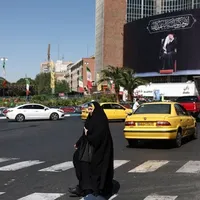
Amnesty International has condemned Iran's new compulsory veiling law, saying it intensifies the oppression of women and girls while exposing activists opposing the rules to charges carrying the death penalty.
“Iranian authorities have adopted a new draconian law that further erases the human rights of women and girls, imposing the death penalty, flogging, prison terms and other severe penalties to crush ongoing resistance to compulsory veiling,” Amnesty International said in a press release on Tuesday.
The "Law on Protecting the Family through the Promotion of the Culture of Chastity and Hijab," comprising 74 articles, is set to take effect this Friday. It imposes severe penalties on women and girls who defy veiling requirements, including exorbitant fines, prison terms, flogging, and travel bans.
Amnesty highlighted that activism against the hijab law may even be deemed “corruption on earth,” a charge punishable by death under Iran's penal code—a concern recently raised by Iranian women’s rights activists.
“This shameful law intensifies the persecution of women and girls for daring to stand up for their rights following the ‘Woman Life Freedom’ uprising,” said Diana Eltahawy, Amnesty International’s deputy regional director for the Middle East and North Africa.
Drafted in May 2023, less than a year after the Woman Life Freedom uprising sparked by the death in custody of Mahsa Amini in September 2022, the law was introduced in response to widespread defiance of compulsory veiling by women and girls, Amnesty said.
Amnesty detailed sections of the new law and how it, warning it criminalizes acts such as “nudity, indecency, unveiling and bad dressing.”
Article 50 of the law defines “unveiling” as failing to cover the head with a hijab, chador, or headscarf. “Bad dressing” is defined in Article 48 as exposing body parts below the neck, other than the hands and feet, or wearing clothing deemed to “contribute to or incite sin by others”.
However, the rights group warned terms such as “nudity” and “indecency” remain undefined in the new law, allowing for subjective interpretation and enforcement.
Under Article 48, fines for “bad dressing” begin at $160 for a first offense and rise to $4,000 for a fourth. Further infractions can result in $8,000 fines, up to five years in prison, a two-year travel ban, and a two-year ban on social media use. Article 49 mandates that “nudity” in public or online may lead to up to 10 years in prison or a $12,000 fine, with repeat offenses punishable by 15 years in prison or a $22,000 fine.
Amnesty noted that women unable to pay fines face severe restrictions, including being barred from reclaiming impounded vehicles, renewing driving licenses or passports or leaving the country. Article 56 also allows for asset seizures or imprisonment in such cases.
Article 38 prescribes up to five years in prison, travel bans, and fines for “insulting or ridiculing the hijab” or “promoting nudity, indecency, unveiling, and bad dressing.” Meanwhile, the law also bans the import and sale of clothing, dolls, mannequins, books, paintings, and other items that “promote nudity, indecency, unveiling, and bad dressing.”
“The complex web of fines, prison sentences and other severe punishments going as far as the death penalty demonstrates the state policy to control women and girls through fear and economic hardship. This law has particularly devastating consequences for the most economically disadvantaged in society,” Eltahawy added.
Amnesty warned the law grants sweeping powers to Iran’s intelligence and security forces, including the Revolutionary Guard and Basij militia, to enforce veiling rules.
Eltahawy called on the international community to act urgently, urging governments to use diplomatic and legal avenues to hold Iranian authorities accountable for systematic human rights violations.

When Canada’s former Justice Minister Irwin Cotler penned an op-ed warning of the dangers of Iran's transnational repression and plots to assassinate dissidents - he did not yet know he too was already a target.
Cotler said he was the subject of an alleged Iranian plot to kill him on Canadian soil.
The threats, according to Cotler, mean anyone who dares speak up against repression even non-Iranians as far away as Canada is in danger, imperiling free speech and posing a key national security challenge.
“My assassination attempt that I experienced should be seen as a wake- up call of a larger phenomenon,” said Cotler, adding that domestic stifling of dissent is linked to Iran's attempts to silence critics abroad.
"The confluence of massive domestic repression, which incentivizes and underpins the extraterritorial aggression targeting those who are engaged in supporting the very Iranian people that are the targets of mass repression."
In an interview with Iran International, Cotler - a vocal critic of Iran’s government - said he was informed by the Royal Canadian Mounted Police (RCMP) in October of an active plot to try and kill him.
“I was supposed to attend the 60th anniversary of my McGill Law class in Montreal. I was prepared. The [RCMP] security detail was prepared to take me there and then I was advised that day that they had a warning of an imminent assassination attempt within the next 48 hours,” said Cotler.
The Globe and Mail, a Canadian newspaper, first reported on the alleged plot in early November, citing law enforcement sources about two suspects involved in his case. Cotler said he’s not aware of the two individuals but said he received confirmation that the threat against him has been lowered substantially.
Threats for more than a year
Cotler’s life has been under threat since 2023, he said, citing Canadian authorities.
The former parliamentarian was flying back home to Montreal from Washington DC with his wife on November 14, 2023 when he was advised by RCMP officials not to leave the airport. Then the text messages started popping up on their screens from neighbors curious about armored vehicles outside the Cotler home.
From that moment he has been under 24-hour police protection. Cotler is accompanied wherever he goes including his medical treatments and family outings.
The life of Cotler and his family would be changed forever, but his voice was not to be silenced.
Armored cars, armed protection and other security details soon became the norm.
“My life was altered with my freedom of movement restricted, but it has not altered my advocacy because I know that the objective of transnational repression and assassination are carried out," said Cotler. "Their purpose is really to intimidate, to silence and to arrest the target. Because I had the beneficiary of the protection, I've been able to engage in my continued public advocacy,”
When he learned later that the threats were coming from Iran, he wasn’t surprised.
“I first advocated for putting the IRGC on the terrorist list back in 2008 when I was a Member of Parliament. It took until 2024 and I fought until it happened.”
As a lawmaker, justice minister and now as chair of human rights organization the Raoul Wallenberg Centre, Cotler has been an advocate for human rights in Iran for decades.
A former lawyer, he also represented Iranian dissidents and political prisoners throughout his career.
As a retired politician, Cotler receives protection that an average Canadian under similar circumstances would not. In speaking directly with Iranian dissidents in Canada and abroad, he understands their fears and threats they face.
One major concern is Iran’s connections to organized crime in Canada.
US law enforcement agencies say two Canadians with ties to the biker gang Hells Angels were hired at the behest of Iran’s intelligence services to carry out assassinations in Maryland.
An unsealed US indictment revealed last month that two men, allegedly hired by the Islamic Republic to kill prominent Iranian-American human rights advocate Masih Alinejad.
Alinejad, whom Cotler refers to as a friend and colleague, has been the subject of several Iranian murder-for-hire plots on US soil. The same indictment also alleges Iran planned to assassinate president-elect Donald Trump prior to the American elections.
Iran's Foreign Minister Abbas Araghchi denied that Tehran was linked to an alleged plot to kill Trump.
While Cotler continues to raise alarm bells, he said Canada can and should be doing more by taking the lead in fighting transnational repression.
In a recent conversation with Canadian Prime Minister Justin Trudeau, Colter said he encouraged the Prime Minister to make Iran's attempts to assassinate critics abroad a top priority at next year’s G7 summit, which Canada is hosting.
“The real problem has been the culture of impunity," said Cotler. "What is needed now is a culture of accountability,”
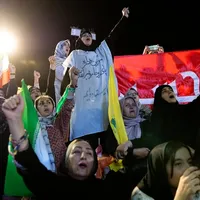
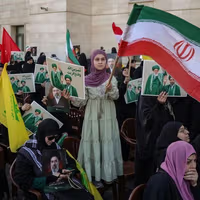
Tehran's mayor warned that the fall of Iran's main Arab ally Syria to rebel forces would pose a long-term threat to the country.
“If we fail to address this situation, we risk enduring harm for centuries,” Alireza Zakani said on Tuesday.
"But with care, we can turn this threat into an opportunity," he added, without elaborating.
The Israeli military has been pounding military infrastructure in Syria in attacks they say aim to ensure Syrian and Iranian weapons and facilities don't fall into the hands of extremists.
Around 300 airstrikes have taken place in Syria, in the wake of the fall of the Assad government, with attacks intensifying on Tuesday.
Read more...