Israel and Hezbollah 'close' to clinching ceasefire, Israeli diplomat says
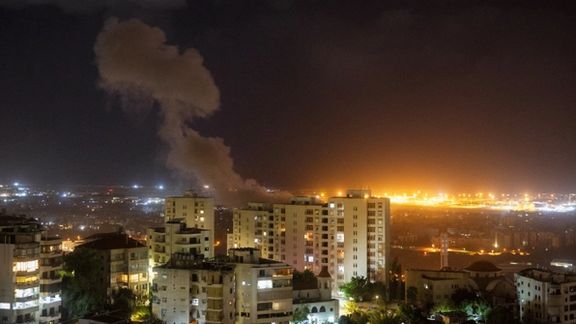
Israeli bombing of suspected Hezbollah targets in Beirut. Nov. 24, 2024
Israel’s ambassador to the United States said that ceasefire talks with Iran-backed Hezbollah in Lebanon are progressing, in spite of the 250 projectiles fired into Israeli territory and continuation of Israeli strikes in Lebanon at full pace on Monday.
"We are close to an agreement, it could happen within days, some corners remain to be closed,” Mike Herzog, Israel's ambassador to the US, told Army Radio on Monday.
The United States believes the two sides have reached a ceasefire agreement, Axios reported on Monday citing a senior U.S. official.
On Sunday night, Israeli Prime Minister Benjamin Netanyahu held closed talks on the matter which would have to be approved by the security cabinet.
The US Undersecretary of Defense for Middle East Affairs, Dan Shapiro, will arrive in Israel on Monday and meet with Defense Minister Israel Katz and other Israeli officials.
A key agenda item will be addressing Israeli concerns its so-called freedom of action and ensuring immediate cooperation on the matter, with Israel insisting on keeping the option for self-defense firmly open.
A senior Israeli negotiator, working closely on the Gaza file, told Iran International: “Each side wants a ceasefire in Lebanon.”
He said that there is no desire to wait until the Trump administration begins in January, as the country is being battered by war, impacting economically and psychologically, while 101 Israeli hostages remain held by Iran-backed Hamas in Gaza and the war rolls on there.
“Bibi fears that the Biden administration may impose sanctions, enforce an arms embargo or even seek retribution against him,” the source said.
“At the same time, he rightly believes that this is a moment when Hezbollah and Iran are at their weakest, Israel not gaining any more by inflicting havoc on Lebanon.”
Lebanese Parliament Speaker Nabih Berri meets with US special envoy Amos Hochstein in Beirut, November 19, 2024.
In September, coordinated attacks over two days saw thousands of Hezbollah operatives taken out of action when pagers and walkie-talkies exploded simultaneously.
Soon after, swathes of the group’s leadership, including long-time leader Hassan Nasrallah, were killed in a wave of targeted strikes, which continue today.
Lebanese Parliament Speaker Nabih Berri, a close political ally of Hezbollah, last week said there was progress in the talks, but there were still “technical details” to resolve.
The US-drafted proposal entails an initial 60-day suspension of hostilities during which Hezbollah fighters would move north of the Litani River, about 30 kilometers (19 miles) away from the Israeli border.
However, it would require the Lebanese army to enforce the deal, deploying thousands of troops, which has historically been impossible to impose as Hezbollah continues to defy the army which is essentially weaker than Iran’s largest ally in the region.
Former General Khaled Hmadeh told Iran International that on the ground, the prospects of a ceasefire look more bleak.
"The efforts initiated by Amos Hochstein's recent visits to Beirut and Tel Aviv have yielded little productive outcome, highlighted by the immediate resumption of Israeli reconnaissance flights over Beirut following his departure. The situation further deteriorated with a surge in military operations characterized by escalating violence and destruction after his visit to Tel Aviv," he told Iran International.
He said problems between the US and Iran remain key barriers. "Clear terms that could address the critical issues between Israel and Lebanon remain elusive. Instead, the situation seems to be heading toward further escalation. A significant factor in this deepening rift is Iran's resistance to the changes the United States is implementing in the region, particularly concerning Iranian influence and the status of Iranian-backed armed militias," he added.
Tehran, in turn, he said appears to be "exploiting and capitalizing on its dominance over Hezbollah, and through it, Lebanese political decision-making in the face of US pressure over its regional role and nuclear ambitions".
He said that while Lebanon bears the brunt of the conflict, suffering damage to its political stability, security, and national economy, the effectiveness of the Lebanese government is also under scrutiny, "particularly concerning Parliament Speaker Nabih Berri's navigation of Tehran's influence".
International pressure on Tehran will be key in what not only comes next, but the key to any kind of lasting peace.
"The responsibility to pressure Tehran into dismantling Hezbollah's military capabilities should be recognized as an international and American obligation that transcends purely Lebanese concerns," he added. "Without consistent external support aimed at solidifying the Lebanese Army's role and addressing Hezbollah's military presence, the prospects for stability in the region will remain precarious at best."
A soldier in the elite Golani unit not authorized to speak to media, told Iran International: "I hope we finish them. Lebanon agrees, they also hate Hezbollah."
In spite of being seriously wounded in Lebanon, he longs to go back to the front lines, and "finish the job". "We can't allow them to get strong enough to raise their heads again," he said.
Lior Akerman, a senior fellow and Head of National Resilience Desk in the Institute for Policy and Strategy at Reichman University, said that in the current reality, an agreement with Hezbollah has a wider importance.
It could allow the "return of sanity to the State of Israel", including the cessation of fighting in Gaza, the return of the 63,000 displaced Israeli residents to their homes in the north, the return of the kidnapped in Gaza, and the rebuilding of the state.
The former deputy head of division and a former chief of staff in the Shin Bet told Iran International: "In the distant future, there is no doubt that an all-out war will be required to destroy Hezbollah, but in the meantime, we can be content with keeping them away from the border and giving the Israeli army the opportunity to thwart any security activity against us in the territories of southern Lebanon."
Israel's right-wing national security minister, Itamar Ben-Gvir, urged Netanyahu to reject a ceasefire. On X, he said: "An agreement with Lebanon is a big mistake. A historic missed opportunity to eradicate Hezbollah. I understand all the constraints and reasons, and it is still a grave mistake."
He urged the military to continue to weaken the group, considered terrorists by countries including the US and UK.
"You have to listen to the commanders fighting in the field, listen to the heads of the authorities. Precisely now, when Hezbollah is beaten and longs for a cease-fire, it is forbidden to stop. As I warned before in Gaza, I warn now as well: Mr. Prime Minister - it is not too late to stop this agreement! We must continue until the absolute victory!"
Iran has backed a ceasefire, with Foreign Minister Abbas Araghchi saying last month in Beirut: "We support efforts for a ceasefire on the condition that it would be acceptable to the Lebanese people, acceptable to the resistance, and thirdly, it would be synchronized with a ceasefire in Gaza."
Images of the three suspects released by UAE. Nov. 25, 2024
The United Arab Emirates has named the three suspects arrested in the case of the murdered Moldovan-Israeli rabbi, Zvi Kogan, which Israel has branded a terror attack.
The country’s Interior Ministry statement identified the three men as Olimpi Tohirovic, 28, Mahmoud John Abdul Rahim 28, and Azizi Kamilovic, 33.
The state-run WAM news agency carried images of the three men, their faces blurred, and did not mention charges filed against them.
Israel was quick to vow revenge for the killing of the 28-year-old who has been at the heart of building the UAE’s nascent Jewish community, which has thrived since the 2020 Abraham Accords brought peace between Israel and Arab nations including the UAE.
On Sunday, following the discovery of Kogan’s body, after he had been missing since Thursday, Israel’s prime minister Benjamin Netanyahu said: “The murder of Zvi Kogan is a criminal anti-Semitic terrorist incident. The State of Israel will act in all of its abilities to bring to justice the criminals responsible for his death."
Israeli security officials were quick to point the blame at Iran, which has carried out missions in the UAE before. In 2020, a German-Iranian was abducted from Dubai and in 2013, a British-Iranian is believed to have been murdered by Iranian agents in Dubai.
Kogan ran the kosher supermarket in Dubai, where hundreds of Jews and Israelis live, and hundreds of thousands more have flocked for tourism since 2020.
Speaking to The Telegraph, Oded Ailam, former head of counter-intelligence at Israel’s Mossad, said: "The case raises a wave of questions and speculation about what happened, with Iran immediately suspected of being behind the incident.
“The pattern of action attributed to the Iranians is well known: recruiting local or foreign criminals to carry out acts of sabotage, kidnapping or assassination. This pattern has been observed in failed operations in Mumbai, Thailand, Turkey and even Israel, but Iranian determination, along with the principle of the "law of large numbers", meaning that eventually one day the attempts will succeed, continues to pose a real threat.”
Reuters reported that since 2020, court documents and public statements by government officials have shown at least 33 assassination or abduction attempts in the West in which local or Israeli authorities allege an Iran link.
There has been no formal mention of Iran from either Israel or the UAE in relation to the case, but earlier this year, the IRGC had plotted to attack key Jewish centers in Uzbekistan and Kazakhstan, using a Tajik national.
If the incident is proven to be Iran-backed, it will indeed risk ties between the two countries which are already at odds amid a battle over sovereignty over three disputed islands in the Persian Gulf.
Between 2016 and 2022, the two countries had no diplomatic ties, the UAE aligning with Saudi which cut links after the storming of the Saudi embassy in Tehran in 2016 following Riyadh's execution of a prominent Shia Muslim cleric.
Only last year did Saudi resume ties with its regional rival.
Mr Ailam told The Telegraph: “It is not surprising that at this stage the authorities in the UAE are refraining from public statements attacking Iran, and are devoting their efforts to clandestine activity.”
Kogan will be buried in Jerusalem, where he was born, on Tuesday.
Ali Khamenei speaking to a group of Basij militia members, November 25, 2024.
Supreme Leader Ali Khamenei said on Monday that the world's top court should have sentenced Israeli Prime Minister Benjamin Netanyahu to death for war crimes, ramping up his rhetoric against Iran's arch-foe.
“Issuing an arrest warrant is not enough; a death sentence for Netanyahu should be issued,” Khamenei said in a speech to members of the Basij militia.
The ICC’s chief prosecutor, Karim Khan, issued arrest warrants on November 21 for Netanyahu, former Israeli Defense Minister Yoav Gallant, and Mohammed Deif, the Hamas military leader who is presumed dead.
These warrants allege war crimes and crimes against humanity stemming from the Gaza conflict triggered by Hamas’s attacks on Israeli civilians on October 7, 2023. However, Khamenei demanded harsher penalties for Israeli officials, accusing them of criminality in their military operations against Gaza and Lebanon.
The Gaza conflict led to direct military confrontation between Israel and Iran this year, and can still turn into a more serious war in the region. Iran also faces more potential sanctions and pressure by the incoming Trump administration.
Khamenei’s demand comes as international legal bodies, including the ICC, stand firmly opposed to capital punishment. Human rights organizations have repeatedly criticized Iran for its extensive use of the death penalty, labeling it a violation of international norms.
This contradiction underscores the disparity between Khamenei’s calls for justice abroad and the practices of his system at home, where capital punishment is frequently employed against political dissidents and protesters.
Khamenei justified his remarks by referencing Israel’s military response to Hamas’s October 7 attacks, which killed approximately 1,200 Israelis, including 46 Americans, and led to the abduction of nearly 250 hostages.
Hamas, classified as a terrorist organization by the European Union and the United States, receives significant support from Tehran.
Khamenei’s criticism of Israel comes as the Islamic Republic has cracked down on domestic dissent. Groups like Iran Human Rights have documented systematic killings and repression since protests erupted in 2022. Hundreds of protesters have been killed, and thousands more injured or imprisoned, with these actions widely condemned by international human rights organizations.
Khamenei also hailed the growth of the so-called Resistance Front, a term used by Iranian officials to describe Tehran-backed armed groups in the region, including Hamas, Hezbollah, and other militias.
“Today, the Resistance Front has grown significantly; tomorrow, this growth will multiply,” Khamenei said, emphasizing his commitment to supporting anti-Israel factions despite international criticism.
Zvi Kogan, a Chabad rabbi who was murdered in the UAE in November 2024
Iran has denied involvement in the murder of an Israeli rabbi in the United Arab Emirates, after Hebrew media pointed fingers pointed at Tehran and the Israeli prime minister promised to punish those who ordered the murder.
Emirati authorities on Sunday identified the body of missing Chabad emissary Rabbi Zvi Kogan. They later announced that three suspects had been arrested in connection with the murder, which is being investigated by Israel's intelligence service and the UAE.
Senior Israeli officials told Walla News on Saturday that the focus of investigations was "a terrorist squad of Uzbek origin that operated in Dubai on behalf of Iran and allegedly carried out the abduction and then fled to Turkey."
However, the Iranian embassy in the UAE told Reuters on Sunday that it "categorically rejects the allegations of Iran’s involvement in the murder of this individual."
The statement came hours after Israeli prime minister Benjamin Netanyahu called the murder "an antisemitic terror attack" and vowed that "Israel will act with all means to bring justice to the murderers and those who sent them."
Over the past two days, Israeli media have been reporting that the rabbi's murder may be related to Tehran's plan to avenge Israel's October 26 air strikes on Iranian military targets.
Israel has not yet accused Iran of involvement in the murder. However, the country has in the past alleged Iran's involvement in numerous attempts to kidnap Israelis abroad. Iran has also been involved in the kidnapping and killing of foreign nationals in the UAE, according to the Emirati and Western officials.
Iran suspected in hoax targeting Israeli ministers
In one of the latest cases, several Israeli government ministers recently received an invitation to an event hosted by Chabad in New York. Upon further investigation, it turned out that the invitation was signed in the name of a fictitious figure, raising suspicions the message was an Iranian attempt to lure government ministers, Israel's Ynet website reported.
Estimations now suggest the Iranians, or whoever orchestrated the attempt, used artificial intelligence to fabricate the identity of a rabbi, the report added, shortly after the murder of the Chabad emissary to the UAE.
In a similar case in May 2020, Israel’s security agency Shin Bet uncovered an alleged plot by Iranian intelligence to lure Israeli academics and former defense officials to travel abroad in order to kidnap them.
The agency said Iranians contacted the Israelis while posing as academics, journalists, businesspeople and philanthropists, using spoofed emails with the identities of real people living overseas who were unaware their names were being used.
Iran's intelligence targets thousands of Israelis
Israel Hayom reported on Sunday that Iranian intelligence agencies have compiled detailed profiles on thousands of Israelis, identifying them as potential targets for operations both within Iran and abroad.
Citing security sources, the report said hundreds of these individuals are classified as "high-risk," with some reportedly receiving direct threats from Iranian agents. The targets include current and former defense officials, scientists, and academics.
This effort, ongoing for over a decade, is viewed as Iran's strategic retaliation against the alleged Mossad-orchestrated assassinations of Iranian officials and scientists. In response, Tehran has reportedly established cells in various countries, aiming to target Israelis living or traveling in these regions, the report said.
Mossad Director David Barnea warned in September 2023 that Iran's leaders would pay a direct price at "the highest echelon" if Israelis or Jews are harmed in what he said was an ongoing, significantly stepped-up, state-organized Iranian "terror effort" worldwide.
Iran's Supreme Leader Ali Khamenei and his advisor Ali Larijani
Iranian authorities are preparing to respond to Israel's October 26 attack on the Islamic Republic's military sites, an advisor to Iran's Supreme Leader Ali Khamenei said on Sunday.
"Military officials are planning various strategies to respond to Israel," Ali Larijani said in an interview with the IRGC-affiliated Tasnim News.
Iran has been threatening to retaliate against Israel over the air strikes, which according to Israeli and US officials, knocked out Iran's last three Russian-provided S-300 air defense missile systems and left the country "naked".
Larijani's remarks came shortly after the body of an Israeli rabbi was found in the United Arab Emirates following his abduction by an allegedly Iran-linked cell, giving rise to suspicions that his assassination may be related to Tehran's plan to avenge the Israeli attacks.
Washington's 'shadow war' against Iran
In his Sunday interview, Larijani accused the United States of orchestrating the Israeli actions in the Middle East, including its operations against Iran.
"Israel was counting on the United States' support when planning its operation against Iran, with many US resources and aircraft operating in the region to assist them," he said.
"It can be said with certainty that the Americans are orchestrating events here. But why are they doing this? Because they prefer to engage in a "shadow war," staying out of sight while pushing others into the forefront," the senior advisor to Khamenei said.
He also called on the incoming administration of Donald Trump to stop its support for Israel and prevent what he called the tarnishing of the US image in the region.
"It seems that the United States and its current leadership, which has undergone changes, need to gain a proper understanding of the situation. The officials of the Zionist regime (Israel) are drowning themselves and dragging the Americans down with them, tarnishing the US's reputation in the region," he said.
Trump’s incoming administration plans to revive its “maximum pressure” policy to “bankrupt” Iran’s capacity to support its so-called Axis of Resistance and pursue nuclear development, The Financial Times reported last week.
Trump’s team is preparing executive orders for his first day in office that would tighten existing sanctions and introduce new ones on Iran’s oil exports, the FT report said citing unnamed sources.
A file photo of Iran nuclear talks at the Palais des Nations in Geneva November 24, 2013
Iranian foreign ministry spokesperson Esmail Baghaei confirmed Sunday that Tehran is set to hold nuclear talks with Britain, France, Germany, and the European Union on November 29th in Geneva.
Earlier in the day, Japan's Kyodo News Agency reported the meeting, citing several Iranian diplomatic sources.
The report indicated that Iranian President Masoud Pezeshkian's administration aims to resolve the nuclear impasse before the inauguration of the next US president, Donald Trump.
According to Baghaei, the upcoming talks with the three European countries are seen as a follow-up to meetings held with them on the sidelines of the United Nations General Assembly in New York.
“In this round of talks, which were planned in New York, a range of regional and international issues, including Palestine and Lebanon, as well as nuclear issues, will be discussed.”
Iranian Deputy Foreign Minister for Political Affairs Majid Takht Ravanchi, who previously served as Iran’s ambassador to the United Nations and was a member of the Iranian nuclear negotiating team for the JCPOA nuclear accord is said to be leading the negotiations.
There is no direct confirmation of scheduled talks from the European sides.
Earlier on Sunday, Iran's state-run ISNA news agency quoted the EU's lead spokesperson for foreign affairs, Peter Stano, as saying that the bloc is in contact with Iran regarding the prospect of resuming the talks. However, there is no independent source confirming Stano's statement.
The outgoing High Representative of the EU Josep Borrell and his team are in contact with Iran, other parties of the Joint Comprehensive Plan of Action (JCPOA), and also the United States to keep all communication channels open and maintain the possibility of meaningful nuclear negotiations, he said according to ISNA.
Stano also expressed hope for a swift resumption of nuclear diplomacy with Tehran, according to these reports.
"We hope that nuclear diplomacy can resume soon since a solution to the Iran nuclear issue cannot wait any longer. It will also be conducive to the stabilization of the region," he told the semi-official ISNA. "Diplomacy is the way to find solutions on sensitive issues and we have already reached out to the new President Pezeshkian and Foreign Minister Araghchi." However, this statement, if correct, is not a confirmation of any immediate talks.
Criticizing Tehran’s lack of transparency over its nuclear program, Stano noted, "The EU fully relies on the International Atomic Energy Agency (IAEA), and the agency's report regarding Iran's nuclear trajectory and lack of cooperation is very concerning.” "The EU is committed to a comprehensive political approach based on mutual respect," he added.
On November 21, 2024, the IAEA Board of Governors passed a resolution against Iran over its perceived non-cooperation with international inspections, saying it is not convinced that Iran’s nuclear program is peaceful. It has been asking questions and seeking clarification on several issues for years. But many remain unresolved.
The IAEA is calling on Iran to urgently improve its cooperation with the agency and provide a comprehensive report on its nuclear activities.
The resolution against Iran may prove a crucial step in building a case for more binding measures. It provides a basis for the parties to the JCPOA to claim Iran is violating its commitments and potentially initiate what is known as the Trigger Mechanism.
Trigger Mechanism is an informal term for a provision under the 2015 deal that allows signatories to reimpose Iran sanctions that were lifted under the agreement.
In 2018, the Trump administration withdrew the United States from the JCPOA and reimposed harsh sanctions on Iran. In response, Iran began violating the deal's nuclear limits, including stockpiling enriched uranium, enriching it to higher purity levels, and installing advanced centrifuges.
Indirect talks between the Biden administration and Iran to revive the deal have been unsuccessful. Despite this, Trump stated during his election campaign in September that a nuclear deal with Iran is necessary to avoid adverse consequences. "We have to make a deal, because the consequences are impossible. We have to make a deal".