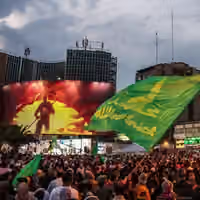
Protests in Iran during the 2022 Woman, Life, Freedom movement following the death of Mahsa Jina Amini.
Israel's impending strike on Iran could present a pivotal opportunity for dissidents to challenge and potentially overthrow the clerical government, according to an Iranian-Canadian human rights expert, and a former advisor to Israel’s Prime Minister.
As the word awaits Israel’s response to Iran’s Oct 1. barrage of more than 180 ballistic missiles on the Jewish state, lawyer and advocate Kaveh Shahrooz told Iran International there are creative ways to respond to Iran’s aggression that could secure a country no longer under Islamic rule.
Speaking over zoom, Shahrooz told Iran International this would involve the West training and funding Iran’s opposition to bring the Iranian establishment down.
Shahrooz suggests utilizing tools like unrestricted internet access, which the government routinely blocks at the first sign of protests, and funding a massive strike fund for Iranian workers to cripple the economy—particularly by targeting critical infrastructure such as the oil industry.
He acknowledged that Israel must respond to Iran’s ballistic missile attacks, proxy threats, and other aggressive actions. However, he emphasized that Israel’s long-term success hinges on empowering Iranian dissidents to overthrow their government. While targeting Iran’s nuclear capabilities is understandable, Shahrooz argued that eliminating future threats requires the complete end of the Islamic Republic.
“Iranian protestors are ready to get back onto the streets. The level of anger that Iranians have at the regime is palpable,” he said.
Alex Selsky, an advisor to the Middle East Forum and former advisor to Israeli Prime Minister Benjamin Netanyahu, said Israel’s next strike should encourage the overthrow of the Islamic Republic.
“All of us hope that this strike can be a game changer for the opposition and for the people in Iran,” said Selksy over zoom in Israel.
Tweet unavailable
The Netherlands-based Gamaan institute conducted an opinion survey in 2023 finding that more than 80 percent of 158,000 respondents in Iran reject the Islamic Republic and prefer a democratic government.
“We really hope that this is an opportunity that we will not miss, that Israel will not miss, that the West will not miss,” he added.
Selsky said he’s in touch with Iranian dissidents, who he said have suffered the most at the hands of Iran's authorities and understand the Iranian threat better than anyone.
He foresees Israel's future strike, no matter the target, as one that will weaken the establishment, but he stressed it must aim at supporting the people of Iran seeking change.
Since the "Woman, Life, Freedom" uprising, Iranian authorities have escalated their use of the death penalty. In 2023, executions reached an eight-year high, with Amnesty International reporting that the regime used the death penalty as a tool of oppression, particularly against the persecuted Baluch minority, who suffered a disproportionate number of hangings.
According to Amnesty International, Iran has arbitrarily executed 10 men since December 2022 in relation to the September-December 2022 protests.
Both Shahrooz and Selsky agree the Iranian people have proven that they have risked their lives to achieve freedom - knowing they risk executions and torture. The United Nations Fact Finding Mission found Iran committed crimes against humanity against its own people.
Ultimatum to Iran: Free your people or face attack
Shahrooz said there’s another alternative: give Iran an ultimatum – put down your guns and agree to free and fair referendum on Iran’s future – and you will be allowed to go into exile with your money or Israel will attack.
“The Iranian regime is a paper tiger,” said Shahrooz, who added that Iran’s capabilities and deterrence power have been decimated by Israel in recent weeks.
Since Oct 7, Israel has focused on weakening Iran’s proxies. The leader of Hamas Ismail Haniyeh was assassinated in Tehran while visiting the country for the inauguration of its new president, Masoud Pezeshkian, on July 31. Israel has not claimed responsibility but is believed to be behind the attack. Then, Yahya Sinwar, the mastermind of Oct 7 was killed in Gaza. The leader of Hezbollah, Hassan Nasrallah, once thought untouchable by many observers, was killed in an Israeli airstrike in Beirut.
On 17 and 18 September, thousands of pagers and hundreds of walkie- talkies belonging to Hezbollah operatives exploded simultaneously across Lebanon and Syria in a coordinated Israeli attack. The killed at least 42 people, including at least 12 civilians, and injured more than 3,000.
Hamas, military and political capabilities, have been obliterated although supporters and fighters do still exist, and Hezbollah is wounded but not out.
If Iranian authorities are given an ultimatum, Shahrooz believes they will take it to hold onto the wealth they’ve amassed since the inception of the Islamic Republic in 1979. Selsky pointed out that he believes people within the Iranian establishment are likely there for money and power.
Prime Minister Benjamin Netanyahu directly addressed the people of Iran in a prerecorded video three weeks ago, saying "Israel stands with you."
The question now: will Israel's next strike put those words into action and support Iranian opposition?
The exiled son of the late Shah of Iran Prince Reza Pahlavi received the Nixon Foundation’s Architect of Peace Award at a ceremony in California on Tuesday evening.
“There is no one I stand more proudly side by side with than the people of Iran today. And I will stand with them until victory," Pahlavi said in his acceptance speech.
The award recognized his advocacy for human rights and peaceful change in Iran after protests since 2022 were met with violence by authorities.
During his speech, Pahlavi described his commitment to ensuring a transition from authoritarian rule to a secular democratic government.
“I will work tirelessly to oversee and ensure that Iran undergoes a peaceful and secure transition to a secular democracy—one where every citizen can live as equals, free from any form of discrimination,” he said.
Honoring the hundreds who have been killed by the Islamic Republic's security apparatus, in addition to hundreds more executed since 2022, Pahlavi paid tribute to the resilience of ordinary Iranians.
He called them the “real architects of peace” and acknowledged the sacrifices they continue to make in their quest for freedom.
Prince Reza Pahlavi, accompanied by his wife Yasmine Pahlavi, receives the Nixon Foundation’s Architect of Peace Award during a ceremony in California on October 22, 2024.
“Despite everything, they continue to rise, they continue to fight for the realization of our great civilization,” he said, referencing the widespread protests that have rocked Iran in recent years.
“It is because of them, my dear compatriots, that I have stayed in this fight. I seek nothing for myself, only to serve them. So as long as I live, I will continue my lifelong mission to free Iran from this oppressive regime. I will do everything in my power to ensure that the future of Iran is one of peace, democracy, and justice.”
Pahlavi addressed the increasing instability in the Middle East, as the Islamic Republic and its armed allies confront Israel.
“This is the war of a dictator, Ali Khamenei, who thrives on division and conflict," he said. "The Iranian people do not seek war. They seek peace, security, and a future free from tyranny,” he said, distancing ordinary Iranians from the policies of the current leadership.
Iran’s last Queen, Farah Pahlavi, former US President Richard Nixon, Mohammad Reza Shah Pahlavi, and his son, Prince Reza Pahlavi (from left to right)
Offering hope for the future as the movement against the Islamic Republic continues, he added: "We are nearing the day when the Iranian people will once again take their rightful place in the world—a free, democratic, and peaceful Iran. This is the future we seek. This is the future we will achieve.”
Over the years, the award has been presented to leaders including former Presidents Gerald Ford, George H.W. Bush, and George W. Bush; former Secretaries of State Henry Kissinger and Mike Pompeo; Senators Elizabeth Dole, Joe Lieberman and John McCain.
Amid a budget bill emphasizing heavy military spending and the looming threat of an Israeli attack, Iran's currency, the rial, surpassed its previous all-time low against the US dollar on Wednesday.
The rial, which began its decline in September, plummeted to more than 680,000 against the dollar, while Iranian officials and state-controlled media remained silent on Wednesday. In mid-August, the currency was trading at 585,000 to the dollar, representing a drop of more than 15% in under two months.
The rial dropped to 737,000 against the euro and 885,000 against the British pound.
Iran is already grappling with soaring inflation exceeding 40%, and the rial's continued decline will drive prices even higher, further impoverishing a population that has seen its purchasing power erode significantly since 2018. That year, U.S. sanctions imposed by the Trump administration—following its withdrawal from the 2015 nuclear deal—targeted oil exports and banking, slashing Iran’s income and dealing a severe blow to its oil-dependent economy.
In August, Israel began its punishing attacks on Iran’s proxy, the Lebanese Hezbollah, and eventually killed its leader, Hassan Nasrallah. This led to an Iranian retaliation with ballistic missiles on October 1. Since then, Iran has been expecting a retaliatory strike by Israel, that could inflict damage on its infrastructure, including the oil sector.
On top of mounting military and economic pressures, President Masoud Pezeshkian unveiled next year’s budget on Tuesday, allocating nearly 20% of Iran’s oil export revenue—estimated to exceed $10 billion—primarily to the Revolutionary Guard. In the current budget, the military’s share of oil is around 200,000 barrels per day, while next year it would be an estimated 430,000 barrels.
The practice of handing oil to the military to export is to guarantee their share of the budget, instead of risking their allocation amid the government's constant financial challenges.
In addition to oil revenue, the military will also receive direct budget appropriations, although the exact figure was not disclosed in the published bill. This substantial military spending may have further driven the rial's decline when Tehran’s exchange markets opened on Wednesday.
Over the past five years, tens of millions of Iranians have seen their living standards erode as wages fail to keep pace with soaring inflation. Today, the average worker earns roughly $200 per month, while official estimates suggest that a minimum of $500 is needed for basic survival.
Federal prosecutors in Brooklyn indicted a senior official in Iran’s Islamic Revolutionary Guards Corps (IRGC) on Tuesday and three other in a failed assassination plot against prominent human rights activist Masih Alinejad.
The indictment accuses the group of orchestrating a 2022 plan to kill US-Iranian citizen Alinejad, a prominent journalist an critic of Iran’s treatment of women.
"Today’s indictment exposes the full extent of Iran’s plot to silence an American journalist for criticizing the Iranian regime,” US Federal Bureau of Investigation Director Christopher Wray said in the unsealed indictment.
Writing on X, Alinejad blasted Iran's theocratic rulers.
"The revelation that the assassination plot against me in July 2022 was orchestrated by Ali Khamenei’s IRGC is a stark reminder of the brutal lengths to which the Islamic regime will go to silence dissidents, even those far beyond Iran’s borders," said Alinejad, responding to the indictment.
The alleged plot was disrupted by US law enforcement, which had previously charged members of an Eastern European criminal organization with ties to Iran with murder-for-hire.
This latest indictment directly implicates a high-ranking Iranian official for the first time. Brigadier General Ruhollah Bazghandi, a senior counterintelligence figure within the IRGC, is named as the key organizer of the assassination effort.
The US Treasury Department had already sanctioned Bazghandi in 2022, accusing him of playing a role in the detention of foreign prisoners in Iran and overseeing multiple assassination attempts against journalists and foreign nationals.
In announcing the new charges, US officials highlighted the IRGC’s extended reach in carrying out Iran’s policies abroad, including criminal activities aimed at silencing opposition voices.
Alinejad, who had resided in Brooklyn but has since relocated to another part of New York, has long been a vocal opponent of the Iranian government’s policies, particularly its strict laws regarding women’s dress codes.
She had previously written about Tehran’s efforts to abduct her and described the IRGC’s use of criminal gangs to carry out its work overseas. "The Iranian regime always uses criminal gangs to do their dirty jobs beyond their own borders, to get away from punishment," Alinejad said on Tuesday.
Failed plot
The indictment also mentions three other Iranian operatives involved in the plot—Hossein Sedighi, Seyed Mohammad Forouzan, and an individual known only by an alias, Haj Taher.
According to US prosecutors, the group had been continuously monitoring Alinejad since a failed attempt to kidnap her. This earlier plot, which came to light in 2021, involved using private investigators to track Alinejad’s movements and developing plans to transport her from New York to Venezuela.
Alinejad, whose criticism of Iran extends back decades, has accused the government of using her family in Iran as leverage against her. She says that the Iranian intelligence ministry had even attempted to lure her to a family reunion in Turkey, a ruse she believes was part of a larger plan to capture her.
Federal prosecutors have been stepping up efforts to counter foreign influence operations in the US.
The charges come at a tense time for US-Iran relations, with Iran’s influence in the ongoing conflict between Israel and Hezbollah, the Lebanon-based militant group backed by Tehran, in focus as Israel prepares to hit back at Iran after an Oct. 1 ballistic missile attack.
Iran has carried out assassinations and kidnappings of its opponents abroad over the past four decades. Countries like Germany, France, Turkey, and Iraq have been targets of Iranian intelligence for its deadly operations.
Some Iranian "reformists" who supported President Masoud Pezeshkian in the election are now criticizing him for breaking promises and appointing political rivals to key government positions.
The criticism also reflects growing tension, partly fueled by Israel's threats pf military retaliation in response to Iran's October 1 missile attack.
In response to Ali Asghar Shefieian, an aide to President Pezeshkian who defended the president's recent government appointments, Javad Emam, spokesperson for the Reform Front—an umbrella group coordinating over two dozen groups—posted on X: "Why did the people vote for Pezeshkian? For no change? To endorse the ultraconservative Paydari Party’s agenda? To continue the previous government's political and security policies? To prolong regional tensions? To keep filtering the Internet and maintaining the Morality Police, and to let the military steer domestic politics? Or to ignore his supporters and campaign workers?"
Meanwhile, many social media users argued that things would not have been different had Pezeshkian’s rival won the election. Mocking Pezeshkian's campaign slogans, they posted satirical comments as if hardliner Saeed Jalili were now president, saying, "If Pezeshkian were president, the shadow of war wouldn’t loom over Iran. The EU wouldn’t have called the three Iranian islands occupied, and it wouldn’t have sanctioned Iran!" Nearly all such posts emphasize the looming threat of war between Iran and Israel.
Commentator and political figure Hashemi Taba. File photo
In another development, prominent "reformist" figure Mostafa Hashemi Taba urged the government to be transparent with the public and "tell them the truth." He also called on President Pezeshkian to address discrimination and curb unnecessary government spending.
Criticizing Pezeshkian's idea of national reconciliation, Hashemi Taba said, "The president has appointed individuals with varying political affiliations to key jobs in various areas, but it seems they are not committed to their mandate. In this way, the government looks like a joint stock company that has no particular policy or methodology." Meanwhile, he pointed out that the selection of the government's middle managers has been done with a bad taste.
Stressing the need for government transparency, Hashemi Taba said President Pezeshkian could maintain public trust by keeping his promise to be honest with the people. As an example, he cited the government's claim that 20 million liters of gasoline are being smuggled out of Iran daily. He questioned the Oil Ministry's role, noting that it controls all aspects of gasoline. "How is the Oil Ministry merely watching as gasoline is imported and smuggled out of the country?" he asked.
Hashemi Taba hinted at government involvement in fuel smuggling, saying, "The government shouldn't reveal only 10 percent of the truth and remain silent on the other 90 percent." He added, "The 20 million liters of gasoline doesn’t come from gas station nozzles—it's too much, and there must be a system behind it. If they were honest with the people, they might not need further economic reforms." He also emphasized that "ending discrimination and curbing overspending should be central to the government's agenda."
Further criticizing Pezeshkian's notion of national reconciliation, Hashemi Taba remarked, "What we are witnessing is not true national reconciliation, which cannot be achieved under the current circumstances." He noted that the political rivals appointed to government positions are unlikely to change their views. "There must be a clear policy in place, and individuals from different political backgrounds should be committed to following that policy," he added.
Elaborating on the theme of honesty with the public, reformist activist and social media influencer Mehdi Mahmoudian wrote on X: "Pezeshkian is an honest man. He openly admitted that everything he did during the campaign was to win votes, and that after his victory, he would follow Khamenei's directives." Mahmoudian also accused Pezeshkian of catering to the 20 percent of eligible voters who supported him, while now showing an iron fist to the 60 percent who chose not to vote.
The former commander of Iran's Islamic Revolutionary Guard Corps said that Israel might attempt a limited attack on Iran but that its archenemy lacks the heft for a big operation.
The remarks appeared aimed at bolstering domestic morale after the Islamic Republic's armed allies in the region have been dealt heavy military blows by Israel in recent weeks.
“Israel is too small to be able to attack Iran,” Major General Mohammad Ali Jafari told reporters on Tuesday. "Israel may carry out a limited and small attack to just say that it has responded. However, it definitely cannot have an attack that is on a par with Iran's Operation True Promise 2."
Jafari was referring to the IRGC's missile barrage against Israel on October 1, which came in response to Israel's likely assassination of Hamas leader Ismail Haniyeh in Tehran and killing of Hezbollah chief Hassan Nasrallah.
"If it carries out a significant and notable action, it will certainly see a response several times bigger," Jafari added.
This warning follows Hezbollah’s recent drone strike targeting Israeli Prime Minister Benjamin Netanyahu's residence, escalating calls in Israel for a stronger reaction against Tehran. Channel 11 cited an Israeli official saying that the country is preparing for a very significant strike on Iran, indicating heightened military readiness.
In a show of support, the United States has authorized the deployment of a Terminal High-Altitude Area Defense (THAAD) battery to Israel aimed at bolstering defenses against potential missile threats.
A military source linked to the IRGC was quoted by the Tasnim news agency affiliated with the Guards that any attack on Iran's nuclear sites would prompt a decisive response from Tehran.
"If the attack only targets Iran's military positions, Tehran's response will be both certain and beyond the Zionists estimates." Tasnim quoted the source saying. "Iran is certainly not committed to maintaining the previous scope, type, or intensity of its response" if its infrastructure is affected.
In response to the escalating situation, US President Joe Biden on Friday said he was aware of the nature and timing of planned Israeli actions against Iran but declined to elaborate.
Iran's Foreign Minister Abbas Araghchi cautioned that anyone aware of an Israeli attack's timing and manner must be held accountable, in apparent reference to regional states.
On October 1, Tehran fired over 180 ballistic missiles at Israel, labeling the attack as retaliation for the recent assassinations of Hezbollah leader Hasan Nasrallah and IRGC General Abbas Nilforoushan in Lebanon.