Baghdad condemns attacks on Iraqi and American bases
The Iraqi government issued a statement Tuesday saying that they will not tolerate any actions targeting Iraqi and American bases or diplomatic missions.
The statement also slammed any attack from inside or outside Iraq that targets the country's interests.
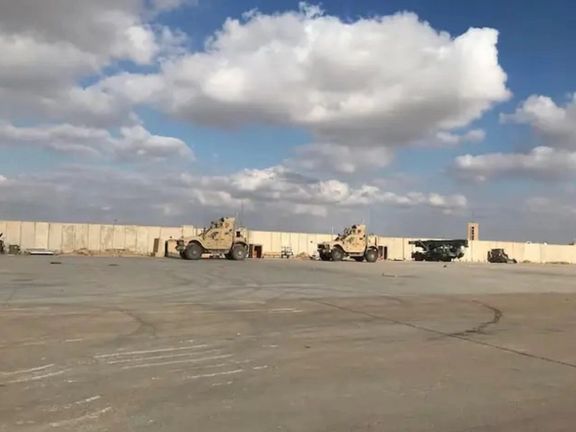
On Monday, an attack occurred on the American Ain al-Asad base in Iraq, resulting in injuries to at least five American personnel.
An Iranian ballistic missile shot down over Israel in April
As Iranian officials continue to issue threats of missile retaliation against Israel for the killing of Ismail Haniyeh, a conservative newspaper on Tuesday suggested that a more effective response would be to create insecurity within Israel.
Khorasan Daily, a traditionally conservative newspaper distinct from hardliners, argued that while a missile response was appropriate in April when Iran retaliated against Israel’s air strike on its embassy compound in Damascus, the nature of this recent attack is different. The paper suggested that Iran’s proxies should now focus on launching attacks in Tel Aviv to create insecurity, and that the ‘Resistance Front’ should move away from relying solely on missile deterrence.
What's even more intriguing is the newspaper's stance that any response to Israel should not be launched from Iranian territory.
Although few government-controlled media outlets or authorized commentators inside Iran have acknowledged that Tehran’s April attack failed to inflict any damage on Israel, the Iranian public is generally well aware of this fact. Online, jokes frequently mock the IRGC’s missiles and their exaggerated claims. Some have even nicknamed the missiles “flying water heaters,” humorously suggesting they need frequent welding before use.
Arguing that Iran’s missile strategy cannot offer good answers any longer, Khorasan newspaper said, "The region and the Axis of Resistance are now obligated to deliver an appropriate response to the Israeli regime.” The newspaper immediately added that a response at this time must be prioritized, “but with several considerations: first, it should not involve missile or drone operations; second, it should not be carried out from Iranian soil."
It's difficult to determine whether the newspaper was expressing its own opinion or publishing the article under the direction of state authorities or a particular political faction. However, the call for Iran to avoid direct involvement, especially while the top leadership advocates for a response, is noteworthy.
This sentiment is reflected in overall Iranian public opinion, as seen in social media posts: Why should Iran continue to pursue a costly confrontation with Israel and potentially the United States? Many also view a potential war as a threat to the regime's very survival—a possibility that has not gone unnoticed by the Islamic Republic leaders.
Khorasan Daily also argued that Iran’s missile and drone attack in April was successful in demonstrating that Iranian weapons could reach Israel. However, the newspaper suggested that repeating the same operation would not yield additional benefits. Instead, it urged the leaders of Iran’s proxy groups to adopt new tactics and strategies to harm Israel.
The suggestion to make Tel Aviv unsafe without relying on Iranian missiles may hint at terrorist-style operations, similar to those frequently used by Palestinian groups in the past, though with little strategic success. For those in Iran, including regime insiders, who recognize the untenable costs of a serious war, the focus is elsewhere. Many Iranians argue that as long as high tensions with Israel persist, Tehran's hopes of re-starting negotiations with the United States remain dim, forcing the country to continue bearing the heavy burden of sanctions.
Lebanese media report that four people were killed in an Israeli airstrike in southern Lebanon.
The IDF has confirmed conducting an airstrike in Maifadoun, southern Lebanon, targeting a building used by Hezbollah's Southern Front unit.
According to the IDF, this unit serves as the terror group's regional command in the area. Another Hezbollah-affiliated building in Khiam was also struck.
Asghar Jahangir, the spokesperson for Iran's Judiciary, stated in a press conference on Tuesday that no arrests have been made in the case of Ismail Haniyeh's killing.
He labeled the reports about arrests as “rumors.”
Previously, the New York Times, citing two informed Iranian officials, reported that the IRGC intelligence had arrested over 20 people, including senior intelligence and security officers, military officials, and staff at the IRGC's security guesthouse in northern Tehran, where Haniyeh was assassinated.
A newly formed group named "Al-Thowrioun" (The Revolutionaries) claimed responsibility for Monday attack on the American Ain al-Assad base in Iraq, where at least five US personnel were injured, IRGC-affiliated Tasnim News Agency reports.
Iraqi security sources reported that two Katyusha rockets struck the base. The motive behind the attack remains unclear, with speculation about a potential link to Iran's threats of retaliation.
A US official indicated one American was seriously injured, with ongoing assessments of the damage.
Reza Rasaei, a 34-year-old Iranian who was arrested during the 2022 anti-government protests in western Iranian province of Kermanshah, was executed on Tuesday morning.
Rasaei, who comes from the marginalized Kurdish and Yarsan minorities in Iran, was sentenced to death by a Revolutionary Court on trumped-up charges related to the killing of an IRGC agent on November 18, 2022, and his death sentence was upheld by the Supreme Court in December 2023.
In late 2022, while the Islamic Republic’s security forces were in the throes of their violent crackdown on unprecedented protests, news spread that a senior IRGC intelligence official had reportedly been stabbed to death. In response to Nader Bayrami's killing in Kermanshah Province, authorities arbitrarily detained dozens of protesters in retaliation.
Bayrami was reportedly killed during a gathering to honor Seyed Khalil Alinejad — an influential Kurdish and Yarsan figure believed to have been killed by security agents. Originating in 14th-century Iran, Yarsan is one of the Middle East's oldest faiths, with over one million followers in the country. The Islamic Republic refuses to recognize Yarsan as a legitimate faith, labeling it a "false cult" and regularly persecuting its followers.
Rasaei had received a call from state security agents before the gathering to get a commitment that he would not engage in protests. He attended the ceremony anyway, holding up a photo of his cousin Khairullah Haqjoyan, who was in custody at the time.
One of Rasaei's friends, who was also in attendance, reported that the crowd suddenly began chanting anti-regime slogans like "Death to the child-killing government" and "Woman, Life, Freedom." Authorities quickly began beating people with batons. After a gunshot was heard, security forces released tear gas to disperse the crowd.
Bayrami was giving a warning to a woman refusing to wear the hijab, when a group of people confronted him and eventually began beating him.
Days later, authorities in Kermanshah singled out Rasaei, blaming him for the alleged crime.
Exclusive interviews with eyewitnesses to the killing of the IRGC official and sources close to Rasaei’s family cast complete doubt on the regime’s narrative.
According to sources, Rasaei was not involved in the altercation that led to the death of the IRGC official and was ultimately forced to confess to Bayrami's murder under extreme torture.
Amnesty International announced in February 2024 that his death sentence was issued after an “unfair trial” based on “forced confessions.”
Amnesty International noted that during interrogations Rasaei was subjected to torture and other ill-treatment, including electric shocks and severe beatings to compel him to self-incriminating “confessions”.
The Dadban legal group, which monitors the legal proceedings of imprisoned protesters and political prisoners in Iran, also declared on social media that the death sentence against Rasaei is unlawful.
They noted that the court selectively accepted testimony from certain defendants while disregarding evidence that could have exonerated Rasaei. Despite the prosecutor's report highlighting flaws in the case, the judges persisted in issuing a guilty verdict.
Furthermore, the group of legal experts said, the court ignored the opinions of forensic experts regarding the cause of death and the weapon involved.
Dadban emphasized the influence of powerful institutions in Rasaei's case, suggesting that the verdict was predetermined despite numerous contradictions and flaws.