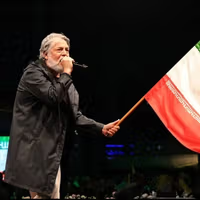
Iran’s judiciary: No arrests in Haniyeh's assassination case
Asghar Jahangir, the spokesperson for Iran's Judiciary, stated in a press conference on Tuesday that no arrests have been made in the case of Ismail Haniyeh's killing.
He labeled the reports about arrests as “rumors.”
Previously, the New York Times, citing two informed Iranian officials, reported that the IRGC intelligence had arrested over 20 people, including senior intelligence and security officers, military officials, and staff at the IRGC's security guesthouse in northern Tehran, where Haniyeh was assassinated.
A newly formed group named "Al-Thowrioun" (The Revolutionaries) claimed responsibility for Monday attack on the American Ain al-Assad base in Iraq, where at least five US personnel were injured, IRGC-affiliated Tasnim News Agency reports.
Iraqi security sources reported that two Katyusha rockets struck the base. The motive behind the attack remains unclear, with speculation about a potential link to Iran's threats of retaliation.
A US official indicated one American was seriously injured, with ongoing assessments of the damage.
Reza Rasaei, a 34-year-old Iranian who was arrested during the 2022 anti-government protests in western Iranian province of Kermanshah, was executed on Tuesday morning.
Rasaei, who comes from the marginalized Kurdish and Yarsan minorities in Iran, was sentenced to death by a Revolutionary Court on trumped-up charges related to the killing of an IRGC agent on November 18, 2022, and his death sentence was upheld by the Supreme Court in December 2023.
In late 2022, while the Islamic Republic’s security forces were in the throes of their violent crackdown on unprecedented protests, news spread that a senior IRGC intelligence official had reportedly been stabbed to death. In response to Nader Bayrami's killing in Kermanshah Province, authorities arbitrarily detained dozens of protesters in retaliation.
Bayrami was reportedly killed during a gathering to honor Seyed Khalil Alinejad — an influential Kurdish and Yarsan figure believed to have been killed by security agents. Originating in 14th-century Iran, Yarsan is one of the Middle East's oldest faiths, with over one million followers in the country. The Islamic Republic refuses to recognize Yarsan as a legitimate faith, labeling it a "false cult" and regularly persecuting its followers.
Rasaei had received a call from state security agents before the gathering to get a commitment that he would not engage in protests. He attended the ceremony anyway, holding up a photo of his cousin Khairullah Haqjoyan, who was in custody at the time.
One of Rasaei's friends, who was also in attendance, reported that the crowd suddenly began chanting anti-regime slogans like "Death to the child-killing government" and "Woman, Life, Freedom." Authorities quickly began beating people with batons. After a gunshot was heard, security forces released tear gas to disperse the crowd.
Bayrami was giving a warning to a woman refusing to wear the hijab, when a group of people confronted him and eventually began beating him.
Days later, authorities in Kermanshah singled out Rasaei, blaming him for the alleged crime.
Exclusive interviews with eyewitnesses to the killing of the IRGC official and sources close to Rasaei’s family cast complete doubt on the regime’s narrative.
According to sources, Rasaei was not involved in the altercation that led to the death of the IRGC official and was ultimately forced to confess to Bayrami's murder under extreme torture.
Amnesty International announced in February 2024 that his death sentence was issued after an “unfair trial” based on “forced confessions.”
Amnesty International noted that during interrogations Rasaei was subjected to torture and other ill-treatment, including electric shocks and severe beatings to compel him to self-incriminating “confessions”.
The Dadban legal group, which monitors the legal proceedings of imprisoned protesters and political prisoners in Iran, also declared on social media that the death sentence against Rasaei is unlawful.
They noted that the court selectively accepted testimony from certain defendants while disregarding evidence that could have exonerated Rasaei. Despite the prosecutor's report highlighting flaws in the case, the judges persisted in issuing a guilty verdict.
Furthermore, the group of legal experts said, the court ignored the opinions of forensic experts regarding the cause of death and the weapon involved.
Dadban emphasized the influence of powerful institutions in Rasaei's case, suggesting that the verdict was predetermined despite numerous contradictions and flaws.
The Wall Street Journal reports that the Biden administration is preparing for a possible Iranian attack on Israel following the assassination of a senior Hamas leader in Tehran.
US officials have observed Iran mobilizing missile launchers and conducting drills, indicating potential retaliation.
Officials from the Biden administration are also worried that an Iranian attack could be accompanied by strikes from Hezbollah, the Lebanese militia, along with other Iranian proxies. This coordinated effort could be aimed at overwhelming Israeli defenses.
The Australian Iranian Community Alliance (AICA) condemns the Iranian ambassador's comments advocating for violence against Jewish people and the destruction of the Jewish state.
“The ambassador’s call for the destruction of the Jewish state and incitement to violence against Jewish people is not only abhorrent but also reflective of the violent ideology propagated by the current regime in Iran," reads AICA’s Tuesday statement. “Such rhetoric not only fuels regional instability but also poses a significant threat to global peace and security,” it added.
Iran’s ambassador to Australia, Ahmad Sadeghi, faced diplomatic consequences after making controversial comments about Israel on social media. He called for a “wiping out” of Israelis in Palestine by 2027 and described them as a “Zionist plague.” Prime Minister Anthony Albanese strongly condemned the remarks, stating, “There’s no place for the sort of comments that were made... by the Iranian ambassador. They’re abhorrent, they are hateful, they are antisemitic and they have no place.” Foreign Minister Penny Wong also criticized the comments as "inflammatory" and "repugnant."
A view of the entrance of Evin prison in Tehran, Iran October 17, 2022.
Thirty-seven female political prisoners in Tehran's notorious Evin Prison have been denied visitation rights.
According to information obtained by Iran International, it came in response to their participation in an overnight sit-in on July 24 to protest the death sentence of fellow inmate Pakhshan Azizi.
Among the protesters were Nobel Peace Laureate Narges Mohammadi and Iranian writer and human rights advocate Golrokh Iraee.
The prisoners further protested Azizi’s death sentence through a one-day hunger strike on July 30, part of the ongoing “No to Execution” campaign held every Tuesday.
Azizi, sentenced to death for "armed rebellion," is one of at least four women at risk of execution on similar charges.
Azizi was the second woman in July this year to be sentenced to death on charges of "armed rebellion."
Already this year, rights groups claim Iran has carried out 300 executions. Last year, over 850 were reported as an execution wave sweeps the country in a bid to quash dissent.