Ali Khamenei says Zangezur corridor 'detrimental' to Armenia
Supreme Leader Ali Khamenei has declared Iran's opposition to the Zangezur corridor, calling it "detrimental" to Armenia and affirming a "firm stance" on the matter.
Azerbaijan Republic is seeking a land corridor through Armenia to connect with its enclave of Nakhichevan.
"We are strongly committed to developing relations with Armenia, and cooperation between the two countries will continue robustly based on defined interests, without regard for the policies of others," Khamenei added during a meeting with Armenian PM Nikol Pashinyan on Tuesday.
Last week, Iran International reported that Tehran and Yerevan have signed an arms deal worth $500 million. According to a list seen by Iran International Iran is set to supply to Armenia drones such as Shahed 136, Shahed 129, Shahed 197, and Mohajer, as well as air defense missiles.
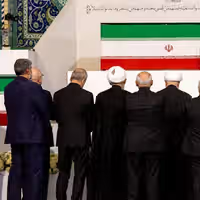
Mostly comprised of low-ranking delegations, representatives from Africa, South America, and Asia, arrived in Tehran to attend the inauguration of Iran's new president, Masoud Pezeshkian.
The ceremony, to be held today at the parliament, comes amidst international scrutiny over Iran's controversial policies.
Among the prominent attendees, only Enrique Mora, Deputy Secretary-General of the European External Action Service, and Emomali Rahmon, President of Tajikistan, are present.
Also present are representatives from regional allies such as senior Houthi official and the group's spokesperson Mohammed Abdul-Salam as well as Hamas leader Ismail Haniyeh.
According to IRNA state news agency, the prime minister of Armenia, the special envoy of the president of Kyrgyzstan, the speaker of the parliament of Uzbekistan, the minister of agriculture of Lebanon, the deputy foreign minister of South Korea, the secretary-general of the Organization of Islamic Cooperation, the special envoy of the prime minister of Japan, the speaker of the senate of Kazakhstan, the vice president of Brazil, the speaker of the parliament of Mali, the foreign minister of Egypt, the foreign minister of Mauritania, the deputy speaker of the parliament of Sierra Leone, the speaker of the parliament of Burkina Faso, the speaker of the parliament of Senegal, the minister of state for foreign affairs of Qatar, the deputy chairman of the cabinet of ministers of Turkmenistan, the foreign minister of Congo, the minister of transport of India, the minister of state of Jordan, the prime minister of Georgia, the prime minister of the Republic of Azerbaijan, and the speaker of the parliament of Algeria are among the main guests.
A voter marks a ballot during the primary election and abortion referendum at a Wyandotte County polling station in Kansas City, Kansas, US August 2, 2022.
Iran is rejecting claims that it is attempting to undermine former US President Donald Trump's campaign, by interfering in the ongoing election.
"Iran has no objective or activity aimed at influencing the American elections. A significant portion of these accusations are psychological operations designed to create false momentum for election campaigns," the Iranian mission to the United Nations in New York stated on Monday.
US spy agencies say they observed Iran attempting to influence the 2024 election to prevent former President Trump from securing a second term in the White House.
Notably, the press briefing held by the Office of the Director of National Intelligence, suggested a shift in Iran's strategy from previous years.
Instead of merely acting as a "chaos agent," Iran is now spreading “disinformation” through “vast webs of online personas and propaganda mills.” These efforts are in addition to clandestine attempts to influence the campaign in favor of Vice President Kamala Harris.
First reported by the Wall Street Journal, US officials say Iran has accelerated its use of covert social media networks to influence voters in the lead-up of election -- aiming to avoid increased tensions with the US.
Influence by “foreign actors” has been a source of apprehension in recent US elections, especially since 2016, when ‘Russian meddling’ became a major theme, with people on both parties accusing the other of having benefited from it.
Director of the US National Intelligence Avril Haines warned in a statementon July 9 that "Iran is becoming increasingly aggressive in their foreign influence efforts, seeking to stoke discord and undermine confidence in our democratic institutions."
In yet another warning on Monday, an unnamed US intelligence official told Reutersthat US foes targeting November's election with influence operations are expected to adapt to presidential contest developments, seemingly alluding to Joe Biden's withdrawal from the 2024 presidential race.
The official suggested that US intelligence agencies anticipate foreign actors will redirect their influence operations towards Vice President Kamala Harris. "We expect these actors to adjust to these developments and integrate them into their influence narratives, aiming to undermine democratic institutions."
There seems to be a growing consensus in Washington that the ‘influence’ offensive from the Tehran has to be taken seriously, even though it’s not yet as serious as threats from Moscow and Beijing –and perhaps not on the same global scale.
Russia, China, and Iran deny all such accusations, punching back with allegations of American influence campaigns –and direct interventions– across the world.
The senior intelligence official told Reuters Tehran and Moscow are sticking to their traditional presidential preferences. According to prior intelligence assessments, Iranian operatives are focused on undermining the Republican ticket, while Russia is making efforts to smear the Democrats.
Foreign actors have already used the July 13 attempted assassination of Trump "as part of their narratives," Reuters quoted the US intelligence official as saying.
Another official explained that Russia and Iran have in the past tried employing actual Americans in their operations through false front companies and third-party websites. "Doing so provides them with cover and offers a more authentic voice," the official said.
The Director of US National Intelligence had warned in May that Iran will pose a significant threat to the upcoming US elections, predicting that Tehran will intensify its cyber and influence activities.
"Iran's actions are becoming increasingly aggressive," Haines told the US Senate Select Committee on Intelligence. She added that Iran seeks to “stoke discord and undermine confidence” in democratic institutions, pointing to their interference in previous election cycles as evidence of this ongoing threat.
In 2021, the US Treasury sanctioned Iranian cyber company Emennet Pasargad formerly known as Net Peygard Samavat Company along with five individuals associated with the company for having "engaged in covert and deceptive activities to disseminate disinformation through websites and social media designed to undermine Americans’ faith in US elections."
Iran International revealed in an investigation with Semafor last year that an Iranian-backed influence network, called the Iran Experts Initiative, sought to build relationships with overseas academics and researchers in the West to affect Washington's foreign policy on Tehran.
A Baluch woman was killed and three other civilians injured during a raid on a village in Khash, in Iran's Sistan-Baluchestan province, according to rights groups.
According to rights group Halvash, which covers developments in Sistan-Baluchestan Province, security and military forces launched an assault on the village to search residents' homes without a judicial warrant.
When the villagers protested, the officers responded with gunfire, resulting in the death of one woman. A teenager was also among the injured in the shooting, Halvash reported.
The report indicates that military forces obstructed emergency services from accessing the area to transport the injured to the hospital, forcing villagers to use private vehicles to transfer the wounded to Khash Hospital.
Fars News Agency, affiliated with the Revolutionary Guards, reported on the operation, stating that a four-member team transporting explosive materials for Jaish al-Adl was apprehended in the village of Qaderabad.
The separatist militia has refuted the Islamic Republic's allegations regarding the arrest of four individuals linked to the organization in Qaderabad, Khash.
In their official statement, the Baluch group, designated a terror group by Iran, the US and Pakistan, proclaimed: "The regime's propaganda concerning the apprehension of four Jaish al-Adl members in Qaderabad, Khash, is a blatant falsehood and an attempt to justify and cover up the atrocity committed by the notorious security forces in this village.
"The opening of fire by Khamenei's agents on ordinary civilians in Qaderabad, resulting in a grievous crime, is a despicable and abhorrent act that, God willing, will not remain unanswered."
Jaish al-Adl, an insurgent Sunni Baluch group, advocates for an independent Balochistan encompassing Baluch populations on both sides of the Iran-Pakistan border.
In June, the group announced that it had identified and apprehended nine key members of a "terrorist and espionage" network affiliated with the Revolutionary Guards, comprising Iranian and Pakistani nationals, as well as members of the former Afghan government's armed forces.
One of the most intense confrontations between the group and Iranian border forces transpired in April when Jaish al-Adl forces launched simultaneous attacks on five public locations as well as military and law enforcement bases in Chabahar and Rask. The Baluch community, alongside the Kurds, has long been among the most persecuted minorities in Iran. The region is one of the most impoverished in the country, characterized by high unemployment rates and inadequate infrastructure. Consequently, smuggling fuel, goods, and, in some cases, drugs has become a vital means of survival for many.
In a meeting with Iran-backed Hamas leader Ismail Haniyeh, Iranian president-elect Masoud Pezeshkian stated, "We are certain that the resistance of the Palestinian people and fighters will lead to ultimate victory and the liberation of the land of Palestine."
The meeting took place prior to Pezeshkian's swearing-in ceremony, scheduled for Tuesday afternoon.
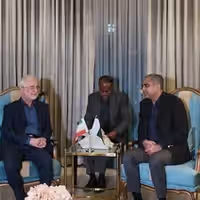
Armenian Prime Minister Nikol Pashinyan met with Supreme Leader Ali Khamenei during his visit to Tehran. Newly appointed First Vice President Mohammadreza Aref was also present at the meeting.
Earlier on Tuesday, Pashinyan arrived at Mehrabad International Airport, leading a delegation to attend the swearing-in ceremony of president-elect Masoud Pezeshkian. Additionally, Tajikistan's President Emomali Rahmon, also in Tehran for the ceremony, held a meeting with the Supreme Leader on the same day.