Iranian president-elect Pezeshkian expresses support for Hamas
In a meeting with Iran-backed Hamas leader Ismail Haniyeh, Iranian president-elect Masoud Pezeshkian stated, "We are certain that the resistance of the Palestinian people and fighters will lead to ultimate victory and the liberation of the land of Palestine."
The meeting took place prior to Pezeshkian's swearing-in ceremony, scheduled for Tuesday afternoon.
Armenian Prime Minister Nikol Pashinyan met with Supreme Leader Ali Khamenei during his visit to Tehran. Newly appointed First Vice President Mohammadreza Aref was also present at the meeting.
Earlier on Tuesday, Pashinyan arrived at Mehrabad International Airport, leading a delegation to attend the swearing-in ceremony of president-elect Masoud Pezeshkian. Additionally, Tajikistan's President Emomali Rahmon, also in Tehran for the ceremony, held a meeting with the Supreme Leader on the same day.
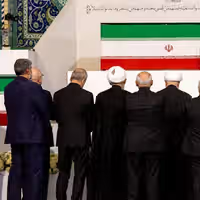
Ismail Haniyeh, Head of Hamas' Political Bureau, and Ziyad al-Nakhalah, Secretary-General of the Islamic Jihad Movement, met with Supreme Leader Ali Khamenei in Tehran on Tuesday. The leaders are in the Iranian capital to attend the swearing-in ceremony of president-elect Masoud Pezeshkian.
In a statement, Hamas announced that Haniyeh also held discussions with Pezeshkian, during which he briefed him on the latest political and on-the-ground developments in the Gaza conflict. Haniyeh expressed gratitude for the Islamic Republic's support.
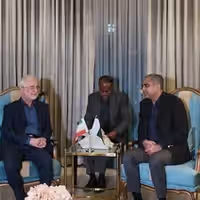
In a meeting with Mohammed Abdul-Salam, the spokesman for Yemen's Houthi Ansarullah movement, Iranian President Masoud Pezeshkian praised the group's recent actions against Israel and maritime navigation.
"Your actions have clearly put pressure on the Zionist regime and its supporters," Pezeshkian said.
The meeting took place as Abdul-Salam visited Tehran to attend the swearing-in ceremony of the president-elect. The Iranian president further emphasized the need for collaboration among Islamic countries, stating, "We must work with Islamic countries to end the oppression of Muslims."
A person mourns as he embraces the picture of his loved one killed at a soccer pitch by a rocket Israel says was fired from Lebanon, in Majdal Shams, a Druze village in the Golan Heights, July 29, 2024.
The sounds of grief and images of white caskets as parents buried their children, killed by an Iran-made rocket launched from Lebanon into a remote Druze village, underscore the region's uncertainty and fears of a wider war.
A deadly rocket strike on Saturday in Majdal Shams village in the Israeli-occupied Golan Heights killed 12 children playing soccer, becoming the latest victims in a suspected Hezbollah attack on Saturday.
12 children and youth killed by a Hezbollah rocket in Majdal Shams on July 27, 2024 (Photo: Israeli Ministry of Foreign Affairs)
The Druze are an Arabic-speaking ethno- religious group who adhere to the Druze faith, residing in Israel, Lebanon, Syria and Jordan.
The scale of the massacre is the largest civilian loss in Israel since October 7. Druze and Israelis are still mourning and coming to terms with the immense loss, said Anan Wahabi, a lecturer at the University of Haifa, specializing in national security.
Wahabi is also a Druze-Israeli.
“It was unprecedented attack that killed the innocent and beautiful children. Their only guilt was just to come and to try and play football,” he said.
The complex situation of the Golan Heights Druze has been highlighted in the most tragic way possible. Wahabi said those in the area had longstanding Syrian identity in the past, but now have a growing affiliation with Israel, especially the younger generation, some of whom serve in the Israeli military. They are not forced to serve and volunteer should they enlist.
The people of Golan Heights are residents of Israel and an increasing number are choosing to become Israeli citizens. Since the Syrian civil war, and October 7, Israeli citizenship by Druze in that area, jumped significantly. In contrast, other Druze in Israel, serve in the military and police, including the war against Hamas with many reaching high ranks in the IDF and government.
After the 1967 Mideast war, Israel captured the Golan Heights from Syria - and effectively annexed it in 1981.
For the Druze, their identity and history is complex and multifaceted.
“I must tell that the first identity is the Druze identity for them, and we have our own flag. Secondly there is the national identity. We've gotten a lot of messages from all parts of the Israeli society giving condolences and standing with us in this very hard time,” said Wahabi.
The Druze in Syria are angry said Wahabi, calling Hezbollah, which translates to the party of God in Arabic to the party of the devil, instead. He said the Druze in Lebanon are not speaking up and are trying to avoid confrontation, with the Iran-backed Shiite military organization that dominates the country.
"We could hear voices, from the Syrian Druze calling Hezbollah, Hezbsheytan; the party of the devil."
No escaping Geopolitics:
But there is no escaping the geopolitics of the region no matter the ethnic or religious identity.
IDF Spokesman Rear Adm. Daniel Hagari said in a press conference from the scene the rocket that struck Majdal Shams was an Iranian-made Falaq-1. The rocket identified as having had 53 kg load of explosives.
US intelligence officials said there is no doubt that Hezbollah carried out the attack, however, what is not clear is if the children were the target or if they misfired.
Israeli officials were quick to offer support to the community and pointed the blame at Tehran.
Prime Minister Benjamin Netanyahu promised a “harsh response” during a visit to Majdal Shams Monday.
Hezbollah denied responsibility but said it had launched strikes on what it said were military targets in nearby areas.
"A Jewish child murdered on the Gaza border on Oct. 7 and a Druze child murdered on the Golan Heights are the same. These are our children," Defense Minister Yoav Gallant said Monday while with the Prime Minister in Majdal Shams.
A turning point?
Some experts believe the deadly incident involving youth could be a turning point in the conflict.
The FDD’s Behnam Ben Taleblu said Israel’s response will likely be severe, referring to it as “deterrence by punishment.”
“The question is really where and when,” said Taleblu.
Taleblu said a number of factors, like America’s upcoming presidential elections, will determine just how far Israel can go in their response.
“If Israel does look to restore deterrence, it may be a short lived deterrence. Iran, Hezbollah and many of these other actors think there's a longer leash here because the US may want to avoid a military conflict or may want to avoid even the potential for escalation as it gets closer to the election,” said Taleblu.
On Monday, the US declared support for Israel but also cautioned its Middle East ally about escalation with the Iranian-backed Hezbollah.
French President Emmanuel Macron urged Iran’s President Masoud Pezeshkian on Monday to “avoid regional military escalation,” according to Élysée Palace.
The Alma Research and Education center based in Northern Israel published an assessment, saying that Hezbollah finds itself in a“Win-Win” situation, where it benefits regardless of the outcome.
The report, by Alma founder Sarit Zehavi, states Hezbollah has a desire to draw Israel into a full-scale conflict with the aim of consolidating power in Lebanon.
"An occurrence of such a large-scale tragedy resulting in several casualties has the potential to provoke a substantial and notable reaction from Israel. Within the upcoming hours and days, we shall ascertain whether this event truly marks a pivotal moment," as written in the Alma report.
Iran's state media says 70 foreign delegations from different countries and international organizations will attend the swearing-in ceremony.
Iranian officials are emphasizing the attendance of many foreign dignitaries as a sign of the Islamic Republic's recognition in the world.
However, except a representative from the EU and a delegation from China that does not include top officials, the other foreign guests represent neighboring countries as well as a few friendly government in Africa and Latin America.
So far Tajikistan’s President Emomali Rahmon and Armenian Prime Minister Nikol Pashinyan and Enrique Mora, the Chief of Staff of EU foreign policy chief Josep Borrell, are among the highest ranking guests.