UK PM Honors Two Iranians Ahead Of World Press Freedom Day

UK Prime Minister Rishi Sunak paid homage to jailed Iranian Nobel Peace Prize laureate Narges Mohammadi and Iran International’s host Pouria Zeraati ahead of world press freedom day.

UK Prime Minister Rishi Sunak paid homage to jailed Iranian Nobel Peace Prize laureate Narges Mohammadi and Iran International’s host Pouria Zeraati ahead of world press freedom day.
“I’d like to take this chance to pay tribute to all those suffering behind bars in the name of freedom and democracy,” Sunak said at the Society of Editors 25th Anniversary Conference in London on Tuesday.
He expressed solidarity with Mohammadi, who is serving a 12-year prison sentence in Iran, along with facing 154 lashes, two years of exile, and various other social and political restrictions. Despite her imprisonment, Mohammadi has been vocal against the regime's human rights abuses and the mandatory hijab law.
The prime minister also addressed the recent attack on Pouria Zeraati, who was stabbed outside his London home last month. Zeraati, a prominent journalist at Iran International, suffered leg injuries. This came following multiple threats from Iranian intelligence aimed at journalists of Iran International.
Sunak's comments came as part of a broader discussion at the conference, which drew editors, academics, lawyers, and journalists together to debate the pressing issues facing the journalism industry today. He underscored the essential role of the media in strengthening democracy by holding governments accountable, exposing corruption, and elevating new voices.
Iran has one of the world’s worst records for press freedom according to Freedom House, with over 70 journalists arrested since the 2022 uprising alone. Among those were the two women to first report the arrest and subsequent death of Mahsa Amini whose death in morality police custody triggered the worst uprising in Iran since the foundation of the Islamic Republic.

After weeks of intensified and renewed crackdown to enforce the mandatory hijab in Iran, ‘reformist’ women activists have condemned it as a smokescreen to distract from the state’s own governing failures.
“The repressive policies against women under the pretext of compulsory hijab are reactionary and an attempt to distract public attention from rampant corruption and inept social administration,” the 21 women activists said in a statement posted on the Telegram channel of the Nationalist-Religious political faction Melli-Mazhabi.
Notable figures among the signatories of the statement include former lawmakers Parvaneh Salahshouri and Elaheh Koulaei.
“Women will not give up on their rightful demands,” the statement read.
Following the death of Mahsa Jina Amini at the hands of the regime’s so-called morality police in 2022 and the months of nationwide protests in Iran it sparked, more women from the “reformist” camp and religious backgrounds have changed direction and joined Iranian protesters in demanding freedom of choice.
It's significant to note that many Iranian activists have long held the belief that efforts to ‘reform’ the Islamic Republic have proven futile. They often perceive those who still adhere to such views as a faction that continues to sustain the regime's authority.
Meanwhile, Tahereh Taleghani, the daughter of Mahmoud Taleghani, a prominent cleric and figure during the 1979 Islamic Revolution, published a video on social media emphasizing that treating women under the guise of compulsory hijab has no religious basis.
Islamic scholar Sedigheh Vasmaghi has also demonstrated her support for women's right to choose by removing her hijab. After her public criticism of Supreme Leader Ali Khamenei as a dictator and her condemnation of the compulsory hijab law, she was arrested in March. She was released this week after being imprisoned at Tehran's notorious Evin Prison, where her health deteriorated drastically. During her detention, she lost her eyesight and experienced life-threatening heart issues.
The new wave of crackdowns resumed after police launched a new initiative, dubbed “Plan Noor” on April 13.
Social media has been flooded with video footage of morality police violence against women rebelling against the hijab since then; there are also allegations of police officers extorting money from women in exchange for leniency, as well as theft and sexual harassment claims.
Additionally, the Islamic Revolutionary Guards (IRGC) announced that it was joining the enforcement efforts, forming units known as “Kindness Ambassadors" (Mehr in Persian) to ensure that women maintain the regime’s strict Islamic dress code.
The situation has once again raised alarm both domestically and internationally, with human rights organizations, student groups, and prominent lawyers condemning the Iranian authorities' violations of fundamental freedoms.
Despite this, Iranian women continue to flaunt the hijab laws in acts of resistance.
One notable incident occurred at the Beheshti judicial complex in Tehran, in which a woman was arrested for not wearing a hijab. She stated, "I have come here with hijab all my life; this time, I came without a hijab to reclaim my rights.”

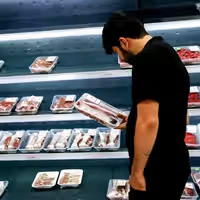
Iran’s former President Mohammad Khatami has slammed the government over the country's skyrocketing inflation rate, now exceeding 52%, marking an 80-year high.
“The issue of inflation, increasing liquidity, and other problems have grown day by day and now reached an extremely worrying level. I hope the country's leaders are concerned enough to solve it," Jamaran website quoted him as saying.
In a dialogue with university professors and experts, Khatami criticized the government's approach to economic reforms, particularly the reduction of subsidies which he argued should have been implemented gradually to shield the society from adverse effects.
The current administration's efforts led by President Ebrahim Raisi have fallen short of curbing the inflation crisis, despite assurances during the election period. The Ham-Mihan newspaper highlighted that such an inflation level is unprecedented since 1943.
Further compounding the economic strain, a study from the Parliament Research Center revealed a widening gap between the minimum wage and the poverty threshold across various provinces, including Tehran, Alborz, and Qom.
According to the study, families of three living in these regions are finding it increasingly difficult to meet basic living expenses under the current economic conditions. Nationally, at least one third of the country is living below the poverty line as even the once middle classes are plunging into economic despair.
The report also pointed to significant nutritional deficits among the Iranian population, with half failing to meet the daily recommended calorie intake of 2,100 calories—a problem exacerbated by inflation-driven rises in food and housing costs.

The Tehran municipality is embroiled in controversy over several multi-million-euro contracts with Chinese companies.
Four Tehran City Council members have voiced concerns in a letter to the council head regarding the opacity and relevance of the transactions. The contracts have reportedly channeled two billion euros of Tehran's budget towards relatively unknown Chinese entities.
The issue came to light through the efforts of media activist Yashar Soltani, who disclosed on his website that the Chinese construction company involved, established in 2010, was ill-equipped for the public transportation projects it was hired for.
The revelation prompted a heated debate in a Sunday council session, leading to a division among the members—seven of whom walked out in protest as Tehran Mayor Alireza Zakani defended the contracts.
Zakani claimed that all transactions were conducted “transparently” and had been fully briefed to critical regulatory bodies like the ministry of industry and the central bank.
The contentious contracts include a 400 million euro agreement for "smart equipment and traffic control cameras" from a Chinese firm, raising alarms about potential security risks due to giving foreign companies access to “sensitive data”.
Furthermore, the letter to the council's head criticized the planned purchase of 150,000 electric motorcycles and 27,500 new taxis, worth 225 million euros each, from the automaker GAC Aion, selected from numerous possible suppliers without a conventional tendering process.
The deals highlight concerns about the municipality's dependence on Chinese firms, driven by the necessity to utilize foreign currency resources available in China, a strategy deeply influenced by the overarching impact of international sanctions on Iran.

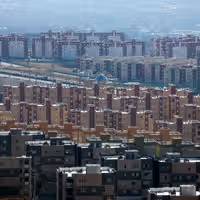
Iran is grappling with a dire housing shortfall with an annual need for one million homes but only 200,000 being constructed.
In a recent interview with Entekhab, housing expert Beitollah Sattarian highlighted the economic barriers that have made housing an "ultra-luxury and unattainable commodity" for most Iranians, except for a privileged class that thrives on a rentier and corrupt economy.
Against this backdrop, Iran's Central Bank reported an annual inflation rate of 52.3 percent last year—the highest rate in eight decades—which has exacerbated the housing crisis.
Sattarian criticized the country's macroeconomic policies for nurturing a "super-capitalist rentier economy" within a closed state framework, pushing a large segment of the population toward poverty.
The newspaper Etemad echoed the sentiments, noting that the poverty rate has increased by 10 percent over the past two years, adding approximately eight million people to the nation's poor.
"The new year, like the past fifty years, is a year of expensive housing ... When housing prices increase, all connected parameters, including rent, will increase. We may have much more than a 40 percent increase in prices and rents," noted Sattarian.
During his election campaign, President Ebrahim Raisi had promised to build one million homes annually but so far, the shortfall only continues to worsen.
After intensifying criticisms of the government's failure to fulfill the promise, First Vice President Mohammad Mokhber said: "There is a difference between building housing and constructing it by the government. The government should build part of it; we can give land to the people so they can build it themselves."
Sattarian predicts that housing prices will continue to rise sharply this year, possibly exceeding a 40 percent increase, as all connected parameters, including rent, escalate. The prediction is supported by official reports indicating a 52 percent increase in house rents in the capital over the past year.
Rents have surged by an average of 130 percent across Tehran and other cities, making housing costs a predominant economic concern among Iranians.

Iran will face a slowdown in economic growth in the coming years, the International Monetary Fund’s latest report suggests, as US sanctions and mismanagement decrease national income.
While the country’s GDP increased by 4.7% last year due to a 19% increase in oil production, GDP growth is projected to decline to 3.3% in 2024 and 3.1% in 2025, according to the IMF.
Iran's oil production increased by 0.5 million barrels per day (mb/d) to 3.1 mb/d last year, but it is projected to increase by only 0.1 mb/d in both the current year and 2025.
The IMF has evaluated Iran's economic performance based on official statistics and its own estimates, which include data from Iranian government sources that are not always considered reliable.
Notably, both the International Energy Agency and OPEC had projected Iran’s oil production growth for 2023 at 305,000 barrels per day, 40% less than the IMF’s estimates.
The IMF also estimated gas production growth for Iran in 2023 to exceed 6%, whereas the National Iranian Gas Company (NIGC) has reported a growth rate of approximately 1%.
The IMF also estimated a 9% increase in Iranian gas production for 2022, while BP and NIGC reported growth rates of about 1% and 1.7%, respectively, for the same year.
Before US sanctions, Iran’s crude oil output exceeded 3.8 mb/d in 2017. However, it declined to below 2 mb/d in 2020.
Iran has seen a rebound in oil production since Joe Biden assumed office at the White House, which has positively influenced its oil exports – reaching about 3.2 mb/d in March 2023, according to OPEC.
Kpler’s statistics also show that Iran’s oil exports have increased from 350,000 b/d in 2020 to about 1.5 mb/d in the first quarter of 2024.

Budget deficit
The IMF says the Iranian government needs $121/barrel oil price to avoid a budget deficit.
Currently, the Brent benchmark is sold at below $90, while the IMF predicted the average Brent price at $78.61 in 2024 and $73.68 in 2025.
Iran also offers a discount of at least $13 per barrel for Chinese refineries, a factor that the IMF did not account for in its calculation of the "breakeven oil price" for the Iranian government.
The report also says Iranian government and state enterprises’ debts would increase by $4 billion (based on NIMA exchange rate, or $1:410,000 rials) in 2024 to above $118 billion, equaling 25.5% of GDP.
NIMA is designed for exporters to sell foreign currencies at a lower rate and for importers to purchase what they need at the same low rate to finance their purchases from other countries. The official rate at NIMA is approximately 40% lower than in the foreign currency free market.
Since early 2023, the Iranian currency, the rial, has depreciated by approximately 33% in open markets, largely due to ongoing significant government budget deficits.
Recently, the Iranian Central Bank (CBI) reported that the government and state entities' debts to the banking system increased by 56% year-on-year in 2023, reaching approximately 13,100 trillion rials, equivalent to $32 billion based on NIMA rates and $21.5 billion based on open market rates. Additionally, the Iranian government's foreign debts stand at $5.8 billion, according to the CBI.
On the other hand, the National Development Fund (NDF) of Iran claims the government owes about $100 billion from this entity.
It appears that Iranian government debt is at least $11 billion higher than the IMF's estimates for 2023.
With that, Iran's financial stability remains precarious as it needs higher oil prices to prevent deficits while it grapples with mounting government debt, and contends with currency depreciation.
Inflation
The IMF estimated Iran’s inflation for 2023 at 41.5%, consistent with Iran’s Statistical Center’s official reports.
However, the Central Bank of Iran (CBI) recently released a report calculating the "payment of debt and dowry" based on a 52.3% inflation rate in 2023. This suggests that Iran's actual inflation rate is significantly higher than the official statistics indicate.
Many field research studies conducted by local media indicate that the actual inflation in the country is much higher than the official data reported by the Statistics Center or submitted to the IMF and other international entities by the Iranian government.