• العربية
  • فارسی
Brand
  • Iran Insight
  • Politics
  • Economy
  • Analysis
  • Special Report
  • Opinion
  • Podcast
  • Iran Insight
  • Politics
  • Economy
  • Analysis
  • Special Report
  • Opinion
  • Podcast
  • Theme
  • Language
    • العربية
    • فارسی
  • Iran Insight
  • Politics
  • Economy
  • Analysis
  • Special Report
  • Opinion
  • Podcast
All rights reserved for Volant Media UK Limited
volant media logo

Sen. Cardin Unaware Of Bi-Partisan Iran Sanctions Bill
Iran International Newsroom
Jan 24, 2024, 12:06 GMT+0Updated: 11:10 GMT+0
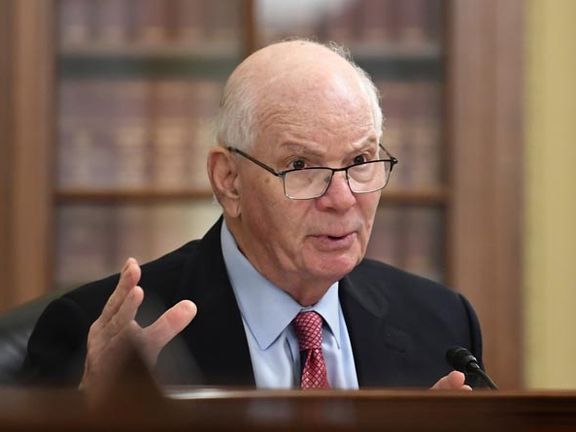
Chairman of the US Senate Foreign Relations Committee, Ben Cardin

Chairman of the US Senate Foreign Relations Committee, Ben Cardin, says he’s not familiar with the MAHSA Act, an Iran sanction bill that activists say he’s blocking.

The bipartisan Mahsa Amini Human rights and Security Accountability Act (MAHSA Act) passed the House of Representatives with overwhelming majority in September 2023, but has not yet been moved forward for a vote in the Senate.

It is named after the 22-year-old Kurdish-Iranian girl whose death in hijab police custody in September 2022 sparked country-wide protests, challenging the clerical regime like never before.

Iranian-American activists blame Senator Cardin for the grounding of the MAHSA Act –a bill that aims to codify sanctions on the offices of the President and the Supreme Leader of the Islamic Republic of Iran.

But Senator Cardin seemed to be unaware of any such legislation, when approached by Iran International’s Arash Alaei at the Capitol on Tuesday.

“First, we’re not blocking any legislation,” Cardin said. “There is an order to how we bring up legislation... So, I’m not familiar with this bill, when it’s going to be coming up.”

His response baffled and angered many Iranian-American activists.

“It’s almost laughable,” wrote one activist on X, “after months of back-and-forth emails between activists and his legislative team, several meetings, protest’s outside of his DC office? Senator Cardin is unfamiliar.”

As the chairman of the influential Foreign Relations Committee, the Democratic Senator is ultimately responsible for marking up the bill for a vote.

Last December, Cardin’s staff confirmed in a brief email that there were no plans to “move forward with the bill.” This spurred a group of Iranian-American activists to gather in front of his office two weeks ago, protesting what they see as a deliberate attempt to halt the bipartisan initiative.

Senator Cardin rejected this in his interview with Iran International, suggesting that he had not heard of the MAHSA Act, and that any delay was a matter of “procedure”.

“I’m afraid Senator Cardin is very familiar with the MAHSA Act,” wrote another activist on X. “We sent several petition letters with 117 signatories from MD and 405 signatories from 33 other states. We have email correspondence that goes back to July 2023 with his staff. A few of us met with his staff on zoom on 8/10/23. Then on 12/21/23 we finally received this response after 4 months of being completely ignored.”

Since Mahsa Amini’s killing by Iran’s hijab police, and the ensuing protests in which the regime killed around 550 civilians and blinded and maimed many more, Iranian-American activists have been trying to fight human rights abuses in Iran; hence the MAHSA Act.

At dawn Tuesday morning Iran time, the regime executed another young protester, Mohammad Ghobadlou, despite the fact that his sentence had been overturned by the Islamic Republic’s Supreme Court.

The execution highlighted the importance of pressuring the regime in Iran through such punitive measures as the MAHSA Act.

“Mohammad Ghobadlu’s execution is an extrajudicial killing according to international law and the Islamic Republic’s own laws,” Mahmoud Amiry-Moghaddam, director of the Norway-based Iran Human Rights (IHR NGO) said, demanding that Iran's Supreme Leader Ali Khamenei and its judiciary to be held accountable for the execution.

In Washington, Senator Cardin tried to reassure the public that everything possible would be done to effect positive change in Iran.

“Iran’s actions are horrible,” he said. “We’ve taken extreme steps. We’ve imposed the maximum amount of sanctions that we’ve imposed against a country. We continue to look for additional ways to put additional pressure on Iran to stop its nefarious activities.”

Many Iranian activists have become increasingly critical of the Biden administration –and by extension, the Democratic party– for what they believe is “appeasement” of the regime ruling in Iran. Some say that Senator Cardin, a senior Democratic party member, would prefer to go along with Biden's diplomatic soft approach with Iran.

Cardin, however, claimed that he was prepared “to take additional steps” against Iran. “We’ve already taken a lot of steps,” the Senator said. “But make no mistake about it: we’ll do everything we possibly can to isolate Iran and what it's doing.”


Most Viewed

Iran negotiators ordered to return after internal rift over Islamabad talks
1
EXCLUSIVE

Iran negotiators ordered to return after internal rift over Islamabad talks

2
ANALYSIS

US blockade enters murky phase as tankers spoof signals and buyers hesitate

3
ANALYSIS

Why the $100 billion Hormuz toll revenue is a myth

4

US tightens financial squeeze on Iran, warns banks over oil money flows

5
ANALYSIS

US blockade targets Iran oil boom amid regional disruption

Banner
Banner

Spotlight

  • Hardliners push Hormuz ‘red line’ as US blockade tests Iran’s leverage
    INSIGHT

    Hardliners push Hormuz ‘red line’ as US blockade tests Iran’s leverage

  • Ideology may be fading in Iran, but not in Kashmir's ‘Mini Iran'
    INSIGHT

    Ideology may be fading in Iran, but not in Kashmir's ‘Mini Iran'

  • War damage amounts to $3,000 per Iranian, with blockade set to add to losses
    INSIGHT

    War damage amounts to $3,000 per Iranian, with blockade set to add to losses

  • Why the $100 billion Hormuz toll revenue is a myth
    ANALYSIS

    Why the $100 billion Hormuz toll revenue is a myth

  • US blockade targets Iran oil boom amid regional disruption
    ANALYSIS

    US blockade targets Iran oil boom amid regional disruption

  • Iran's digital economy battered by prolonged blackout
    INSIGHT

    Iran's digital economy battered by prolonged blackout

•
•
•

More Stories

Hardliners In Iran Bar Ex-President Rouhani From Elections

Jan 24, 2024, 10:48 GMT+0

Iranian hardliners controlling the candidate vetting process for the March 1 elections, have rejected the candidacy of former President Hassan Rouhani, local media report.

Rouhani had registered and was eager to run for a seat on the Experts Assembly that will take place along with parliamentary elections in five weeks. The Assembly has the constitutional duty to select Iran’s next Supreme Leader after Ali Khamenei’s death.

Rouhani in November had stressed the importance of the election, considering political uncertainties in the event of Khamenei’s absence.

The interior ministry and the Guardian Council, both in charge of vetting candidates, have rejected hundreds of non-hardliners for the March vote, repeating the same tactic as was employed in the 2020 parliamentary and the 2021 presidential elections. As a result, the outgoing parliament is controlled by ultraconservatives, who also dominate President Ebrahim Raisi’s administration.

Rouhani's rejection by Khamenei loyalists has now pushed all former Iranian presidents into political isolation.

Those rejected are all regime insiders and not opponents, who could never be allowed to run in an election. Many are former high-ranking officials or lawmakers.

Relatively independent media outlets, commentators and many politicians agree that turnout in the elections will be extremely low, as voters have lost trust that any election in the Islamic Republic can improve their deteriorating economic condition or offer more freedoms. The widespread candidate rejections also diminish any chance that government efforts to entice the population to vote can bear any results.

The manipulation of elections take place even though hardliners know a low turnout can further erode the regime’s legitimacy, damaged by economic crisis and repeated nationwide protests.

Iran’s Regime Effectively Ends Election Weeks Before Voting Day

Jan 23, 2024, 15:36 GMT+0
•
Iran International Newsroom

Iran's ruling hardliners have crushed the election hopes of reformists and moderates in the parliamentary vote on March 1 by disqualifying nearly all their candidates.

Javad Heravi, the spokesman for the Moderation and Development Party, closely associated with Former President Hassan Rouhani and Former Vice President Mohammad Baqer Nobakht, announced on Monday that very few candidates have been approved to run. Other likeminded parties also do not have enough approved candidates to form a coalition with them.

In Heravi's words, "Practically, we are not players any longer," indicating that one of the most significant moderate parties in Iran will not participate in the elections. He added, "We are not to be blamed if we do not have a list of candidates for the election."

Javad Heravi, the spokesman for the Moderation and Development Party (undated)
100%
Javad Heravi, the spokesman for the Moderation and Development Party

Iran's elections are not free from the start, with stringent vetting processes conducted by the interior ministry and the Guardian Council. This process has become increasingly political since 2020, resulting in the rejection of most non-hardliner candidates. As a result, hardliners, who are loyal to Supreme Leader Ali Khamenei, dominate the elections.

This situation effectively means that hardliners have already predetermined who can run and win in the elections, as nearly all ultraconservative candidates have passed the Guardian Council's scrutiny.

The party also criticized Iran's foreign policy, citing recent missile attacks on neighboring countries and stating that it has left voters concerned about the upcoming elections. Additionally, Iran’s 50-percent annual inflation rate and economic crisis have added to people's anxieties in the weeks leading up to the election.

Heravi explained that the Majles (parliament) cannot bring about positive change without elected lawmakers, and this can only happen with a high-turnout election. The party currently has 40 candidates remaining after the vetting process, but it will not release a candidate list unless it can field enough candidates for all constituencies in the country.

Furthermore, the party's spokesman noted that state television and the government appear to treat the elections as a competition among conservatives, and many former lawmakers, including those close to former Majles Speaker Ali Larijani, have been disqualified by the Guardian Council. Heravi emphasized, "Party members and others cannot expect anything from us while we have not been given a chance to compete."

Media reports indicate, the Guardian Council has not yet finalized the vetting results for 26 current members of the parliament and dozens of former lawmakers who have contested their disqualifications.

A former senior lawmaker, who has been disqualified by the Guardian Council, is Heshmatollah Falahatpisheh, the former head of the Iranian parliament and commentator who regularly writes about Iran's foreign policy with a critical view.

Meanwhile, Hadi Tahan Nazif, the spokesman for the Guardian Council has said that 12,033 candidates have been approved to run in the upcoming election. He confirmed that 26 incumbent MPs, as well as tens of former lawmakers, have been rejected. However, he added that the Guardian Council will soon release one more list of qualified candidates.

In the face of public reluctance to vote and the lack of popular support for participating in the election, the government has mobilized clerics and young seminarians to encourage voter turnout. Seminary students have formed a group called "Forty Days of Advice" to motivate people in the 40 days leading up to the election. However, clerics do not enjoy significant popularity in Iranian society, which poses a challenge to this propaganda effort.

A cleric, Jalal Razavi Mehr, the head of the Association of Qom Seminary Students has said that voting in the election is as important as honoring the chastity of one's wife and daughters. 


Iran's Once Burgeoning Film Festival Plunges Into Darkness

Jan 22, 2024, 22:12 GMT+0
•
Iran International Newsroom

The Fajr Film Festival, Iran's biggest and most extravagant annual cultural event, has become mired by the politics of fundamentalism and Islamic populism.

Before conservative President Ebrahim Raisi took office in 2021, major film festivals in Europe and the United States, including those in Berlin, Cannes, and Chicago looked forward to the event to select some of the finest Iranian movies for their own events.

Until three years ago, no international film festival was perfect without an Iranian movie directed by an internationally renowned Iranian filmmaker. Things have now changed.

Iran's populist Culture Minister Mohammad Mehdi Esmaili even cautioned reporters not to use the words Festival Palace, and to use the revolutionary expression Festival House instead, as "Palace" was a place for taghooties (those who do not worship God). The word came back to the press from the darkest dungeons of the overtly fundamentalist and seemingly militant 1979 Islamic revolution.

The same Culture Minister tried earlier this week to lure a popular Iranian singer in Los Angels to return to Iran after four decades. This was of course a move to pacify a sulking nation to encourage them to take part in the upcoming elections. Minutes after the statement by the Culture Minister an Iranian lawyer warned the singer that he would be facing a 28-year jail sentence if he ever set foot in Iran again.

Culture Minister Mohammad Mehdi Esmaili addressing the closing ceremony of Fajr Film Festival in 2023
100%
Culture Minister Mohammad Mehdi Esmaili addressing the closing ceremony of Fajr Film Festival in 2023

Iranian social media users, including a former presidential chief of staff, who can crack dark jokes about any serious matter, reminded the singer, Nasrollah Moin, that the Minister was right. He can always arrive at the Tehran international airport, but there is no guarantee he would be able to depart.

Film critics widely agree that the quality of Iranian cinema has declined in recent years. It's important to note that the deterioration in the film industry didn't solely occur during President Raisi's administration. The decline began during former President Hassan Rouhani's second term when Iranian filmmakers faced pressure from the IRGC and intelligence organizations. Even internationally acclaimed director Jafar Panahi received a lengthy prison sentence. The situation worsened after the 2022 protests. 

At present, most Iranian films are produced by intelligence organizations and the IRGC, with a directive to promote official ideology. As a result, numerous uninspiring movies are being made, often featuring the same group of actors and filmmakers. Many other talents in the industry are no longer favored by the government, as some prominent figures, such as Mahnaz Afshar and Hamid Farrokh Nejad, have left Iran to join opposition groups

Some 106 Iranian movies are to be screened for the first time in this year's festival from February 1 to 11, during the Ten Days of Dawn, or the anniversary of the 1979 revolution. These movies are mainly directed by individuals hitherto unknown to Iranian film industry and movie-goers. They are well-connected individuals who can get hold of hefty government budgets to make these films.

However, a few like comedian Mehran Modiri and Soroush Sehhat and renowned cinematographer Mahmoud Kalari have also presented their films to the festival. The first two artists were reportedly barred from entering the Festival House to meet the formalities for screening their films and were branded as taghooties.

Meanwhile, asked why all the members of the festival's selection committee are men and there are no women among them, the festival's secretary, Mojtaba Amini, said selecting films is a tough job and women cannot do that, but he will make sure that a woman filmmaker is on the board of the jury. Interestingly, Amini was the producer of IRGC-funded TV series Gando that levelled many unfounded accusations against former Foreign Minister Javad Zarif.

All of the members of the Selection Committee of the festival have been carefully chosen from among hardliners in Iran's film industry. 


US, UK Sanctions Tighten Grip On Iran's Proxies

Jan 22, 2024, 18:01 GMT+0
•
Iran International Newsroom

Amid simmering Middle East tensions, the US and UK have announced new rounds of sanctions against financial and logistic supply networks of Iran’s proxies.

On Monday, the US Department of the Treasury’s Office of Foreign Assets Control (OFAC) designated Iraqi airline Fly Baghdad and its CEO, Basheer Abdulkadhim Alwan al-Shabbani, for helping Iran’s Revolutionary Guard’s extraterritorial Qods (Quds) Force (IRGC-QF) and its proxy groups in Iraq, Syria, and Lebanon. 

The new measures also include designating three leaders and supporters of one of the IRGC-QF’s main militias in Iraq, Kata’ib Hizballah (Kata'ib Hezbollah or KH), as well as a business that moves and launders funds for the group, officially listed as a terrorist organization by Japan, the United Arab Emirates, and the United States.

According to the Treasury, Iraqi airline Fly Baghdad has for years supported the operations of the IRGC-QF and its proxies by delivering materiel and personnel throughout the region. “Fly Baghdad flights have delivered shipments of weapons to Damascus International Airport in Syria for transfer to members of the IRGC-QF and Iran-aligned militia groups on the ground in Syria, including the Syrian Arab Republican Guard, Lebanese Hezbollah, KH, and the KH-affiliated Abu al-Fadl al-Abbas Brigade.”

Iraqi Shiite Muslim men from the Iranian-backed militia Kataib Hezbollah hold the party's flags as they walk along a street painted in the colours of the Israeli flag during a parade in Baghdad in this July 25, 2014.
100%
Iraqi Shiite Muslim men from the Iranian-backed militia Kataib Hezbollah hold the party's flags as they walk along a street painted in the colours of the Israeli flag during a parade in Baghdad in this July 25, 2014.

Fly Baghdad, which has a fleet of eight aircraft including six Boeing 737s, has delivered the groups a range of weapons, including Iranian-made Fateh, Zulfiqar, and al-Fajr series missiles, as well as AK-47s, RPG-7s, and other grenades and machine guns. The airline has also been involved in the transfer of hundreds of Iraqi fighters, including fighters affiliated with the US-designated Iranian proxy militia Asa’ib Ahl al-Haq (AAH), in support of the Iranian proxies’ attacks on Israel on October 7. 

Underscoring the ongoing threat the IRGC-QF and its proxy network pose to US personnel and the region, the Treasury said Kata’ib Hizballah has carried out a series of sharply escalating drone and missile attacks against American personnel in Iraq and Syria since Hamas’s attack on Israel on October 7.

Monday's sanctions came a day after US Central Command announced that multiple ballistic missiles and rockets were launched by Iranian-backed militants in western Iraq targeting al-Assad Airbase, which hosts US troops. “A number of US personnel are undergoing evaluation for traumatic brain injuries,” read the statement by CENTCOM. 

“Iran and its proxies have sought to abuse regional economies and use seemingly legitimate businesses as cover for funding and facilitating their attacks,” said Under Secretary for Terrorism and Financial Intelligence, Brian E. Nelson. “The United States will continue to disrupt Iran’s illicit activities aimed at undermining the stability of the region.”

Also on Monday, the US, UK and Australia announced new sanctions on key figures in the financial networks of Hamas and Palestinian Islamic Jihad (PIJ). The measure targets networks of Hamas-affiliated financial exchanges in Gaza, their owners, and associates, and particularly financial facilitators that have played key roles in funds transfers, including cryptocurrency transfers, from the IRGC-QF to Hamas and the PIJ. 

Britain's foreign office said the sanctions target Zuheir Shamlakh, a Gaza-based financial facilitator known as Hamas’s "main money changer" and a key figure involved in the group's shift towards cryptocurrencies who helped transfer large sums of money from Iran to Hamas ahead of the group's October 7 atrocities which saw at least 1,200 mostly civilians murdered and another 250 taken hostage in Gaza. 

“Over the last several years, members of the Shamlakh family have become the main end point for funds transferred from the IRGC-QF to Hamas and PIJ in Gaza,” said the US Treasury. 

Zuhair has used his companies Al-Markaziya Li-Siarafa (Al-Markaziya) and Arab China Trading Company to channel funds for the Izz al-Din al Qassam Brigades (al-Qassam Brigades), the military wing of Hamas. Gaza-based financial facilitators Ahmed Shamlakh (Ahmed), Alaa Shamlakh (Alaa), and Imad Shamlakh (Imad), also serve as key players in the financial flow from Iran to Hamas and PIJ. 

“Hamas has sought to leverage a variety of financial transfer mechanisms, including the exploitation of cryptocurrency, to channel funds to support the group’s terrorist activities,” Nelson added. 

According to the UK's Foreign Secretary David Cameron, “These sanctions send a clear message to Hamas: the UK and our partners are committed to ensuring there is no hiding place for those financing terrorist activities.” 

Iranian Conservatives Jockey Ahead Of Lackluster Elections

Jan 22, 2024, 07:39 GMT+0
•
Iran International Newsroom

With all the talk about Iran's fate in a possible escalation of war in the region, the parliamentary election on March 1 is not the foremost concern for Iranians.

Besides immediate fears of war and conflict, Iranian media also highlight expectations of a low turnout amid a general indifference to the regime’s highly manipulated elections.

Nevertheless, Iranian media are passionately discussing what the election might hold for Iranians, although almost all of them are quite sure that ultraconservatives will win the majority of seats in the parliament (Majles).

Reports in the reformist media alternate between the news of fresh divides and new alliances in the conservative camp. Arman Melli, a reformist daily, wrote last week with a high degree of certainty that "Conservatives are unlikely to reach unity."

The daily argued that although it is too early to predict what will happen in the conservative camp, the dynamics among conservative groups indicate that there is a likelihood of an alliance, and it is almost certain that Majles Speaker Mohammad Bagher Ghalibaf's name will be at the top of the conservatives' list of candidates.

This comes despite Ghalibaf not being the most popular figure among Iranian conservatives, as even members of the parliament have lately criticized him harshly for his inaction and his failure to establish the parliament's supervisory role.

Yet, the daily speculated that there are more signs in the conservative camp indicating divides among various groups. Arman Melli wrote that the sheer number of various groups is more indicative of divides than alliances. The daily noted that all conservative groups in Iran believe that unity is something good only if they are the leader of the alliance. This is what can easily turn the illusion of an alliance into solid signs of divide.

Another pro-reform daily, Arman Emrooz, wrote on January 16 that an alliance is likely to be formed by conservative groups, led by the hardliner Paydari Party, which holds the majority in the current Majles and most of the cabinet ministers of the Raisi Administration are its members. The daily argued that accepting Paydari's leadership is the only condition that can bring about an alliance among Iranian conservatives.

Arman Emrooz added that key conservative figures such as father figure Gholam Ali Haddad Adel and Assadollah Badamchian of the Islamic Coalition Party have already agreed that Paydari should lead other conservative parties and political groups. Although the two men are influential enough, but other conservative groups have still not voiced their views about Paydari's leadership.

Badamchain has recently said that his party has 200 candidates for constituencies all over the country. It appears that there is currently an agreement among conservatives that Paydari should continue to hold the majority of the Majles under the speakership of current Speaker Mohammad Baghert Ghalibaf. This was the arrangement that was first made after the current Majles convened for the first time in May 2020. Ghalibaf does not have a big number of followers in or out of the parliament, but despite essential differences, even Paydari agrees that as a relative of Supreme Leader Ali Khamenei, Ghalibaf can be a good leader for the Majles, and his kinship ties gives him the leverage to resist pressures coming from the executive branch.

However, Ghalibaf has powerful rivals in the internal election for choosing a speaker. Paydari's Leader Sadeq Mahsouli, and the Chairman of its Central Council Morteza Aqa Tehrani have always been serious competitors for the post. In the next Majles, there is a true conservative heavyweight Ghalibaf and others need to tackle: Mohammad Reza Bahonar. Even hardliner Mohammad Hossein Naqavi Hosseini says Bahonar stands way higher than others in the competition for the post of the speaker of the parliament.

The only thing that can stop Bahonar, a seasoned politician and a former Vice Speaker, from rising to the position of Speaker is a sold alliance among other conservative groups, Naqavi Hosseini said.