Iraqi Militias Reportedly Target Air Base Hosting US Troops Again

Fars News Agency affiliated with Iran's Revolutionary Guard has reported another attack on the Ain al-Asad airbase in Iraq hosting US troops, by militia forces.

Fars News Agency affiliated with Iran's Revolutionary Guard has reported another attack on the Ain al-Asad airbase in Iraq hosting US troops, by militia forces.
The unconfirmed attack, carried out using a combination of drones and rockets, seemingly targeted American military personnel stationed at the base, as reported by Iran-affiliated Al Mayadeen news network.
Washington and official Iraqi sources have not reported any attack taking place on Saturday.
Simultaneously, another military base housing US forces near Baghdad's international airport also faced rocket attacks, Al Mayadeen added.
Iran-backed Islamic Resistance of Iraq has claimed responsibility for the attack, according to Fars, emphasizing that it was executed with “precision, hitting its intended targets.”
There were already attacks in recent days against US bases in both Iraq and Syria.
The alleged attack follows earlier warnings from Iraqi militants aligned with Iran against potential US intervention in support of Israel during the conflict with Hamas in Gaza. In the past 48 hours, this marks the fifth attack on Iraqi military bases hosting US forces.
The United States maintains approximately 2,500 troops in Iraq and an additional 900 in Syria. The troops are primarily engaged in advising and assisting local forces in the fight against the Islamic State, which seized significant territory in both countries in 2014.
Ain al-Asad airbase, the target of the attack, is situated in the western Anbar province of Iraq.
The UN has sent letters to countries announcing end of bans on Iran’s missile program, removing barriers for the clerical regime to sell dangerous technologies.
“The Secretariat removed on 19 October 2023 from the Security Council website the list of 23 individuals and 61 entities subject to the aforementioned restrictive measures,” read the UN letter, terminating all provisions of Annex B of UN Security Council Resolution 2231 that prohibited activities such as development, tests, military employment, and others. The resolution endorsed Iran’s 2015 nuclear deal (JCPOA) with P5+1 (the five permanent members of the Council -- China, France, Russia, United Kingdom, United States, plus Germany).
“All it takes is one letter” to the UN Security Council by parties of the JCPOA to keep checks and balances on Iran’s drones and missiles, Behnam Ben Taleblu, a senior fellow at US-based think-tank the Foundation for Defense of Democracies (FDD) tells Iran International.
The hypothetical letter would start a 30-day clock for a different party to put forward a resolution to prove Iran’s compliance with the defunct deal signed with P5+1 (the five permanent members of the Council -- China, France, Russia, United Kingdom, United States, plus Germany). If the evidence for Iran’s non-compliance is clear, a snapback mechanism would crumble the foundations of UNSCR 2231 resolution, practically end the JCPOA and restore six resolutions imposed on Iran from 2006 to 2010 as well as all their prohibitions and penalties.
The US and nearly 50 other countries dusted off a 20-year-old program on weapons of mass destruction as well as issuing further missiles-related sanctions on Iran and the three European parties of the JCPOA, the so-called E3, announced in September that they would keep their sanctions in place. But no letter for a snapback.

Taleblu says unless Iran starts stockpiling weapons-grade uranium, these countries will not pursue a snapback mechanism. “Despite the recently lapsed UN prohibitions on Iranian missile testing and transfers, snapback still remains an option and should be considered an option. Legally under UN Security Council resolution 2231, snapback will remain an option until the fall of 2025. That means that the US or the E3 can still snap back and restore older multilateral penalties on Iran’s nuclear, missile and military program. And yes, all it takes is a letter from one of these JCPOA participants to the president of the UN Secretary Council and to run a 30-day clock,” Taleblu added.
On the Termination Day of the JCPOA, which will occur 10 years after Adoption Day (i.e. in 2025), the remaining EU measures will be terminated, the UNSC will conclude consideration of the Iran nuclear issue and UNSC resolution 2231 (2015) will be terminated.
Now that the prohibitions are lifted, Iran can now make money legally from its missile and drone sales and then can use the profits to finance its militant and terror proxies in the Middle East. The more chaos and destruction across Eurasia and perhaps Africa, the more Iran can find markets for its products. It can look for new buyers, who no longer face international consequences for their arms trade with Iran.
According to Taleblu, one of the more imminent perils is Iran selling ballistic missiles and related long-range strike technologies to Russia. Tehran has been providing President Vladimir Putin with a platter of miscellaneous drones, but not ballistic missiles. Russia has grown close to Iran since invading Ukraine in February 2022 and would likely use the easier flow of missiles to facilitate its invasion. Many of the hundreds of one-way attack drones it has used to bomb Ukraine in the last year were Iranian made.
“It is absolutely true that Iran did violate even arms transfer prohibitions prior to them expiring in 2020, however, thus far Iran has not given ballistic missiles to Russia,” he said, arguing that Iran waited for these US measures to end so that it can trade its missiles in broad daylight.“It is my contention that Iran was waiting for these international prohibitions to lapse to more seriously consider supplying Russia with ballistic missiles. Iran wants some of its arms transfers to not be penalized by the West and considered legal,” Taleblu said.
In addition to Russia, Iran will try to sell its missiles and drones to all its anti-West allies. Taleblu believes Iran’s leftist allies in the Americas as well as new Asian markets may be the prospective destinations of Iran’s drones and missiles.
In terms of customers for Iran’s long-range missiles or drones, “Venezuela is a growing industry.” He added that Bolivia is also a potential buyer while Belarus also offers a possible niche market. “The most acute and the most dangerous” remains the sale of Iran’s close-range ballistic missiles to Russia to help the invasion of Ukraine. “That will be a game changer and a record breaker for the history of Iranian arms proliferation as well as a game changer in the Russo-Iranian relationship.”
“The Islamic republic is an ideological actor committed to the export of the revolution, committed to keep developing a nuclear weapon, committed to protecting and defending its proxies and partners through illicit arms exports. This is a fact. Legal, political, normative and international prohibitions can hinder or name and shame it, but there is no such thing as a magic bullet.”
“Snapback matters because it sets a multilateral and international legal baseline for pressure against Iran.”

An hardline Iranian lawmaker has threatened that if the Hamas-Israel conflict worsens Tehran might enter the war and close the Strait of Hormuz in the Persian Gulf.
Media in Tehran reported that Hassan Norouzi, an influential lawmaker, was asked how Iran is planning to play a role in the war. He was quoted as responding that “So far, resistance forces in Palestine, Syria and Iraq are sufficient, but if the situation becomes critical and we are asked [for assistance], it is possible that we would go to war against Israel to support the resistance.”
Iran refers to Palestinian and other militant groups in the region that receive support from Tehran and act on its behalf, as the “Axis of resistance.”
Asked about what Iran would do if the United States entered the conflict, he replied, "The United States does not have the audacity to enter directly. If it does, it will face difficult conditions. Even if it attacks, the Middle East and Western Asia's resistance forces have the capability to counter. It's also not unlikely that we could close the Strait of Hormuz. If America directly aids Israel in a war, we will close the Strait of Hormuz."
Iran foreign Minister Hossein Amir-Abdollahian who was visiting Lebanon last week threatened a wider war if attacks continued against Hamas. "The continuation of war crimes against Palestine and Gaza will receive a response from the rest of the axis. And naturally, the Zionist entity and its supporters will be responsible for the consequences,” he stated.
The Iranian regime so far has celebrated Hams’ October 7 brutal attack on Israel that resulted in the killing of about 1,400 people, but has taken no direct military action to support Hamas.

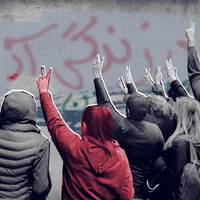
A French-Iranian researcher, who recently returned to France after being held hostage in Iran, has expressed her deep appreciation for the Women, Life, Freedom movement.
Fariba Adelkhah said the movement, which sparked months of nationwide anti-regime protests, brought her “great joy during her time in the Iranian jail.”
Adelkhah made the statement during a visit to her workplace, the Paris Institute of Political Studies on Friday. Her return was met with warm welcome and encouragement from professors and students alike.
The renowned institute, often referred to as Sciences Po, announced on Wednesday that Adelkhah, who endured more than three and a half years of imprisonment in Iran, had returned to France.
Reflecting on the nationwide protests that erupted in Iran after the tragic death of Mahsa Amini, Adelkhah remarked, "We were very happy about what was happening outside."
The seasoned researcher praised the new generation in Iran, emphasizing that they have "nothing to lose" and are "much braver" than their predecessors.
Adelkhah was detained during her visit to Iran in June 2019 and subsequently sentenced to five years in prison, accused of espionage. She was released from Evin Prison in February and was recently allowed to leave the country.
She also disclosed that she spent "entire nights" writing during her imprisonment and interrogations to communicate to her captors that she was not the "spy" they perceived her to be.
Over the past decade, Iran's Revolutionary Guard has detained numerous dual nationals and foreign individuals, often on unsubstantiated allegations of espionage and security breaches. Human rights organizations have characterized the detentions as hostage-taking maneuvers designed to extract concessions from Western governments.

Iran’s ambassador to Thailand says some of the hostages taken captive by the Hamas after their attack on Israel will be set free when the IDF ceases bombardment of Gaza.
According to the Bangkok Post, Reza Nobakhti, speaking at a press conference held in Bangkok, discussed the hostages who hold Thai citizenship. He mentioned that he had been informed that Iran's President Ebrahim Raisi, who met with Ismail Haniyeh, the political leader of Hamas in Qatar last week, requested the release of the hostages as well as Filipino captives.
Among the approximately 200 hostages that Hamas has brought from Israel to Gaza, there are citizens from various countries, including 19 Thai nationals and individuals from the Philippines.
Nobakhti stated that all Thai hostages are being kept "safely in good health" in Palestinian territories, and the "well-being of Thai hostages is the main concern of Iranian authorities."
As of now, at least 30 Thais have been killed since the start of the war between Hamas and Israel.
He added that Hamas has agreed to release the hostages; however, “the challenge is that, due to Israel's continuous bombardment, they are unable to transfer the hostages from Gaza to Israel.”
On Friday Hamas announced the release of two American hostages, a mother and her daughter, following Qatar's mediation.
Bloomberg also reported that the United States and some European countries have called on Israel to postpone the ground offensive in the Gaza Strip, considering the ongoing negotiations for the release of hostages via Qatar.
Israel, in response, stated that the release of two American hostages by Hamas will not affect the country's ongoing military operations.

A prominent Iranian politician has called for the establishment of a tribunal to bring to trial the statesmen who have jeopardized Iran's national interests.
The former head of the Iranian parliament's National Security and Foreign Relations Committee Heshmatollah Falahatpisheh has told the press in Iran that three groups of Iranian statesmen should be put on trial on charges of weakening the country by their injudicious actions and policies.
He identified the three groups as "Those who have sacrificed national interests for factional political gains, those who have benefitted from international sanctions and plundered the country's financial resources, and those who prevented the forming of a rational foreign policy."
These characteristics point to ultraconservatives who have opposed cordial relations with the West and the JCPOA nuclear agreement between Iran and the United States. The same faction of hardliners also opposed accession to financial regulations set by the international Financial Action Task Force (FATF) that could have facilitated international trade and banking, as well as compromise with the European and American partners to the JCPOA that could have paved the way for ending the sanctions that have paralyzed Iran's economy.
Meanwhile, Falahatpisheh charged that the same ultraconservative groups, who previously claimed that furthering the negotiations to revive the 2015 nuclear deal was treason against the country's national interests and prevented the passing of the FATF bills, are currently pretending to be supporting the JCPOA and the ratification of financial regulations.

He was alluding to President Ebrahim Raisi and his ultraconservative economic teas and populist supporters in the government who have asked Supreme Leader Ali Khamenei to revive the debates about the FATF bills at Iran's Expediency Council, where the bills have been shelved since 2017 because of faction fighting at the parliament and government.
Falahatpisheh said that these groups, which he did not specifically identify, have squandered billions of dollars of the country's financial resources through their obstructive measures.
In another development, the conservative Jomhouri Eslami daily, a critic of the government policies wrote on Thursday that while it's a positive step that some of the country's officials have come to realize that their policies concerning the JCPOA and FATF were mistaken, these politicians should be held accountable for their decisions and compelled to bear the consequences of their detrimental actions.
The daily stated: "The people certainly welcome this change of approach on the part of the politicians who used to oppose the nuclear deal and healthy international trade and banking. But those politicians should be held accountable for the losses they imposed on the country's economy."
Similar to Falahatpisheh, Jomhouri Eslami also pointed out that some of the current advocates of the JCPOA and FATF are the same individuals who used to dismiss the nuclear agreement and FATF. "They asserted that they could address the country's economic problems without becoming party to the FATF conventions. They also contended that joining the convention would result in divulging Iran's economic secrets to foreigners and compromising the country's sovereignty."
The daily noted that during parliamentary discussions about the FATF, some individuals did not have a clear understanding of the acronym's meaning, and others even misspelled it.
Jomhouri Eslami also warned that although some hardliners now say they have changed their minds about the two topics, there is still a powerful opposition. The daily further warned that the continuation of this dispute might create bigger problems for Iran.
In yet another development, former President Hassan Rouhani told the congress of his political party, the Moderation and Development Party on Wednesday, that "Iran's way out of its current problems is moderation." Referring to the monopoly of power by hardliners, he warned that when a minority rules in the country, the people will have to voice their demands in the streets."