Iran Again Voices Concerns Over Armenia-Azerbaijan Conflict
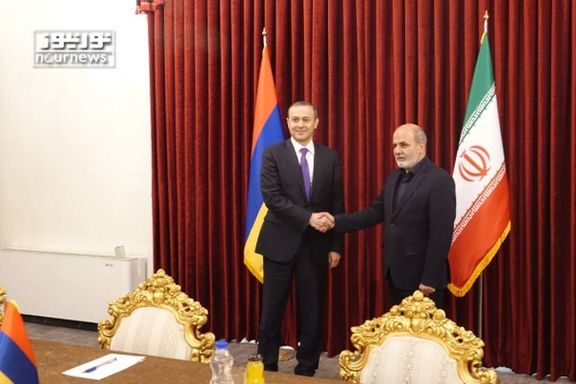
Iran has once again expressed concerns regarding the ongoing conflict between Armenia and Azerbaijan and the existing threat to the territorial integrity of Armenia.
Iran has once again expressed concerns regarding the ongoing conflict between Armenia and Azerbaijan and the existing threat to the territorial integrity of Armenia.
The Secretary of Iran's Supreme National Security Council threatened that any shifts in the region's geopolitical landscape would result in “heightened insecurity and the exacerbation of existing crises.”
Ali Akbar Ahmadian made the remarks during a meeting with his Armenian counterpart, Armen Gregorian, in Tehran on Sunday.
Since Armenia's defeat in the 2020 war on Azerbaijani soil, it has become vulnerable to potential incursions from its more powerful neighbor. In this scenario, Iran would lose a secure land corridor to the north, which connects it to Russia through Georgia. Tehran has repeatedly revealed its concerns and has warned that it would not tolerate such actions by Azerbaijan. It has also bolstered its military presence on the border to underscore this stance.
The conflict carries the potential to reshape the geopolitical dynamics of the South Caucasus region, which is intersected by vital oil and gas pipelines. Iran has previously cautioned against altering the political landscape in the Caucasus and adjusting international borders.
Tehran has stated that if either side attempts to modify the geopolitical balance in the Caucasus or the international borders, it will abandon its neutral position and respond directly. However, Tehran did not intervene this month when Azerbaijan attacked Karabakh, the Armenian autonomous enclave within its territory and forced more than 100,000 people to flee.




The former head of Iranian parliament's National Security and Foreign Policy Committee says Azerbaijan's attack on Karabakh is the beginning of a regional crisis.
Heshmatollah Falahatpisheh told Didban Iran [Iran Monitor] website in Tehran that the country is facing a serious challenge as one of its gateways to Europe is threatened because of the military development in the Caucasus.
Falahatpisheh also pointed out that Iranian officials and military commanders who used to deliver passionate speeches about Iran's interests and authority in the region are silent in the face of threats to Tehran's interest.
During the past months, several Iranian military commanders and politicians warned Azerbaijan not to attack Armenia and avoid closing Iran's gateway to Europe at its borders with Armenia. As Azerbaijan expelled 120,000 Armenians from the enclave, it now threatens to enter and occupy the narrow strip of land connecting Iran via Armenia to Russia and Europe.
Iran has also long warned Azerbaijan about its close military relations with Israel, which is the Baku’s main arms supplier.
Mashregh News, a media outlet with close links to Iranian security and intelligence organizations on September 9, called an attack on Karabakh Iran's "red line" and maintained that such an action will entail consequences for Azerbaijan. The threat later proved to be hollow.
Iran's silence in the face of the development is apparently linked to a visit to Iran by Russia's Defense Minister Sergey Shoigu immediately before the attack. Meanwhile, Tehran's inaction was quite embarrassing for the regime and its military commanders considering months of bragging on IRGC media outlets and social media channels about Iran's swift reaction in case Azerbaijan attacked Karabakh.
Some Iranian social media users ridiculed the Iranian military and posted a photo of a smiling Iranian military attache' walking alongside victorious Azeri officers in Karabakh following the attack. One user wrote: "I wrongly thought that the Iranian regime's officials were trying to be strategically patient in the face of Azerbaijan's alliance with Israel."
Falahatpisheh told Didban Iran that "All this is an outcome of Iran's outdated foreign policy. At times we saw Iranian officials delivering irresponsible speeches at the borders with Azerbaijan. If what is happening now is Iran's real policy, those speakers should be accountable for agitating the society at the expense of Iran's national interests."
The former lawmaker said that the forced displacement of ethnic Armenians in Karabakh is not the end of the conflict. On the contrary, it marks the beginning of a new crisis in the region. Tens of thousands of Armenians have been displaced and their private and public rights poses a new challenge for the region's leaders. This is likely to turn into a chronic challenge not only for Azerbaijan and Armenia, but also for other players such as Turkey and Israel. Particularly because Iran will perceive Israel's presence at its borders as a true challenge.
He said: "Turkish leader Recep Tayyip Erdogan's stance during the conflict were more realistic that the other leaders involved. At least he acknowledged that Iranians are not going to like the closure of one of their key gateways to Europe and the outside world.
Meanwhile, Erdogan’s call for a meeting between the leaders of Turkey, Russia, Azerbaijan and Armenia to discuss the aftermaths and implications of the attack on Karabakh, without mentioning Iran.
Falahatpisheh pointed out that Iran's policy about the region dated back to three decades ago and Tehran was oblivious to the developments and dynamics that have been taking shape during the past thirty years in the region.
He argued that as a result of the current conflict, Azerbaijan will have to allocate a major part of its annual budget to military spending. He added that by inviting countries from beyond the region into this conflict, Azerbaijan has made a mistake. It could have solved its problems with Armenia in a different way.
The chairman of Iran's chamber of commerce says he has heard rumors that the government intends to meet the standards of FATF, the global money-laundering watchdog.
Hossein Selahvarzi, the chairman of Iran's Chamber of Commerce, Industries, Mines and Agriculture said Sunday that there is “unofficial news about the accession to the money-laundering watchdog, the Financial Action Task Force (FATF) and the possibility of more serious economic negotiations.”
Iran’s previous government submitted four bills to parliament in 2017 to adopt laws to implement FATF’s standards. The parliament approved the bills, but the hardliner Guardian Council, which has the final say, rejected two of the bills: One about joining the UN’s Palermo convention to fight international organized crime and the other to join the CFT (Combat Financing Terrorism) convention.
As stated repeatedly by experts, Iran's international trade will continue to suffer without accession to the FATF, even if US sanctions are lifted. In June, FATF retained Iran on its blacklist along with North Korea as Tehran remains reluctant to comply with global regulations.
Experts say that even if sanctions imposed by Western countries on Iran are lifted, Tehran must adhere to FATF standards in banking and financial controls to be considered a safe business partner by international actors. Most important are measures to prevent money laundering and financing of terrorism.
Opponents argue that if Iran accedes to FATF demands it will not be able to provide financial help to allied groups in the region that are part of Tehran’s “axis of resistance”. These groups, such as the Lebanese Hezbollah and some Palestinian militant organizations, are designated as terrorists by the United States and others, and act as proxy forces to help the Islamic Republic spread its influence in the region.
Speaking at an event hosting representatives of the country’s chambers of commerce in Mashhad, he claimed that "News and rumors about removing barriers to foreign trade, the lifting of sanctions, and even the acceptance of FATF rules have emerged, which in reality are not accurate.” He cautioned against persisting with past foreign policies that have imposed significant limitations on economic activities, particularly on the private sector.
Most hardliners are of the opinion that abiding by the regulation of the FATF is too much transparency for the Islamic Republic, which has resorted to a repertoire of illegal tricks and loopholes to circumvent sanctions on its banking system for international trade and its secret financing of militant proxy groups.
Parliament Speaker Mohammad-Bagher Ghalibaf said Saturday that 'BricksPay system – a digital payments platform that is being jointly developed by the member countries of the BRICS -- can be a direct replacement for SWIFT (The Society for Worldwide Interbank Financial Telecommunication). However, even the BRICS members are not looking at the platform as a replacement for other international networks.
Criticizing the government’s economic policies that have created obstacles in the path of international trade, Selahvarzi said that today numerous economic entities are targeted by state bodies under the guise of controlling the rising inflation rate. He argued that “Inflation is controlled when the inflation-inducing engine is turned off," he said, referring to Iran’s money printing to finance its deficit, which in turn leads to vicious cycle of more inflation due to high market liquidity.
He also criticized the government for sidelining private businesses people in the process of devising the budget plans for the country. “I should say that if the oppressive sanctions do not lead to the collapse of Iran's economy, these economic measures will ground the country’s economy."
The recently elected chairman of Iran's chamber of commerce, who is being challenged by hardliners and the government, had to deal with a hardliner heckler during the Sunday meeting. A man asked about Selahvarzi’s support for the Women, Life, Freedom protests, accusing him of not being trusted by the Islamic Republic.
Amid mass anti-regime sentiment expressed by Iranians, a cleric has refuted the notion that the country's problems can be attributed to the 1979 Revolution.
Mohammad Ali Movahedi Kermani, Tehran's interim Imam for Friday Prayers claimed, "Such claims are unfounded, and the public does not subscribe to them. People recognize [Ayatollah Ruhollah] Khomeini as a divine and spiritual figure who dedicated himself to service."
He asserted that these "rumors are fabricated and promoted by adversaries," showing his lack of awareness about the general sentiment in Iran or simply repeating regime rhetoric.
The term "enemy" is a commonly used descriptor by Iran's leadership, including Ali Khamenei, to refer to the United States, Israel, and their allies and partners.
Citizens increasingly blame long-standing issues such as environmental problems, water scarcity, transportation woes, brain drain, and immigration, as well as escalating inflation, on the 44-years of clerical rule. Simultaneously, growing international tensions have fueled concerns among the populace regarding Iran's relations with the world.
Since the 1979 revolution, Iran has experienced bouts of political instability, marked by protests, demonstrations, and government crackdowns, leading to a sense of insecurity and political uncertainty among the populace.
A substantial portion of the Iranian population, including millions of dissatisfied citizens taking to the streets in protest, has lost trust in the overall regime.
Iran has grappled with economic challenges, including high inflation, unemployment, and the impact of economic sanctions. Such difficulties have resulted in financial hardships for many Iranians and limited opportunities for economic advancement.
The title of ‘Iran’s first lady’ has caused a stir as President Ebrahim Raisi's wife denies the role but keeps acting like one in a country with no such tradition.
Jamileh Alamolhoda, Raisi’s wife and daughter of the Supreme Leader’s representative in Razavi Khorasan province, hosted an international event this week on the role of women in media in Mashhad -- her hometown and his hardline cleric father’s turf.
Moderate Iranian news website Rouydad24 talked about Jamileh Alamolhoda’s aspiration to write a book similar to that of Michelle Obama’s. Rouydad24 cited her as saying, “They asked me to write a book similar to this one. I read the book, and it was very beautiful, captivating, and influential. I even showed some parts of it to the president, and he said that writing a book in this field is the right thing to do.”
The presenters of the event, claiming to have brought together “100 media women from 40 countries,” introduced Jamileh Alamolhoda as “Iran’s first lady” whenever she was about to take the stage. However, she started one of the panels of the event addressing the issue, saying that the wife of the Supreme Leader is actually the country’s first lady because Ali Khamenei is the highest authority in Iran.
Her statement has drawn a wide range of reactions from the Iranian public and politicians alike, with hardliners speaking out against the existence of such a position in “an Islamic society” and describing it as a construct of Western culture that must not be copied for Iran.
Several pundits have published opinion pieces about Jamileh Alamolhoda in recent weeks, criticizing her for her double-standard approach about Western culture as she reiterates that Iranian women can best serve the family as a child-bearing housewife, but never misses a chance to accompany her husband on foreign trips.
She keeps denying the existence of the role of the country’s first lady but in practice she follows a Western model for such a role including speaking as such during the UN General Assembly week in New York with global media. She attacks the West's ideas about women and Western-style feminism in society but has announced that she is eying writing a book similar in style to former US first lady Michelle Obama’s memoir Becoming, a number-one best seller in Iran reprinted 37 times.
In a piece for Khabar Online Sunday, Abdoljavad Mousavi decried what he calls “the infatuation of so-called anti-Western officials with the West.” He said a large number of Iran’s hardliners have a superficial and hypocritical view of the West.
“They chant slogans against the West with passionate fervor, but Western countries are the first choice for their offsprings’ education; they do not recognize the United Nations officially but long for standing at its podium and accompany all their family members in their trip to New York,” the pundit said, referring to Raisi’s large entourage to the US for the UN General Assembly.
The latest trip of Iran's president and his hijab-cladded wife saw Alamolhoda thrust into the limelight in a global media blitz. To Newsweek, Alamolhoda spoke of the alleged “women’s rights” enjoyed by Iranian women, who for the last year have been protesting the oppressive conditions of living under the regime while hijab rebels remain locked out of public places including transport and education. Alamolhoda -- who firmly believes a woman’s place is as a mother and wife — claimed Western feminism has no place in Iran.
Mousavi claimed that attention to the concept of “first lady” among the hardliners stems from “a superficial understanding of the West, Islam, identity, and the Islamic Revolution.” “They vehemently criticize the West and its manifestations, but deep down, they secretly aspire to become Westerners. They strive to imitate them, seek their approval, and conform to their standards.”
Moderate Iranian news website Rouydad24 talked about Jamileh Alamolhoda’s aspiration to write a book similar to that of Michelle Obama’s. Rouydad24 cited her as saying, “They asked me to write a book similar to this one. I read the book, and it was very beautiful, captivating, and influential. I even showed some parts of it to the president, and he said that writing a book in this field is the right thing to do.”
Hardliner Telegram channel Bisimchi Media – with links to the Revolutionary Guards – slammed Raisi’s wife for using the term about Khamenei’s wife, saying, “In the structure of the Islamic Republic of Iran and its history, we don't have a position called 'First Lady'.” “Are we supposed to mimic these American ideas?" asked the media outlet.
Tasnim, another IRGC-affiliated media, also rebuked Alamolhoda for her statement about the first lady, saying, "The assumption that with the presidency of an individual in Iran, a special position is created for their spouse according to the country's constitution is certainly a mistake."
Khamenei’s wife, Mansoureh Khojasteh Bagherzadeh, rarely appears in public but several members of her family hold senior positions. Her father was Mohammad Esmaeil Khojasteh Bagherzadeh, a famous businessman in Mashhad and her brother Hassan is a former deputy director of state broadcaster IRIB. In her absence from Iran’s political sphere, the role of a first lady is up for grabs by the president’s wife.
Mohammad-Reza Bagheri, a state TV host, also criticized Alamolhoda, saying that the first lady of Iran should be chosen from among "mothers and wives of Iran’s martyrs and not the the wives of politicians.”
Implicitly admitting that she will hire a team of ghost writers to pen the book, Alamolhoda added that “it's unlikely that one person wrote this book, and a team of experts was probably involved. The book served as a role model for girls worldwide. It follows the pattern of Cinderella. An ordinary girl moves from ordinary life to the highest worldly position."
Speaking about Alamolhoda's book in response to Michele Obama, Rouydad24 said she ignores a significant point. Michelle Obama was a representative of the black women in the US -- once among the most persecuted strata of US society – who became America’s first lady. However, Alamolhoda had a silver-spoon upbringing, thanks to her father's links to the regime.
“She is the wife of the former head of the Iranian judiciary and the current president of Iran. She is the daughter of the Friday Prayer Imam of Mashhad, who holds the utmost power in the province,” the article said, arguing that “she has never represented the marginalized and oppressed segments of society.” Alamolhoda holds her social position thanks to her family status and links to regime insiders, making it very difficult for Iranian women to see a “symbol of oligarchy in Iran as a role model.”
Iran's Deputy Health Minister Hossein Farshidi issued a warning about the country's ageing population, claiming it will double within the next 20 years.
Speaking on World Elderly Day Farshidi said the demographic change is happening much faster than in many developed countries, where it took over a century to see such a rise in the elderly population.
He attributed the trend to global increases in life expectancy and significant reductions in fertility rates during the 20th century. He stressed that Iran has experienced similar demographic shifts, and if it continues, the elderly population will grow significantly.
Iran's Supreme Leader, Ali Khamenei, has stressed the importance of increasing the country's shrinking population to 150 million. However, Iran has been facing a steady decline in birth rates over recent decades. In the early 1980s, the population growth rate was as high as 4.8 percent, but it has since dropped to below one percent in the past decade.
In the last 10 years, Iran's healthcare system has significantly limited screening tests and legal abortions, and it has completely halted its decades-old family planning programs to increase population. Screening tests introduced in 1991 as part of mandatory premarital blood tests to prevent non-communicable diseases have been abandoned.
The government has also prohibited the sale of contraceptives and taken strict action against healthcare providers who assist in terminations outside the healthcare system, leading to the closure of their clinics.