Iran’s Health Ministry Warns of Ageing Population

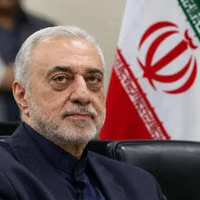
Iran's Deputy Health Minister Hossein Farshidi issued a warning about the country's ageing population, claiming it will double within the next 20 years.

Iran's Deputy Health Minister Hossein Farshidi issued a warning about the country's ageing population, claiming it will double within the next 20 years.
Speaking on World Elderly Day Farshidi said the demographic change is happening much faster than in many developed countries, where it took over a century to see such a rise in the elderly population.
He attributed the trend to global increases in life expectancy and significant reductions in fertility rates during the 20th century. He stressed that Iran has experienced similar demographic shifts, and if it continues, the elderly population will grow significantly.
Iran's Supreme Leader, Ali Khamenei, has stressed the importance of increasing the country's shrinking population to 150 million. However, Iran has been facing a steady decline in birth rates over recent decades. In the early 1980s, the population growth rate was as high as 4.8 percent, but it has since dropped to below one percent in the past decade.
In the last 10 years, Iran's healthcare system has significantly limited screening tests and legal abortions, and it has completely halted its decades-old family planning programs to increase population. Screening tests introduced in 1991 as part of mandatory premarital blood tests to prevent non-communicable diseases have been abandoned.
The government has also prohibited the sale of contraceptives and taken strict action against healthcare providers who assist in terminations outside the healthcare system, leading to the closure of their clinics.

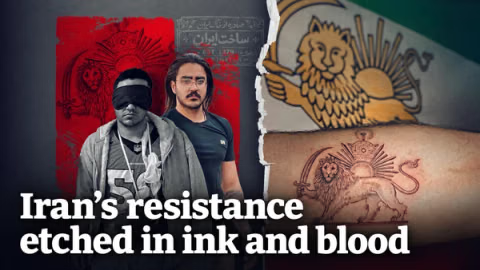
Iranian police have announced the discovery of 12 historical coins during an inspection of a woman's residence in the religious city of Qom.
Faramarz Bazgir, the commander of the Cultural Heritage Protection Unit in Qom, revealed that among the coins, 10 are silver and date back to the Achaemenid, Parthian, and Sasanian eras, while the remaining two are copper coins from the Safavid period. The suspect in possession of the coins has been handed over to judicial authorities.
In accordance with Iranian law, such historical coins and artifacts are considered part of the national heritage and are prohibited from sale or export unless expressly authorized by relevant authorities.
Iran, renowned for its millennia-old cultural heritage, has faced numerous challenges in preserving and protecting the invaluable artifacts.
Following the Islamic Revolution in 1979, the Iranian regime shifted towards emphasizing Islamic culture and values, occasionally leading to a more conservative stance regarding pre-Islamic artifacts.
Despite efforts, the Islamic Republic has failed to curb the smuggling and illegal trade of historical items, with smuggling networks taking advantage of economic incentives and global demand for Persian antiquities, resulting in the loss of irreplaceable heritage items.
Some historical sites and artifacts have suffered from neglect, insufficient maintenance, and the effects of environmental factors, prompting concerns among archaeologists and heritage conservationists about the state of preservation.

A former Iranian diplomat has joined to others in Iran calling for direct talks with the United States, after reports of secret contacts between Tehran and Washington.
Kourosh Ahmadi, in an interview with Khabar Online in Tehran, criticized mediation efforts by Oman and Qatar stating they are inconsistent with Iran's prestige. He emphasized the importance of direct negotiations in diplomatic relations.
However, his choice of words might not have been politically correct, as he stated, "Having small countries such as Oman and Qatar as mediators between Tehran and Washington is not consistent with the prestige of a great country like Iran." He would have been more accurate if he referred to the size of these countries rather than their political importance.
Ahmadi also argued for disregarding European states as mediators, possibly due to Europe's stance on the mid-October deadline for lifting sanctions on Iran's ballistic missile development activities. According to EU Foreign Policy Chief Josep Borrell, the United Kingdom, France and Germany intend to extend the sanctions indefinitely beyond the October 18 deadline.
In response, Iran barred eight IAEA inspectors from accessing its nuclear sites, and some government-owned media in Iran called for "revising" Tehran's ties with the E-3, while other outlets and some politicians raised the issue of direct talks with the United States.

Ahmadi explained that the need for mediators arises from the absence of diplomatic ties between the two countries. Mediators only pave the way for some kind of dialogue and do not play any role beyond that. They cannot alter the essence of disagreements between Tehran and Washington. He suggested that the Europeans may have intervened in the content of the indirect talks between Tehran and Washington.
Former President Hassan during his election campaign in 2013 had also advocated direct negotiations with the United States, downplaying the need to utilize Europe as a mediator.
On the opposite end of Iran's political spectrum, the Khamenei-linked hardline daily Kayhan also called for eliminating mediators in a recent article, albeit without explicitly mentioning direct talks.
Ahmadi rejected the idea of using Qatar and Oman as mediators, pointing out their opposition to Iran's ownership of the islands of Greater and Lesser Tunb and Abu Musa. He also expressed reservations about having the E-3 (UK, France, and Germany) as mediators between Tehran and Washington.
According to Rouydad24 website, some of the “rumors and wishful thinking” about direct talks between Iran and the United States are aimed at influencing the forex market in Iran and subsequently controlling the rising prices of essential commodities and housing.
During the past week, Iran's Foreign Minister Hossein Amir-Abdollahian told the press about several plans by Japan, Qatar, and the Sultan of Oman, to mediate between Tehran and Washington. He also talked about positive signals from the US, possibly in a bid to influence the markets although the markets operate based on facts, not rumors, lies and wishful thinking.
And as for positive signals from Washington, last week, the United States refused to allow the Iranian Foreign Minister's visit to Washington, apparently in the hope of starting overtures about possible talks. He returned to Tehran after attending the UN General Assembly meeting, where he was caught on cameras watching an Iran-Saudi football match on his cell phone, while President Ebrahim Raisi was desperately stuttering through a run-off-the mill text he was trying to read out to impress a delegates who were present during his speech.

The Israeli Defense Forces (IDF) carried out airstrikes near Damascus Saturday night, specifically targeting an Iranian weapons shipment en route to Lebanon.
The airstrikes were initially reported by news outlets associated with the Syrian opposition and were not officially confirmed by state media.
The airstrikes took place in al-Dimas, located west of Damascus, and their primary targets were locations belonging to the Syrian army and pro-Iranian militia groups. Immediate reports regarding casualties were unavailable, and the extent of damage resulting from the alleged airstrikes remained uncertain.
Social media footage captured explosions, but it is unclear if they were the result of airstrikes successfully hitting their intended targets or part of Syrian air defense activities.
Traditionally, the IDF refrains from commenting on specific strikes conducted in Syria. However, they have openly acknowledged conducting numerous sorties against Iran-backed groups over the past decade, with a primary focus on intercepting arms shipments destined for entities such as Hezbollah in Lebanon. Israel has also openly accused the Syrian military of supporting Hezbollah in the region.
Last month, the Syrian Observatory for Human Rights reported that Israel had targeted arms depots and positions of Hezbollah in Lebanon, as well as other militia groups linked to the Islamic Republic in the rural areas of Damascus province.
Additionally, in February, Iran International obtained exclusive information indicating the establishment of an anti-aircraft defense system in Syrian territory by the Islamic Revolutionary Guard Corps. The development suggested that the Islamic Republic was allocating significant funds from Iran's public budget to safeguard the airspace over Syria, where they support the country's regime.

Latest figures show Iran's Sistan and Baluchestan Province has the country's lowest annual income.
The province, with a population of around four million, including around 700,000 Afghan nationals, has undergone some of the worst poverty during the current economic disaster facing the regime, including bread and fuel shortages, limited access to drinking water, severe droughts and mass unemployment.
The data was revealed by the Statistical Center of Iran (SCI) which reported that from March 2022-March 2023, the province was Iran's poorest.
According to the SCI report, the average income of rural households in the province, where the majority of the population is Sunni, was just over $900 annually, which is 55.3% lower than the average income of rural households across Iran.
Meanwhile, the annual average income of urban households in the province was nearly $2,200, marking more than a 35.4% deficit compared to the national average income for the past year.
Despite repeated pledges to improve the situation, successive administrations have made limited efforts to invest in the region, create job opportunities, build suitable housing, or establish decent schools.
Narcotics smuggling from Afghanistan also poses a significant problem in the area, leading to hundreds of small-time traffickers facing execution each year under Iran's stringent criminal laws.
During the last year’s protests that followed the death of Mahsa Amini in custody, Sistan and Baluchestan witnessed the highest number of casualties among all 31 provinces.
The Islamic Republic has been grappling with high inflation since 2019, but the inflation experienced in the past Iranian year was markedly more severe than in previous years. According to the SCI report, inflation in the food and beverages sector reached 87% in certain months.

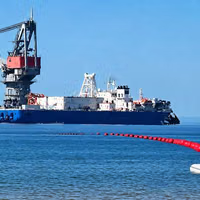
Iran, Venezuela, and Syria are to construct a new refinery in Syria's Homs province to buffer Iran’s “resistance front”.
The Homs refinery is planned to have a daily refining capacity of 140,000 barrels of oil.
The 'resistance front' refers to the various Iranian proxy groups in the Middle East and beyond such as Hezbollah, Hamas, Palestinian Islamic Jihad, and the Popular Mobilization Forces.
The proxy militia groups have been designated as terrorist organizations by the United States, Israel, and several Western nations.
Jalil Salarieh, the CEO of the National Iranian Oil Refining and Distribution Company (NIORDC), announced last week that the governments of Tehran, Caracas, and Damascus are preparing to enter the financial and construction phase of this project.
He also disclosed that Iranian engineers repaired the existing Homs refinery after a visit by President Ebrahim Raisi during his trip to Syria in May. Following the restoration of the current Homs refinery, Iran intends to send 100,000 barrels of oil daily to Syria for processing at the facility.
The specific amount of capital allocated by Iran for the refinery's construction has not been disclosed, and it remains uncertain whether this investment will generate financial returns for Iran.
In addition to offering technical and logistical support to Syria's oil industry to circumvent US sanctions, Iran maintains a significant military alliance with the Bashar al-Assad government in Syria, alongside Russia.