Iran FM Says Azerbaijan Will Keep Historical Iran-Armenia Route Open

Iran's foreign minister says Azerbaijan's president Ilham Aliyev has assured Tehran that it has no plans to close the Iran-Armenia transit route.
Iran's foreign minister says Azerbaijan's president Ilham Aliyev has assured Tehran that it has no plans to close the Iran-Armenia transit route.
The announcement comes amid ongoing tensions between the countries over the Nagorno-Karabakh region and the critical Lachin corridor, which serves as the sole communication route between Armenia and Nagorno-Karabakh.
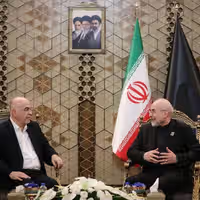
Speaking at the press conference alongside his Armenian counterpart, Ararat Mirzoyan, who was on an official visit to Tehran, Hossein Amir-Abdollahian emphasized the significance of transit routes between Iran and Armenia. He said "Iran and Armenia recognize the importance of the historical transit route, and both nations seek to maintain and strengthen its functionality."
Furthermore, the Iranian foreign minister welcomed the continued peace talks between Armenia and the Republic of Azerbaijan. He said "We are closely following the peace process in the region and are committed to promoting stability and cooperation among our neighboring countries".
However, the Baku authorities have not yet issued a statement regarding President Ilham Aliyev's reported “assurance” to Tehran about the non-closure of the transit routes.
Iran has been deeply concerned about Azerbaijani moves to establish a corridor through Armenia territory to a piece of its territory to the west. While an Azerbaijani military threat exists to force such a corridor, Iran will lose its historic land connection with Armenia.
The Nagorno-Karabakh conflict between Armenia and the Republic of Azerbaijan has persisted for more than three decades, resulting in numerous military confrontations.
Tensions over the transit road have led to military exercises conducted by the Iranian armed forces near the border with Azerbaijan in recent years.




Reports about a serious human rights violator from Iran being treated in a private clinic in Germany have stirred sharp controversy among Iranians and German media.
Iranian opponents of the Islamic Republic on Monday accused the Hanover-based International Neuroscience Institute of expunging the patient record of the “hanging judge” Hossein-Ali Nayeri who was involved in the massacre of hundreds of political prisoners in 1988.
Germany’s largest paper, the mass circulation Bild, reported that INI deleted Nayeri’s medical record in apparent move to avoid a new pro-Iran regime scandal. The director of the INI, Dr.Madjid Samii, scrambled to deny the allegation that he was caught again treating a regime official responsible for severe human rights abuses.
“There are currently no patients from Iran at the INI. These allegations damage our reputation, and not for the first time,” said Samii, according to the regional paper HAZ.
Samii, who was born in Tehran in 1937, faced widespread outrage in 2018 for providing care to Ayatollah Mahmoud Hashemi Shahroudi at INI. Shahroudi headed the Islamic Republic’s opaque judiciary from 1999 to 2009 and imposed executions on 2,000 people, including adolescents. Germany’s government permitted Shahroudi to leave the country after his treatment.
Samii told the HAZ that “As a doctor, I have an obligation to treat every patient, even it is Putin.”
Jason Brodsky, policy director of the US-based United Against a Nuclear Iran (UANI), tweeted a report from the German paper Die Welt that said “According to eyewitnesses, two vehicles with license plates of the Embassy of the Islamic Republic of Iran were in the parking lot of the clinic [INI]last Friday.”
The Iranian-German dissident, Dr. Kazem Moussavi, told Iran International that Samii is a “well-known friend of the mullahs” and also treated former Iranian regime judge Gholamreza Mansouri in 2020. Mansouri incarcerated 20 journalists during his tenure. The regime-controlled Young Journalists Club reported at the time that Mansouri “is said to be hospitalized in Professor[Majid] Samii's hospital in Germany.”
Moussavi added, “As an Iranian member of the opposition and spokesman for the Green Party of Iran in Germany, I sharply criticize the Federal government and Green Foreign Minister Annalena Baerbock for regrettably turning Germany into a secret place of treatment for the mullahs' death judges. He [Nayeri] is being treated in a German city of all places, in Hanover, where the Germanpolitical hostage awaiting his execution in Tehran, Jamshid Sharmahd, lived with his family.”
Moussavi said the German “Federal government must end its appeasement policy” toward Iran’s regime and called for the immediate arrest of Nayeri.
The Bild paper also took the German government to task for its policies that reportedly placate Tehran’s rulers. “Sweden shows that there is another way: Hamid Nouri, a member of the Islamic Revolutionary Guards and Nayeri’s assistant, was arrested [in Sweden] in 2019. Despite protests from Tehran, Nouri was sentenced to life imprisonment in 2021 for torture and murder.”
Moussavi said that Nayeri ”has served as chief adviser to the Islamic Republic's death judge, Gholam-Hossein Mohseni-Ejei, since Ebrahim Raisi's presidency. Both are directly responsible for the political prisoners and those executed in the ‘Woman, Life, Freedom’ protests in Iran.”
The Bild reported that Iranians, who live in Germany and were victimized by Nayeri, filed criminal complaints against the cleric and judge. The human rights activist Mina Ahadi told the paper “Many of his traumatized victims are here in Germany, you meet them everywhere.”
Amnesty International classified the 1988 massacre as a “crimes against humanity” in which the regime slaughtered at least 5,000 political prisoners. Nayeri issued summary executions to hundreds of political prisoners at Evin and Gohardasht prisons.
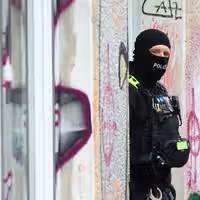
The Iran People’s Tribunal on Monday wrote on its website that it filed a case against Nayeri at the Berlin Prosecutor’s Office. Four witnesses are part of the Tribunal’s case who were taken to Nayeri’s “Death Committee” in 1988. The Tribunal said the Berlin Prosecutor forwarded the case to the Hanover Prosecutor who assigned the police to investigate. The police said Nayeri had not been admitted to the INI.
Mizan, an Iranian regime-controlled news agency affiliated to the judiciary, denied that Nayeri visited Germany.
Sheina Vojoudi, an Iranian dissident in Germany, termed Germany’s conduct toward admitting Iranian regime officials accused of grave human rights violations a “double standard.”
She said, “How can Germany express its concern about human rights violations in Iran, yet let the human rights abusers who are responsible for thousands of innocent lives be hospitalized in Germany while there is no way for the persecuted Christians or political activists to apply for a German visa.”
She continued, “These ayatollahs who have been treated on German soil issued thousands of death sentences to innocent Iranians. Arresting these human rights abusers for their crimes against humanity is the least expected when they enter a democratic country.”
Vojoudi, an associate fellow for the Gold Institute for International Strategy, argued that “Iranian refugees in Germany fled to save their lives from the same Ayatollahs who always come to Germany for the best treatment.”
Iran International sent numerous press queries to the INI and the German Foreign Ministry.
Oman will be the third country that will hold part of the funds Iraq owes Iran, which should be used for non-sanctionable goods, the US State Department said Monday.
Last month, the United States issued a sanctions’ waiver allowing Baghdad to pay over $2.7 billion of the $11 billion it owes Tehran for importing electricity and natural gas. Last week, Washington announced a change in the method of disbursing the funds, by transferring the money to third-country banks and then allowing purchases of goods such as food and medicine.
State Department spokesperson Matt Miller in his Monday briefing announced that the third country selected for the new payment method is Oman. “As we’ve said for some time, we thought it was important to get this money out of Iraq, because it is a source of leverage that Iran uses against its neighbor,” he said, without elaborating.
Late last year, the Biden administration started to tighten controls over dollar transactions by Iraqi banks, seeing evidence that there were banking violations potentially enabling Iran to illegally acquire US dollars. In February this year news emerged that Washington further tightened regulations over dollar transfers to and from Iraqi banks.
The leverage the US has in this matter is that Iraqi oil export proceeds are cleared by its banking system. Iraqi requests for cash dollar shipments and banking transfers are scrutinized by US federal agencies to make sure that illicit activities are prevented.
Since the Trump administration exited the 2015 JCPOA nuclear deal and imposed banking sanctions on Iran, it has periodically issued waivers allowing Iraq to make funds available to Iran for purchase of non-sanctionable goods, but to control all the transactions and Iranian attempts to syphon money out of Iraq has been hard.
Whether shifting the funds to Oman will ensure a tighter control over the process is yet to be seen. Clearly, Iran’s attempts to pressure all parties involved in slackening controls will continue. It is not clear if the change is not the result of an Iranian plan to gradually weaken the impact of US banking sanctions on its dealings with Iraq. Iran’s next move could be to further pressure Iraq to ask the United States to lift restrictions on how the funds are disbursed, enabling Tehran to withdraw cash dollars. The current Iraqi government has closer ties with Tehran than its predecessor.
State Department’s Miller, however, insisted that all funds “will still be subject to the same restrictions as when the money was held in accounts in Iraq, meaning that the money can only be used for non-sanctionable activities such as humanitarian assistance, and that all the transactions need to be approved by the United States Treasury Department in advance.”
There have also been multiple media reports that Washington and Tehran have been negotiating over the release of four American held hostage in Iran in exchange for $7 billion frozen by South Korean banks due to US sanctions. The decision to shift Iraqi funds to Oman could also be related to these secret talks.
Miller was asked Monday about the prisoners, but he refused to provide details.
“It’s obviously a very sensitive matter with respect to these detainees,” he said.
But critics who are suspicious of the Biden administration’s secret dealings with Tehran are wary of attempts to give financial rewards to the Islamic Republic in return for the hostages or a limited nuclear understanding, that has been reported by the media.
Army and security chiefs from Jordan and Syria met Sunday to curb a growing drug trade along their mutual border with deadly skirmishes, blamed on pro-Iranian militias who hold sway in southern Syria.
The meeting comes after Syria's neighbors got a pledge from Damascus in May to cooperate with their efforts to rein in Syria's flourishing drug trade in exchange for helping end its pariah status after a brutal the civil war.
"The meeting discussed cooperation in confronting the drug danger and its sources of production and smuggling and the parties that organize and execute smuggling operations across the border," the Jordanian foreign ministry said.
Syria is accused by Arab governments and the West of producing the highly-addictive and lucrative amphetamine captagon and organizing its smuggling into the Gulf, with Jordan a main transit route.
The kingdom is concerned about lawlessness in the strategic southern region where it echoes Washington's accusations that pro-Iranian militias protected by units with the Syrian army run the multi-billion dollar smuggling networks.
The West blamed Syria's government for the production and export of the drug, naming Maher al-Assad, the head of the army's elite Fourth Division and the president's brother, as a key figure.
Syrian President Bashar al-Assad's government denies involvement, or complicity by Iranian-backed. Iran says the allegations are part of Western plots against the country.
Jordan, impatient with what it says are broken promises to curb the drug war, made a rare strike in May inside Syrian territory where an Iran-linked drugs factory was demolished.
In the last few weeks, Jordan's army downed two Iranian operated drones coming from Syria with one the army said carried weapons.
Jordan requested more US military aid to bolster security on the border.
Iran has once again called on European countries to take stronger action against the burning of the Quran.
Iranian Foreign Ministry spokesman Nasser Kanaanisaid Monday, “We want governments of countries in which such shameful insults occur to prevent the repetition of such disgraceful actions and to strongly deal with the perpetrators."
Two men publicly burned the Quran outside Stockholm's central mosque late in June -- on the first day of Islamic festivities of Eid al-Adha -- an act approved by a Swedish court. Some 200 onlookers witnessed one of the two protesters tearing up pages of a copy of the Quran and wiping his shoes with it before putting bacon in it and setting the book on fire, while the other spoke into a megaphone.
The incident involved Salwan Momika, an Iraqi immigrant, who repeated the act once again last week, this time in front of the Iraqi embassy in Stockholm. Also on Friday, members of the far-right nationalist group "Danske Patrioter (Danish Patriots)" burned a copy of the Quran in front of Iraq's Embassy in Copenhagen, Denmark.
In an effort to garner support from believers of other religions, Kanaani said that “insulting celestial sanctities and Abrahamic religions is unacceptable and cannot be justified by any means.”
According to Kanaani, Iran has taken several measures to hold Sweden responsible for the 'sacrilege,' including summoning Swedish Ambassador to Tehran Mattias Lentz two times in the past few weeks, sending out a note of protest to Stockholm, and writing a letter to United Nations Secretary-General António Guterres.
Iran’s Foreign Minister Hossein Amir-Abdollahianalso held a conversation with the Secretary-General of the Organization of Islamic Cooperation in this regard. Iran has also announced that it will refrain from accepting the new Swedish ambassador and has no plans to send a new ambassador to the country.
He also reiterated the call on Stockholm to hand over the individuals behind the burning of the Quran to Islamic countries. “No country can, based on its own laws, infringe upon the values of others, as it would be a clear violation of the rights of other nations.”
Urging collective action by Islamic countries, Kanaani added, “We believe that Islamic countries must seriously utilize their capacities. It is the request of Islamic countries that actions be taken against criminals.”
He was echoing remarks by Iran's ruler Ali Khamenei, who demanded harsh punishment for the perpetrators, saying that Sweden should hand over the individuals involved to a Muslim country. In the case of some Muslim states, the punishment would be execution.
Following the incident, Hassan Nasrallah, the leader of the Lebanese Hezbollah militant group, called on all Arab and Muslim countries to expel the Swedish ambassadors from their respective nations and recall their own ambassadors from Sweden, echoing the actions taken by the Iraqi government.
The tensions escalated further when hundreds of supporters of Moqtada al-Sadr, a radical Iraqi Shia cleric, attacked the Swedish embassy in Baghdad, setting it on fire. A few days later, Baghdad expelled the Swedish envoy from the country.
Iran’s Revolutionary Guard Commander Hossein Salami has also threatened attacks against those responsible for the incident in their own country, saying that those who burn or desecrate the Quran will not enjoy security.
“We will not allow those who insult the Quran to have security. If someone wants to play with our Quran and religion, we will play with all his world,” Salami threatened. He went on to say, “Sooner or later the vengeful hand of “mujaheds” will reach politicians and stage managers behind this sort of crimes, and we will render the highest punishment to the perpetrator.”
In the late 1980s, Iran’s then-ruler Ayatollah Khomeini issued a Fatwa for the killing of British author Salman Rushdie for his book, Satanic Verses, seen by some Muslims as insulting to Prophet Muhammed. Iran also announced a reward for Rushdie’s killing.
Iran has accused the US of destabilizing cybersphere, claiming that lack of fair international laws has made it vulnerable to US influence.
Speaking at a meeting of national security advisors and secretaries of BRICS countries in South Africa, Iran’s Secretary of the Supreme National Security Council Ali Akbar Ahmadian warned of the impacts of Washington’s interference on the internet.
"The experience of Iran has shown how Americans have tried to make different types of interferences and create insecurity in other societies through cyberspace," Ahmadian said.
He claimed that the US’s control over online platforms like Google, Twitter, Instagram, etc. has made it possible for Washington to assert control over the global online media.
In a subtle attempt to justify the regime’s restrictions on the Internet and access to information, he said "The cyberspace of each country... must be managed exclusively by their respective governments."
Among the challenges the regime faces to stifle voices of dissent and crack down on popular protests, authorities have blocked access to Instagram and WhatsApp in September, when the death of Mahsa Amini in police custody ignited the boldest uprising against the Islamic Republic since its establishment. Facebook, Twitter, and Telegram had previously been banned after the 2009 presidential election and the November 2019 protests.
His remarks came as concerns have been raised over cyber threats emanating from Iran. Hackers linked to the country have targeted critical US infrastructure, including transport, energy, and ports, prompting heightened vigilance in the United States.