• العربية
  • فارسی
Brand
  • Iran Insight
  • Politics
  • Economy
  • Analysis
  • Special Report
  • Opinion
  • Podcast
  • Iran Insight
  • Politics
  • Economy
  • Analysis
  • Special Report
  • Opinion
  • Podcast
  • Theme
  • Language
    • العربية
    • فارسی
  • Iran Insight
  • Politics
  • Economy
  • Analysis
  • Special Report
  • Opinion
  • Podcast
All rights reserved for Volant Media UK Limited
volant media logo

Ending Talks? More Sanctions? Pundits Weigh Iran Options

Iran International Newsroom
Sep 26, 2022, 20:32 GMT+1Updated: 17:43 GMT+1
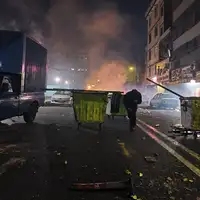
Protest in Tehran on September 20, 2022

Calls for tougher sanctions on Iran over the September 16 death in custody in Tehran of Mahsa Amini go nowhere near far enough for some.

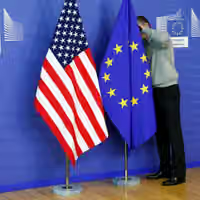
The European Union is considering new measures against Tehran, while the German foreign ministry summoned the Iranian ambassador Monday. According to Berlin-based Wall Street Journal reporter Laurence Norman has already agreed anti-Iran measures. The United States September 22 announced sanctions against Iran’s morality policy while National Security Adviser Jake Sullivan told NBC Sunday the US was on the “side” of “fundamental justice, dignity and rights.”

Sullivan said the administration’s approach differed from that of President Barak Obama, which he said had been slow to express support for 2009 demonstrations in Iran for fear of protestors being seen as US proxies.

Some commentators are not satisfied. “Control of women’s bodies isn’t a by-product of Islamic rule but its foundation,” wrote Janice Turner in the London Times Saturday. “If hijab falls, so does the regime…By enforcing hijab, the government inveigles itself into your bedroom.”

‘Righteous anger’

Turner argued the veil was “neither a Persian tradition nor a practice that, as in Indonesia or Pakistan, grew with the ascendancy of conservative Islam.” Rather it arrived in Iran enforced after the 1979 Islamic Revolution.

In earlier columns, Turner has argued that veiled women in Europe provoked among Muslims “a righteous anger whose logical conclusion is jihad,” and that allowing hijab in colleges and public buildings in Turkey brought the end of “Ataturk’s secular state.”

In the Sunday Times, Nazanin Zaghari-Ratcliffe wrote that Amini’s death had been marked by a gathering in Evin prison, where Zaghari-Ratcliffe, an employee of Thomson Reuters, was held for part of her four years in jail before she left Iran in March after the United Kingdom honored a £400-million debt ($428 million).

“Forty of the inmates then gathered in the communal yard, in solidarity with Mahsa’s family but also with all the women in Iran battling for their rights,” Zaghari-Ratcliffe wrote. “They lit candles, sang songs, chanted together and mourned the death of yet another innocent woman.”

Media ‘legitimizing gender discrimination’

In the Wall Street Journal, Karim Sadjadpour, Washington-based senior fellow at the Carnegie Endowment for International Peace, argued that the “lone source of diversity” in Iran’s “rotting regime” was whether the beards and turbans of its ruling men are black or white.”

Criticizing CBS interviewer Lesley Stahl for wearing a headscarf when interviewing President Ebrahim Raisi in Tehran September 13, Sadjadpour accused news organizations, governments and NGOs of “legitimizing…gender discrimination.”

The Biden administration, Sadjadpour agued, should “reassess its Iran strategy” including “shortsighted” efforts to revive the 2015 Iran nuclear deal, the JCPOA (Joint Comprehensive Plan of Action), which limited Iran’s nuclear program in return for eased international sanctions. A “representative” government in Tehran “could be a political geopolitical game changer for the United States” and was “the single most important key to transforming the Middle East,” Sadjadpour claimed.

But the Carnegie senior fellow stopped short of advocating the end of any talks with Iran. He suggested US should aim both to negotiate with Iran’s leaders and undermine them, as it had done with Soviet Union.

No deals with ‘savages’

By contrast, Masih Alinejad, New York-based social-media influencer and Voice of America contributor, said Sunday no talks should take place with “these savages.” Addressing the advocacy group United Against A Nuclear Iran, Alinejad said history would “judge” President Joe Biden for “saving” Iran’s rulers. “Instead of getting a deal, stand up for your values,” she said.

Alinejad told Fox News during Iranian president Ebrahim Raisi’s recent trip to the UN in New York that “Iranians” wanted to see Raisi meet the same fate as Qasem Soleimani, the general killed with ten others by a US drone strike in Baghdad in 2020 in what the UN deemed ‘unlawful killing.’ Alinejad told Fox presenter Martha McCallum that Raisi “was the terrorist…And he came here with the member of Revolutionary Guards.”

Most Viewed

Iran negotiators ordered to return after internal rift over Islamabad talks
1
EXCLUSIVE

Iran negotiators ordered to return after internal rift over Islamabad talks

2
ANALYSIS

US blockade enters murky phase as tankers spoof signals and buyers hesitate

3
ANALYSIS

Why the $100 billion Hormuz toll revenue is a myth

4

US tightens financial squeeze on Iran, warns banks over oil money flows

5
INSIGHT

Ideology may be fading in Iran, but not in Kashmir's ‘Mini Iran'

Banner
Banner

Spotlight

  • Hardliners push Hormuz ‘red line’ as US blockade tests Iran’s leverage
    INSIGHT

    Hardliners push Hormuz ‘red line’ as US blockade tests Iran’s leverage

  • Ideology may be fading in Iran, but not in Kashmir's ‘Mini Iran'
    INSIGHT

    Ideology may be fading in Iran, but not in Kashmir's ‘Mini Iran'

  • War damage amounts to $3,000 per Iranian, with blockade set to add to losses
    INSIGHT

    War damage amounts to $3,000 per Iranian, with blockade set to add to losses

  • Why the $100 billion Hormuz toll revenue is a myth
    ANALYSIS

    Why the $100 billion Hormuz toll revenue is a myth

  • US blockade targets Iran oil boom amid regional disruption
    ANALYSIS

    US blockade targets Iran oil boom amid regional disruption

  • Iran's digital economy battered by prolonged blackout
    INSIGHT

    Iran's digital economy battered by prolonged blackout

•
•
•

More Stories

Iran Guards Attack Kurdish Groups In Iraq For ‘Backing Protests’

Sep 26, 2022, 12:24 GMT+1

Iran’s Revolutionary Guard says it has started a fresh round of attacks against Kurdish groups in Iraqi Kurdistan amid nationwide protests that originated from Kurdish regions. 

The IRGC said in a statement on Monday that it has launched drone attacks against the Komala Party of Iranian Kurdistan and Democratic Party of Iranian Kurdistan. 

The shelling of Kurdish groups’ positions is the second time the IRGC has attacked the Iraqi Kurdistan in less than a week, allegedly as retaliation for sending forces and arms for “riots” in Iran. 

On Saturday, the IRGC attacked offices of Kurdish opposition groups in Erbil’s Sidakan district, accusing the Kurdish parties of inciting “chaos” in Iran amid demonstrations condemning the death of Mahsa (Zhina) Amini, who died in custody of Iran’s hijab police. 

Amini was from the Kurdish town of Saqqez and was arrested and beaten during a visit to Tehran. After her death in hospital, her hometown and other Kurdish cities were the first to launch antigovernment protests.

Tasnim news agency, affiliated with the IRGC, claimed that the shelling targeted offices of Komala and the Kurdistan Democratic Party of Iran for sending “armed teams and a large amount of weapons… to the border cities of the country to cause chaos.”

The Islamic Republic calls the Kurdish armed groups in the western provinces of Iran, "terrorist groups" or "anti-revolutionary" but these groups say that the goal of their armed campaign is "defending the rights of the Kurds".

Generally, the Kurdish parties − including Komala and the Kurdistan Democratic Party of Iran (KDPI) − favor Kurdish autonomy within a federal Iran.

From Justin Bieber To Pink Floyd: Hashtag For Iran Protests Passes 100 Million

Sep 26, 2022, 11:59 GMT+1

Support for protests in Iran is still rising among international celebrities, with Justin Bieber joining the crowd as hijab victim Mahsa Amini’s hashtag has reached 100 million.

The Canadian popstar used his platform of about 260 million followers on Instagram to raise awareness about the current uprising in Iran with a story of Iranian protesters holding a photo of Mahsa Amini, whose tragic death in the custody of hijab police triggered worldwide rallies against the Islamic Republic. 

The Persian hashtag that has been trending in support of Mahsa, also known as Zhina or Jina, has been retweeted more than 100 million times, and still counting. 

This is by far the highest number of retweets in the history of Twitter, about 25 times more than the trendiest hashtags on the social media platform so far. This has been achieved thanks to numerous celebrities and political figures as well as human rights activists and organizations. 

Iranian celebrities, both from inside the country and abroad as well as athletes from many national teams have expressed support for the uprising despite repeated threats and warning by authorities about banning them from their professions. 

Several foreign singers and artists have also dedicated pieces to the 22-year-old Mahsa, including pop singer Chris de Burgh and community-driven rock star Yungblud.

Legendary co-founder of Pink Floyd Roger Waters has posted a few times since last week, expressing anger over Mahsa’s death. 

Iran In Turmoil As Students Strike And Protests Continue

Sep 26, 2022, 11:56 GMT+1
•
Maryam Sinaiee

Anti-Islamic Republic protests continued Sunday night in Iran and abroad, after state-sponsored rallies in a few cities failed to garner significant support.

Iran Human Rights (IHR) said Saturday at least 54 protesters had been killed, but no clear figure is available. In many cases, handing over the bodies of victims to their families was made contingent on agreeing to secret burials, IHR reported.

For the first time Monday several professors at the prestigious Sharif University of Technology in Tehran went on strike, demanding the release of all detained students.

“I will not hold any classes before detained students of Sharif University are freed to the last person,” Dr. Ali Sharifi Zareji, a professor of bioinformatics and artificial intelligence tweeted Monday.

The Iranian academic year started September 23, but authorities have cancelled all classes at several major universities including Tehran University, where some students have nevertheless staged big protest rallies. Authorities have offered online classes although the government has shut off or slowed down internet access since the protests began eight days ago. They have also arrested dozens of students.

Students at several universities have released statements calling for a strike and demanded the release of all student activists and returning to in-person classes. Students have also urged their professors to join the strike.

The Coordination Council of Iranian Teachers’ Trade Associations Sunday announced a strike for Monday and Wednesday (Tuesday is a public holiday) in support of the protesters. This is the first major call for a strike, although people on social media have been urging workers at key government economic sectors not to show up for work.

In many cities such as Shiraz and Qazvin as well as Alborz province, authorities closed schools Monday “due to air pollution” but in other areas classes convened as usual.

In the past few days, protesters have resorted to writing graffiti on walls and many of those who do not take to the streets to protest show their support by shouting slogans from rooftops and their windows after nightfall or honking their car horns. This stretches available security forces, who have to ignore some protest manifestations.

Meanwhile, thousands of Iranians and their supporters took to the streets Sunday in other countries in Europe and elsewhere including London, Paris, Milan, and Hamburg, to protest the regime. They were also gathering and rallies in the United States.

In London and Paris protests turned violent when crowds who chanted “Death to the Islamic Republic” and “Death to Khamenei” tried to storm the Iranian embassy buildings.

In London protesters also gathered outside the Islamic Centre of England in north-west London and chanted slogans peacefully. A video on social media showed a protester who made it to the roof of the Islamic Centre, also known as Supreme Leader Ali Khamenei’s office in Britain, waving an Iranian the pre-1979 flag.

London police said Monday several officers had sustained injuries including broken bones and five are in hospital following a clash with protesters outside the Iranian embassy and 12 people were arrested. “Officers on duty reported that while the majority of those who were in the embassy on Sunday acted peacefully, a significant group who arrived actively sought to confront officers and protesters,” London News Online wrote.

In Paris hundreds of protesters who wanted to enter the embassy clashed with French anti-riot police which used tear gas to stop them.

Prison Guards Beat Iranian Freedom Activist, Break His Leg

Sep 26, 2022, 11:17 GMT+1

Dissident blogger and freedom activist Hossein Ronaghi, who was arrested over his support for protests, told his family he was beaten in prison and his leg is broken. 

Masoud Kazemi, a dissident journalist and a close friend of Ronaghi who resides in Turkey, said on Sunday that Ronaghi made a phone call to his mother from prison and told her that the prison guards had broken his leg. 

Last week, security agents raided Ronaghi's house to arrest him after his interviews and posts in support of the ongoing protests, but he managed to escape and evade arrest without a warrant. However, on Saturday, he presented himself to prosecutors with his two lawyers and all three were arrested.

He was arrested several times in the past decade and has staged hunger strikes in prison. Ronaghi was first arrested, along with his brother Hassan, in the aftermath of the disputed presidential elections in 2009 for helping journalists and political activists to circumvent internet censorship. He was also charged with insulting Supreme Leader Ali Khamenei in his blog posts.

Ronaghi was one of the first this year to focus his activities against a bill by hardliner lawmakers to introduce highly restrictive internet policies

In an interview with Germany's Bild published on January 28, Ronaghi spoke about losing his kidney while in Evin Prison. "I'm still suffering from the effects of the torture, but the good thing is that I'm still alive and can continue," he said.

Exclusive: Khamenei Doctor Sought To Forge Mahsa Amini’s Records

Sep 25, 2022, 22:45 GMT+1

Iran International has learned that Dr. Fereydoun Nouhi, a cardiologist trusted by the Supreme Leader, is trying to create fake medical records that Mahsa Amini had a history of heart problems. 

According to the information, Nouhi has asked at least three fellow cardiologists to certify that Mahsa Amini -- the young woman whose death in custody of hijab enforcement police has inspired an uprising across Iran -- had heart problems before her arrest.

Nouhi, who served as the director of the Iranian Cardiology Association, is the head of the Rajaie Cardiovascular, Medical and Research Center. 

Since the death of the 22-year-old woman, Iranian authorities have been trying to convince the public that she died of a heart attack despite evidence that she was beaten to death following several blows to her head. 

The skull CT scan of Amini shows bone fracture, hemorrhage and brain edema, Iran International revealed last week. The medical documents and dozens of exclusive images sent to Iran International by a hacktivist group vividly show a skull fracture on the right side of her head caused by a severe trauma to the skull, which corroborate earlier accounts by her family and doctors. 

Iranian police released CCTV footage, which shows Amini collapsing in the police station, in an effort to reject the evidence. The authorities also brought a neurosurgeon, Dr. Massoud Shirvani, on state TV on September 20 who claimed Mahsa had a brain tumor removed at the age of eight.

“Mahsa Amini was treated with drugs after the surgery under the supervision of an endocrinologist,” the physician said.