Russian Tanker Seized By Greece Carries Iranian Oil, US Group Claims

Greece has impounded a Russian oil tanker off the island of Evia, the Greek coastguard said on Tuesday. A US advocacy group said it was carrying Iranian oil.

Greece has impounded a Russian oil tanker off the island of Evia, the Greek coastguard said on Tuesday. A US advocacy group said it was carrying Iranian oil.
A Greek shipping ministry official said the 115,500-tonne Russian-flagged Pegas, with 19 Russian crew members, had been seized under European Union sanctions imposed on Russia over the Ukraine crisis.
The vessel was seized near Karystos on Evia’s southern coast, just off the mainland near Athens. Earlier this month, the EU banned Russian-flagged vessels, with exemptions, from its ports.
The US advocacy group United Against Nuclear Iran (UANI), which supports US sanctions against Iran and monitors tanker traffic through satellite tracking, said the Pegas − renamed the Lana in March − had loaded 700,000 barrels of crude oil from Sirri island, Iran, on August 19, 2021. The tanker headed to Greece after trying unsuccessfully to unload the oil at a Turkish port, UANI said.
The Athens News Agency reported that before being seized, Pegas had a breakdown and was being pulled by tugs to Greece's Peloponnese peninsula, where its cargo was to be moved to another vessel, and that during this journey it was forced by rough seas to moor near Karystos, where it was seized by Greek port authorities.
Associated Press reported the seizure was Friday. Reuters cited witnesses Tuesday that the Peags was still moored at Karystos bay, and was told by the Greek coastguard that the tanker’s cargo had not been impounded.
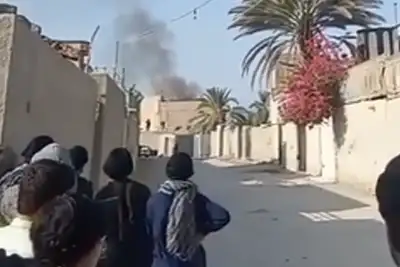

Iran has condemned a terrorist attacks at a boys’ high school and other educational institutions in a Shia-dominated neighborhood of the Afghan capital, Kabul.
In a tweet on Tuesday, Foreign Ministry spokesman Saeed Khatibzadeh censured what he said was Takfiri terrorists shedding the blood of innocent teenagers, urging Taliban officials to identify and punish the perpetrators.
Iranian officials use Takfiri as a vague umbrella term to refer to Sunni dissident or extremist groups and individuals, including the Islamic State (ISIS), alleging that they are organized by western powers and Wahhabis.
Earlier in the day, at least six people were killed, and 25 others were injured after three huge explosions ripped through two educational centers in western Kabul.
A tutoring center in a neighborhood mostly populated by the Shia Hazarah community in the western part of Kabul was targeted with a grenade before two back-to-back blasts targeted a boys’ high school located in the same area.
Initial reports suggested the attack was conducted by suicide bombers, but Kabul police spokesman Khalid Zadran said improvised explosive devices had been placed in backpacks and left outside the school.
No group has so far claimed responsibility for the attack, but the Islamic State militants targeted the area in multiple times between September and December 2021.
Hazaras are an ethnic and religious minority that are frequently targeted by Sunni militant extremists, who regard them as heretics.

Iranian karate champion Sajjad Ganjzadeh has criticized the Islamic Republic for not allowing athletes to play sports matches against Israeli competitors.
Ganjzadeh said in an Instagram post on Monday that such an approach forces athletes to only attend Asian competitions, in which Israel does not participate.
Urging the authorities not to consider only political issues and their ideological position, the Olympics gold medalist said, "We cannot tolerate this anymore. Not competing is more difficult than competing”.
Iran is a sworn enemy of Israel, calling for its destruction and prohibits sportspeople from playing against Israeli competitors. There is no legislation banning athletes but under pressure from federation officials, they usually lose games intentionally, forfeit matches or claim injury to avoid facing Israelis.
Supreme Leader Ali Khamenei has often praised Iranian athletes who refuse to play against Israelis, and in September 2021 said they should continue to do so even if facing punishment by international sports bodies.
About 30 Iranian athletes in recent years have defected from Iranian national teams and sought asylum in other countries, including Judo champion Saeid Mollaei, Greco-Roman national team wrestler Ali Arsalan, and many others.
Mollaei defected to Mongolia in 2019 after reportedly losing a fight to avoid Israel's Sagi Muki. As a result of the Mollaei case, the International Judo Federation in April 2021 banned Iran's judo teams from international competitions for four years. At the 2020 Tokyo Olympics, Mollaei won a silver medal competing under the Mongolian flag.

Iran’s liquidity grew by 40 percent from early 2021 to 2022, according to its central bank, as the country continued to print money amid a revenue crunch.
The amount of cash in the economy was more than 3 quadrillion rials (15 zeros) 14 months ago and jumped to 4.6 quadrillion in February this year. In US dollars the amount might not seem staggering, reaching almost $200 billion, only because the rial has fallen more than eightfold against the dollar in the past four years.
The first six months of this period covers the former Rouhani administration and the next six months the presidency of conservative cleric Ebrahim Raisi, who pledged to control liquidity and inflation during his presidential campaign last June.
But little seems to have improved since August when Raisi took office. Inflation continues at the annual rate of more than 40 percent, while prices of food and other essential goods are rising even faster.
The Raisi administration so far says it is trying to deal with the damage done by the previous government, but people and politicians are increasingly skeptical, saying eight months was ample time for the new president to make a difference.
A breakdown of the Iran’s central bank (CBI) numbers issued on Monday shows that almost half of the increase in liquidity occurred since early August, debunking Raisi’s claim that his government has restricted borrowing from the CBI.
The borrowing continued as the government claimed oil exports increased by 40 percent since August, and presumably its foreign currency revenues also jumped. Oil minister Javad Owji announced on Tuesday that in the past 12 months Iran exported $43 billion of crude oil and derivatives. That is almost double of what was sold in the previous year.
Politicians and media ask where is the impact of the additional government income? Why the currency stays low, and inflation continues at the same rate.
The Raisi administration and its supporters say that the government has been repaying debts incurred during Rouhani’s presidency, but it all does not make sense if liquidity is increasing. One official said that since August the government has spent $400 million a month to repay borrowings by the former administration. A Raisi supporter in parliament said on Tuesday that the Rouhani government printed money against unrealized foreign currency income, thus fueling liquidity and inflation. He was referring to Iran’s funds blocked abroad because of US sanctions.
Rouhani’s central bank chief, Abdolnaser Hemmati has challenged Raisi’s officials to a public debate to rebuttal their accusations.
As the government and the parliament struggle to tell the public that the situation will improve, few public figures dare to openly say that Iran’s economic problems cannot be solved without first reaching an agreement with the United States and lifting oil export and banking sanctions.
Negotiations in Vienna have stopped since March, but the main decision maker in the country, Supreme Leader Ali Khamenei insists Iran can solve its economic issue independent of the nuclear talks.
Oil minister Owji also said on Tuesday that only the country’s natural gas sector needs an infusion of $80 billion to be able to increase falling production. In November, he had announced that the oil and gas sector needed $160 billion to retool and rejuvenate itself.

Taliban's acting foreign minister and his Iranian counterpart have held a phone conversation about recent tensions between the two countries.
In the phone call late on Monday, Afghan foreign minister Amir Khan Muttaqi said a Taliban delegation will soon visit Iran to discuss the situation of a growing number of Afghan refugees living in the country and those jailed in Iranian prisons.
According to a statement by the Afghan foreign ministry, the two sides also expressed determination to expand cooperation, noting that some groups are using media to sow discord between the two countries and pave the ground for violence.
Tensions are high between the two countries, especially after Afghan protesters attacked the Iranian consulate in Herat Monday hurling stones, smashing security cameras, and burning tires before they were dispersed by Taliban security. People also held a demonstration outside Iran’s embassy in Kabul over alleged mistreatment of Afghan immigrants in Iran.
Following the attacks, an Iranian-backed group organized a gathering in front of Tehran’s embassy in Kabul to express support for the Islamic Republic, but Taliban forces closed its center in Kabul and arrested several people who were connected to it in Herat.
Iranian media’s account of the telephone call said that Muttaqi had assured Tehran of full security for Iranian diplomatic facilities, diplomats and staff in Afghanistan.
Tehran says it will not resume its consular services before receiving assurances from Afghan authorities over protection of its diplomatic missions in Afghanistan.

Iran's parliament has approved a plan to investigate reports about the disappearance of 15 trillion rials – around $60 million – in Iran’s Chamber of Commerce.
The parliament gave the go-ahead in its Tuesday session with 190 votes in favor of the move that will probe the transactions of the Iranian Chamber of Commerce, Industries, Mines and Agriculture (Iran Chamber) during the past 10 years. The Chamber is a quasi-state entity.
On Saturday, the conservative Farhikhtegan newspaper alleged that a review of documents related to the payments of 40 companies to the Chamber in the last four years indicates that a huge amount of money is not accounted for in the institution’s ledger.
In one case, the Chadormalu Mining and Industrial Company was supposed to pay the chamber about 900 billion rials but data show that only 30 billion– about one-thirtieth – was actually paid.
The chairman of the Chamber Masoud Khansari said on Tuesday that the reports are not based on accurate numbers and the Judiciary should investigate where such figures came from, describing the report as a blow to the government.
Earlier in April, the general director of a major government pension fund said that around $400 million was lost either through mismanagement or embezzlement.
Iran ranked 150 out of 180 countries in the 2021 Corruption Perceptions Index (CPI), one step lower than the previous year, which weakens its struggling economy.