Afghans Attack Iran’s Consulate In Herat Over ‘Mistreatment Of Refugees’
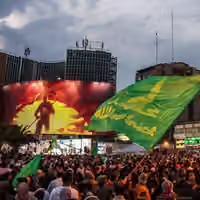
Afghan protesters set fire to the entrance of Iran's consulate in Herat. April 11, 2022
Protestors Monday attacked the Iranian consulate in Herat, Afghanistan, hurling stones, smashing security cameras, and burning tires before they were dispersed by Taliban security.
Iranian foreign ministry spokesman Saeed Khatibzadeh called on Taliban officials to ensure the security of Iran’s embassy in Kabul and its missions across Afghanistan. He warned of efforts on social media to whip up anti-Iranian sentiment over alleged mistreatment of Afghan immigrants in Iran.
Sectarian tensions have risen since last week’s killing of two Shia clerics in Imam Reza shrine, Mashhad, attributed to Sunni extremists. Many Afghans are in Iran unofficially, with numbers increasing since the Taliban took Kabul last year as the United States ended its 20-year military presence.
A conservative newspaper in Tehran claimed Thursday that 8 million Afghans were in Iran, and that the Mashhad knife attack reflected Iranian authorities’ lax approach in allowing violent extremists amid refugees. Jomhuri Eslami reminded readers of the Taliban’s past anti-Shia animosity and said there was no difference between the group and Isis-Daesh, the Islamic State group.
Earlier on Monday, demonstrators outside Iran’s embassy in Kabul held banners with pictures of refugees and the words "Isn't Afghan a human being?"
Ambassador Bahador Aminian met in recent days with Afghan acting foreign minister Amir Khan Muttaqi and former president Hamid Karzai, presumably to further Iran’s hopes of a broad-based government.
Iraqi authorities were forced Saturday by people to open the Shalamcheh border crossing to Iranian trucks without inspections or usual administrative processes.
The border crossing is north of Iran’s oil center Abadan and close to Iraq’s Basra province.
Following the protests, an official in Iraq’s customs administration ordered staff to expedite procedures at the crossing for the entry of agricultural and food products.
Iran and Qatar have signed six agreements for closer cooperation in air and sea transport, particularly during the 2022 FIFA World Cup scheduled for November-December in Qatar.
During a ceremony on Iran’s southern island of Kish Monday, Iranian road minister Rostam Ghasemi and Qatari transport minister Jassim bin Saif Al-Sulaiti inked documents over accommodation, and air and maritime transport for those attending the soccer tournament.
Qatar is expecting 1 million visitors. Iran and Qatar plan 400 direct flights between Kish and Doha, as well as four cruise liners linking Iranian and Qatari ports, during the event. Kish island, off the southern coast of Iran in the Persian Gulf, is 270km from Doha, only 40 minutes by plane and five or six hours by sea. It expects to host nearly 100,000 soccer fans.
Last week President Ebrahim Raisi spoke by telephone with Qatar’s Emir Sheikh Tamim bin Hamad Al Thani to discuss Iran’s role in the World Cup through Kish and other islands nearby.
Iran’s team has been drawn in Group B of the competition along with England, the United States, and the winner of European playoffs between Ukraine, Scotland, and Wales. Iran beat the US 2-1 in the 1998 World Cup in France, its first ever victory in the competition.
Iran has appointed a man with apparent links to the Islamic Revolutionary Guards Corps (IRGC) intelligence organization as new ambassador to neighboring Iraq.
Foreign Ministry spokesman announced the appointment of Mohammad Kazem (Hossein) Al-e Sadeq during his weekly press conference on Monday.
The spokesman, Saeed Khatibzadeh, said the ambassador-designate would be inaugurated soon. He did not provide further details.
Little is known about Al-e Sadeq, who has served as a deputy to the incumbent ambassador to Baghdad, Iraj Masjedi, a former senior IRGC commander who assumed office in 2017.
Al-e Sadeq speaks Arabic and is the younger brother of renowned Iraqi-Iranian poet and writer Mohammed Reza Al-e Sadeq -- also known as Mohammed Reza bin Muhammad bin Sadeq al-Najafi. The family seems to have dual Iraq-Iranian roots, which is not uncommon among Shiites. Many Iranians settled in Iraq decades ago, either as clerics or traders.
He is reportedly a former member of the board of director of the Sepas Veterans Association, which is apparently a nongovernmental organization that commemorates IRGC martyrs, particularly those who held positions in the Revolutionary Guards’ intelligence organization.
The moto of the organisation’s Instagram page is “defending Islam does not end with defending the homeland”, suggesting that its members are supporters of IRGC overseas operations.
Masjedi, the outgoing ambassador to Baghdad, has served as a senior member of the IRGC’s extraterritorial Quds Force and as an advisor to Qasem Soleimani, the Quds Force commander who was killed in a US drone strike in Baghdad in January 2020.
A former US envoy has said Tel Aviv and Damascus were close to reaching a peace deal that would cut Iran out when the Syrian civil war broke out in March 2011.
The Israeli newspaper Haaretz reported on Sunday that the Obama administration was engaged in a covert attempt to mediate between Israel and Syria, a move that was cut short due to the war in Syria.
In a book published earlier in April, former US special envoy to Syria Frederic C. Hof said that the initiative had a promising track, with Syrian President Bashar Assad and then Israeli Prime Minister Benjamin Netanyahu showing willingness to reach a peace agreement during their meetings.
Hof, who worked on Syria-related matters in the US Department of State from 2009 until 2011, said such an accord would have seen Israel leaving the Golan Heights in return for Syria severing ties with Iran and the Lebanese militant group Hezbollah.
The two neighbors have been locked in a war since the establishment of Israel in 1948. Israel captured Golan from Syria in the 1967 Six-Day War and effectively annexed the territory in 1981 in a move not recognized by most of the international community.
Attempts to achieve peace between Israel and Syria have failed mainly due to Damascus’s support for Hezbollah in Lebanon and Hamas militants in the Gaza Strip.
A Tehran City Council member has confirmed that areas in 350 parks and playgrounds in Tehran will be fenced to keep women and their children out of men's sight.
Confirming the plans, Mohammad Aghamiri told Didehban-e Iran website on Saturday that there are "men who are not family members and young [unmarried] men" in parks so it is to women's own benefit to keep men out from where they play with their children. He also claimed that creation of a separate area for women and their children was based on "popular demand".
Those who advocate allocation of a different section of parks and other public areas such as playgrounds to women claim that this will help guard women's privacy and separation from men according to Islamic values.
Limitations for women have always existed since the 1979 Islamic Revolution under the pretext of protecting them, Niki Mahjoub, journalist, told Iran International TV, adding that segregation laws have steadily increased, particularly in the past few years.
Some fear that religious hardliners might be aiming at more segregation in parks and other public places.
Families enjoying a day out in a Tehran natural park.
Addressing a Tehran City Council meeting on Sunday, Aghamiri claimed that Didehban-e Iran had misrepresented his remarks and that he had not meant complete segregation of parks but meant only allocation of a special place for women and their children to play together.
He insisted that the plan ensures "women's safety" and giving them peace of mind that their children would not be "abducted". He went on to claim that women are far less likely to abduct children than men.
"There are special parks for children in all countries but now that this is being done in Tehran those who are hostile [to Islamic values] are painting a dark picture and saying parks are going to be segregated," he said.
Aghamiri added that mother and child parks will help make families happier and healthier. "Men are at work during the day. Mothers who have more free time can go to these parks and spend time with their children," he said.
Young men having lunch in a Tehran city park.
Tehran has over 2,500 large and small parks and neighborhood playgrounds including nine parks that are for women only. Aghamiri said on Sunday that the number of all-female parks is going to increase to forty soon.
The first of all-female parks opened in Tehran was inaugurated by the city's conservative mayor, Mohammad Ghalibaf, in 2008. Some women at the time welcomed the idea because in this park they did not have to wear the compulsory hijab and could dress or exercise as they wished, as even gardeners were female. Others, however, said they feared this was a prelude to greater gender segregation in the city.
Since 2008 all-female parks have also been established in other cities and towns.
On Saturday a video was posted on social mediashowing tall concrete walls built around a park by the municipality in Bojnord in northern Iran. The mayor of Bojonord has said that the walls have been built not to segregate men and women, but to provide "a safe space" for women.
The Islamic Republic enforces complete segregation of men and women in many public spaces including schools, public transportation, gyms, swimming pools, and beaches. Women are allowed at some athletic events such as volleyball games, in a separate part of the stadium, but unofficially banned from others such as football stadiums, men's wrestling competitions and boxing matches.