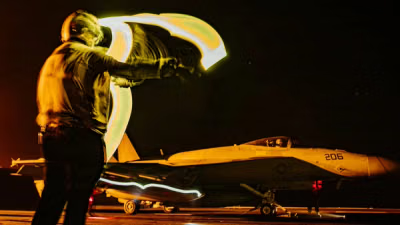
Participants in a roundtable discussion titled “How to Break the Blockade?” broadcast on state television on Saturday, said the prospects for a political agreement with Washington had diminished. They argued that while the United States was maintaining its military readiness for a possible resumption of hostilities, its main strategy had shifted toward intensifying economic pressure on Iran.
Citing statements by President Donald Trump, participants also suggested that Washington might be moving away from direct military confrontation and efforts to restrict Iran's nuclear program toward a combination of economic pressure, security operations and attacks on Iranian infrastructure, potentially aimed at overthrowing the Islamic Republic.
Vahid Khazab, a military analyst appearing on the program, Be Vaght-e Iran, said Trump had "gone back from the nuclear issue to the subject of regime change — regime change that would put the country's resources under his control."
He said economic pressure, alongside security and military operations, would be the instruments used to pursue that objective.
Breaking the blockade becomes the priority
Trump's refusal to accept conditions Tehran insists must be met before any agreement with Washington to end the war, combined with the continuation of a neither-war-nor-peace situation and the widening economic blockade, put breaking the restrictions at the center of hard-liners' agenda.
They argue that Iran should respond by increasing pressure in the Strait of Hormuz and preventing a return to normal conditions in the region. Their proposed strategy involves continuing military operations to disrupt oil flows to international markets and increase economic pressure on the United States and Europe.
Despite repeated predictions by hardliners that oil prices would climb to $150 a barrel and cripple the American and European economies, crude prices have moved in the opposite direction in recent weeks, falling again slightly in Monday's trading.
Khazab described what he called "impact-oriented [military] operations" designed to prevent oil from passing through the Strait of Hormuz as a way to influence global oil markets and alter Washington's economic and political calculations. Such operations, he argued, would increase the costs of maintaining the blockade for the United States and its allies.
Several tankers have encountered incidents in the Persian Gulf and the Strait of Hormuz in recent days. In statements, Iran's Islamic Revolutionary Guard Corps (IRGC) and the Army have claimed that the vessels were "violating" ships that struck naval mines and caught fire.
On Sunday, the IRGC also claimed to have successfully carried out drone a attack against a US. radar installation at the Riffa helicopter base in Bahrain. In its statement, the force warned: "The Strait of Hormuz is closed, and any aggression by the American enemy will be met with an even harsher and more crushing response."
The attack appeared intended to signal that Tehran would not accept a prolonged neither-war-nor-peace situation or the consolidation of the blockade.
The argument for a more aggressive response has also appeared in commentary by prominent conservative figures.
Mohammad Imani, a member of the editorial board of the hardline Kayhan newspaper, wrote in an article published Saturday on the Nameh News website that Iranian officials should concentrate on "a plan to break the blockade and make it costly for the enemy," regardless of the extent of Tehran's engagement with mediators or the messages conveyed through them.
"Strikes against the enemy's vulnerabilities must certainly be carried out through a combination of methods to force it to retreat," he wrote.
Referring to recent threats by Mohsen Rezaei, secretary of Iran's Supreme National Security Council, and senior military commanders to expand the geographical scope of the conflict if the United States attacks, Imani argued that the more pressing question was no longer how Iran would respond to another American strike.
"The real and immediate issue today is not what our response would be if America attacks," he wrote. "The more important issue is that, after its failure in the war, its request for a ceasefire and its pretense of seeking an understanding, America has launched another game in the form of a naval, aerial and land blockade. Now it is Iran's turn to play."
Imani accused Washington of trying to disrupt Tehran's response through threats and diplomatic overtures, including sending intermediaries, so that Iran would refrain from taking what he described as a "corresponding and offensive" response, keeping Iran on the defensive.
He also argued that the United States wanted to distract Iranian officials from immediately planning and implementing "symmetric and asymmetric methods of breaking the blockade" by keeping Iranian decisionmakers occupied with mediators, the details of possible responses and the terms of a potential agreement.
An article published Saturday in Sobh-e No, a newspaper supportive of parliamentary speaker Mohammad-Bagher Ghalibaf, similarly argued that the current neither-war-nor-peace situation kept the threat of conflict hanging over Iran's politics and economy, allowing Washington to use the uncertainty as leverage.
"The end of the neither-war-nor-peace game will come when the threat can no longer be used as a permanent instrument for imposing one's will without incurring serious costs," the article said. "Sustainable deterrence will be achieved when war becomes costly for the other side and endless pressure proves fruitless."
Hossein Ghatib, a political commentator who publishes under a pseudonym on social media platform X, also warned against allowing the blockade to become normalized.
"The greatest danger for Iran is the normalization of the blockade and its transformation into the region's new status quo," he wrote. "If this situation becomes entrenched, the blockade will turn from a temporary measure into a permanent instrument for imposing political demands. Preventing such an outcome must be at the center of Iran's military strategy."
Warnings against further escalation
Not all commentators have endorsed a more confrontational approach. Some have warned that escalating tensions could leave Iran facing prolonged economic pressure without securing a political or military breakthrough.
Kourosh Ahmadi, a former Iranian diplomat, wrote in an article published Saturday in the reformist Shargh newspaper that Trump's recent statements indicating he did not currently intend to launch another full-scale war against Iran, as well as the removal of Vice President JD Vance from responsibilities related to negotiations with Tehran, should be taken seriously.
"Now we are left with a naval blockade, continued American pressure on our neighbors to close their land borders, and the possibility of limited and intermittent attacks on the southern coasts and islands in connection with the Strait of Hormuz," Ahmadi wrote.
He also pointed to the roughly $20 decline in oil prices, which he said appeared to be linked to reduced fears of war, as an important indication of the changing calculations.
"If the threat of war is completely ruled out — which has not yet happened — oil prices could fall below $90 a barrel," he wrote. "In that case, the United States would have no problem with the continuation of this neither-war-nor-peace situation."
Ahmadi concluded that the only hope was for both sides to show flexibility and allow negotiations to reach a conclusion.